Aave Cowswap Integration- Tokenholder Questions

Hello Aave DAO,

This post is not a proposal, but more of an open letter with questions towards @AaveLabs from me as an Orbit delegate & Aave tokenholder.

On the 4th of Dec 2025 Aave Labs made a public announcement on X, that a new partnership with CoWSwap has been established to provide “an improved swap experience across aave.com” (https://x.com/aave/status/1996591393817473247)

This integration essentially means that “cow swap adapters have been deployed on several chains, improved incentives tooling via Merkl and introduced a Balancer v3-based flash loan factory. (AL Development Update | November 2025)

Essentially replacing the existing Paraswap adapters that have been introduced with Aave v2 and v3.

All these adapters allowed Aave to gain advantage in terms of, that a user did not have to leave Aave (the protocol) to do any kind of swaps. This helped to increase user retention and resulted in an additional revenue source for the Aave DAO, as Paraswap introduced in June 2022 a referral program that had no impact on users but redirected revenue to the Aave DAO treasury.

It’s important to mention to anyone reading this, that no fees were enforced on users, to be received by the DAO or anyone else within or outside the DAO. The goal was simply to introduce a great feature to the Aave core protocol.

Then Aave Labs communicated that the Aave UI now allowed to swap directly with CoWSwap (https://x.com/aave/status/1929538754189963350). Adding great features for Aave users.

Now we are coming to the tricky part of this implementation.
According to the Aave docs provided by Aave Labs, extra fees were introduced which are ranging from 15 to 25 bps. This is generally speaking fine, but has multiple layers that need to be broken down and asked.

  1. Is the Aave DAO receiving those fees, similar to the Paraswap referral fee?
  2. Are the fees competitive and user friendly enough, or could this result in users migrating to other protocols, thus reducing Aave DAO revenue?
  3. Charging this fee is only possible due to the nature that the Aave brand is widely known and accepted in the ecosystem. A brand that the Aave DAO has paid for.

So what is the answer to these questions?
I did some research with the help of AI, on-chain explorer and test transactions.

  1. The Aave DAO is not receiving the fees from the different swap adapter anymore.

How do I know this?

I have been doing some test transactions to see where the collected fees are going to, for example to the official Aave DAO treasury address. The result is that all fees collected are going to this address 0xC542C2F197c4939154017c802B0583C596438380.
In addition you can see that the appCode clearly indicates the Aave v3 interface widget and the recipient address mentioned above.

{

"appCode": "aave-v3-interface-widget",

"metadata": {

"orderClass": {

"orderClass": "market"

},

"partnerFee": {

"recipient": "0xC542C2F197c4939154017c802B0583C596438380",

"volumeBps": 25

},

"quote": {

"slippageBips": 426,

"smartSlippage": true

}

},

"version": "1.4.0"

}

In the docs of CoWSwap one can read that the partnerfee is defined in the appData and weekly distributed (Partner fee | CoW Protocol Documentation).

Which perfectly matches this address Address: 0xc542c2f1...596438380 | Etherscan.

Where each week or every 7 days big amounts of ETH are being transferred. For example on the 4th Dec, the last transfer day, 45.99 ETH have been transferred, with a value of approx. 152k$ at the time of writing this post. It’s worth mentioning that this is only the partnerFee received on Ethereum Mainnet. I also did another test on Arbitrum with the same address receiving this fee. Which simply means that on every chain, where there is CoWSwap support on the Aave frontend, another entity rather than the Aave DAO is at least receiving 200k$ per week worth of ETH.
A loss to the DAO over 365 days seen by at least over 10m$, assuming a transfer of only 200k$ each week.
Again, this only translates to my test transactions on two networks, so likely numbers are higher.

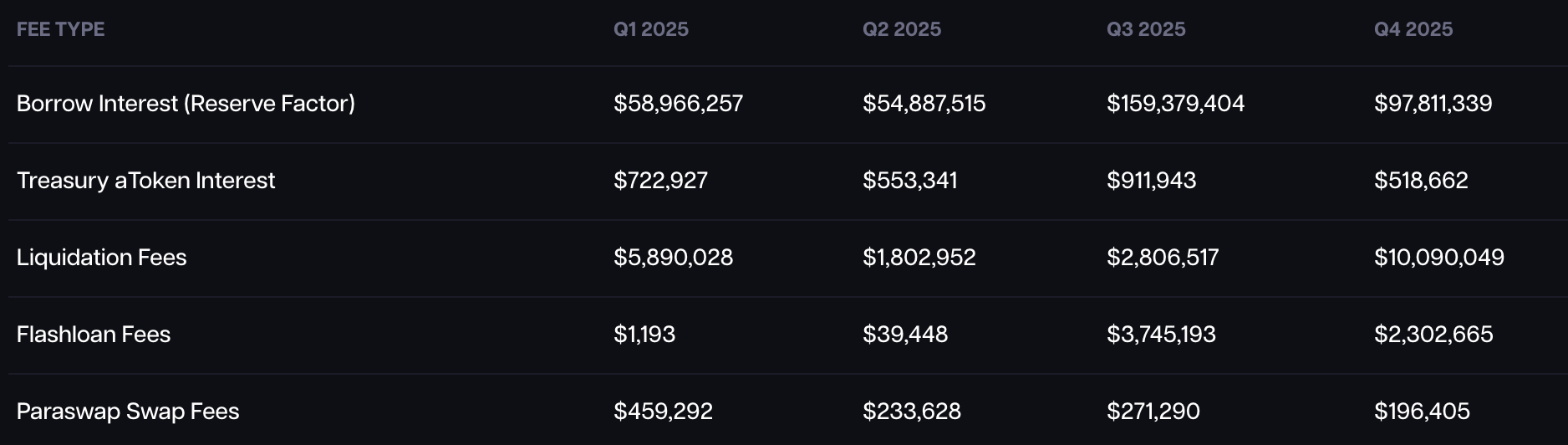
For comparison, here are the fees going to the Aave DAO treasury from the Paraswap referral program. Thanks to @TokenLogic for creating these amazing dashboards.

2024

2025

What is interesting to observe here is that the revenue for these swaps have been going down a lot since Q2 2025. This is likely due to the fact that in June this year Aave’s swap widget was powered by CoWSwap (https://x.com/CoWSwap/status/1929538997782806648).

Also interesting to mention is that the flashloan used for these swaps is based on Balancer v3 based flashloan factory. Which do have 0 fees, unlike Aave flashloans. These can be waived, if the Aave DAO approves it.

  1. This is something that can be argued within the DAO. Based on AI research the fees are the highest among other lending protocols, but also match Uniswaps frontend fee as comparison. Below a table of the biggest lending protocols and their fees.

  1. The Aave visuals are owned by the Aave DAO. ([TEMP CHECK] Aave 2030)

Quote: “The proposed new Aave Visual Identity will be irrevocably licensed to the Aave DAO. This license will grant the community the broad rights to reproduce, distribute, perform, display, and communicate the visual identity for the benefit of the Aave Protocol, the Aave ecosystem, the Aave DAO, and related activities. The use of the visual identity will be strictly prohibited for malicious activities, including but not limited to phishing scams and impersonation. This identity will be separate from that of Aave Labs, which will have its own distinct identity. For the purposes of this proposal, we are using the newly proposed visual identity in an effort to showcase the vision for the brand.”

Looking at the bold highlighted parts, we can essentially come to the conclusion that the DAOs treasury could and should benefit from the visual identity, which is famous in the cryptospace, as it is the core and heart of the DAO and all Aave tokenholder.

Users of the protocol tend to use aave.com/app.aave.com because of the brand identity, and there is a case to be made that they belong to the DAO or at least the DAO should have some decision power to avoid conflict of interest.

After presenting all this information, as a delegate and Aave tokenholder I have the following questions and I invite the DAO to comment.

  1. Can Aave Labs confirm it decided unilaterally to cut the referral revenue stream of the Aave DAO?
  2. Aave DAO members are supposed to be working for the DAO. So, how does it fit that picture when Labs unilaterally decides to slap a fee on a feature that used to be free? Especially without asking the DAO (who used to get the fees) and now that money is going straight to a private company.
  3. The DAO already paid Aave Labs to build the interface and funded others for the advanced features. People use the site because of the protocol, which the DAO owns. So, where’s the alignment? It feels like Labs is just leveraging the aave.com domain to extract value that should rightfully go to the DAO.
  4. Is the swap of provider to CowSwap exclusively because Cowswap is better for users? Or is there any type of agreement between Aave Labs and CowSwap leading to that decision?
  5. Why is Aave Labs posting updates on the forum about features that have never been mentioned in the scope of the DAOs mandate?
  6. What does this mean for the new Aave v4 pro interface? What assurance does the DAO have, that it will not be done with similar features? Considering the DAO paid for the development of V4 and its benefitting from the Aave brands reputation, also built at the cost of the DAO.

All my research and results presented here, have been done via on-chain investigation, AI research and other tools. I have not been compensated by anyone creating this post except the Orbit program, nor is it the intention to harm anyone. I am just a delegate that many people put their trust into and an Aave tokenholder myself. As a delegate my main goal is to grow the Aave protocol and work for the DAO and its treasury.

Just use Aave.
35 Likes

Thank you @EzR3aL for starting this discussion. We’re happy to clarify the distinction between the protocol layer and the product layer.

The interface is operated by Aave Labs and sits entirely outside the protocol the DAO stewards. This has always been the separation of responsibilities. In practice, this means the DAO funds protocol development and approves changes to the protocol’s smart contracts on-chain. Aave Labs funds, builds, and maintains its own interface. The licensing reflects this separation clearly. The interface is a product, not a protocol component, and Aave Labs has the discretion to operate and monetize it in a way that supports its continued development. Any monetization applies only to accessory features such as collateral swaps and does not touch the core economics of the protocol, including borrow interest or other protocol-level flows. That separation keeps the protocol neutral and avoids the kind of centralization that can emerge when a product layer captures value from the core system itself.

This also means Aave Labs carries the responsibility of creating a product that presents the Aave Protocol in a way users find reliable and appealing. That work is grounded in our alignment with the protocol as a core contributor, stakeholder, and token holder. We choose to support Aave exclusively in the lending domain because that alignment is strong and long term. Additionally, the application layer now carries its own attack surface, as the recent Safe ByBit incident showed, and the resources required to operate a secure interface continue to rise as the ecosystem evolves.

As such, maintaining a production interface at this scale requires a full product organization. Engineering, design, application security, DevOps, and adjacent functions all contribute to the interface the community uses today, and each of those roles carries ongoing cost. The team also fields a continuous stream of requests that originate from governance outcomes or from operational needs across the ecosystem. Parameter changes, new markets, new assets, incentive programs, and new initiatives such as governance V3, Umbrella, and sGHO all require immediate support so the interface remains consistent with what the DAO has approved on-chain. Many of these changes arrive with tight timelines and limited notice, and the team has consistently adapted the interface quickly so new features are available when the community expects them. Customer support for the interface and for the programs connected to it adds another layer of daily work.

These responsibilities pull time away from the new product that will support Aave V4, yet they are essential to keep the experience stable for users today. The DAO has never been asked to cover these expenses, nor to fund the initial development of the app, and that separation has been part of Aave Labs’ operating model since the beginning. Aave Labs built and maintained the V1, V2, and V3 versions of the app, each operating flawlessly without a security incident. That level of reliability is uncommon in DeFi and reflects the same standard the protocol aims to uphold.

CowSwap was integrated into the app.aave.com interface because it improves the experience for users, and because many interface users, who we interact with on a daily basis, asked for a path that offered more reliable execution during volatile periods. The batch-auction model reduces exposure to MEV and sudden price movement, which is important for users adjusting collateral or managing debt positions. It also resolved gaps we observed in the earlier ParaSwap implementation. The original swap adapters used to support this flow were built by Aave Labs and have always been maintained by Aave Labs. The team also built the CowSwap adapters for the full set of integrations and funded that work itself. This routing option remains entirely optional. It does not affect protocol behavior and exists to give users a path that performs more consistently when markets move quickly.

The interface also plays a significant role in the protocol’s growth. It brings a substantial share of total traffic into the Aave protocol and has been one of the most consistent sources of revenue flowing toward the DAO. At the same time, nothing is exclusive to this interface. Users can interact directly with the contracts, they can self-host their own interface, and the DAO is free to create a DAO-run interface if that direction is ever desired. A diverse set of interfaces would strengthen the ecosystem by reducing counter-party risk and giving users more ways to access the protocol.

Aave Labs aims to offer a product that respects the permissionless nature of Aave while giving users the best in class experience. We welcome feedback from the community and will continue refining the interface so it showcases the protocol without shaping how the protocol itself functions. As the ecosystem moves toward V4, Aave Labs will decide on the product features that best highlight the new capabilities and present them in a way that strengthens the user experience. Our alignment with the protocol as a core contributor, technical service provider, and large stakeholder guides that work. We will support the full range of features introduced by the protocol, while also remaining opinionated about the product so we can deliver a coherent and best in class DeFi experience. Users remain fully in control of how they interact with the protocol, and the interface is one of several paths available to them.

Just use Aave.

10 Likes

@AaveLabs

On the historical change:

ParaSwap fees flowed to the DAO treasury for years—that was built into the code. What changed? Was there a specific decision point where Labs determined a different model made more sense, and why wasn’t that communicated?


On materiality and transparency:

We’re talking about $10M+ annually. Could you share roughly where that sits relative to Labs’ overall operating budget? Trying to understand whether this is supplementary revenue or a core funding source—context matters for evaluating the decision.


On the value equation:

The interface drives traffic, but users come because of Aave’s security record, liquidity, and reputation—assets the DAO funded and built. How do you think about the value split? It seems like both parties contribute to why users show up.


On the v4 precedent:

The DAO is funding v4 protocol development while Labs builds the interface. If similar monetization opportunities emerge—new features, integrations, accessory functions—what’s the framework for deciding what goes to Labs vs. the DAO?


On the service provider alternative:

Many protocols fund interface work through formal service provider agreements with transparent budgets. What made self-funding through feature monetization preferable to proposing a service agreement to the DAO?


On the boundary question:

At what point does a product-layer decision become significant enough that the DAO should be informed? $10M annually in redirected revenue feels like it might cross that threshold. What’s your framework for making that call?


On a potential path forward:

If this is about sustainable operations rather than maximizing any single party’s revenue, would Labs consider discussing a shared model? A percentage split on swap fees could provide Labs sustainable funding while giving the DAO some return on the protocol it built.

5 Likes

Thanks for the response to the issue brought up by @EzR3aL. I want to address one statement directly however, because it is incorrect in my opinion and central to this discussion.

“The original swap adapters … were built by Aave Labs and have always been maintained by Aave Labs.”

BGD Labs (funded by the DAO) explicitly built and delivered key swap adapters, including the ParaSwapDebtSwapAdapter, see:

BGD. Aave Debt Swap adapter contract

Their own post from April 2023 states:

“We are happy to present the ParaSwapDebtSwapAdapter…
This contract inherits the existing Paraswap adapter infrastructure…
The contract will be owned by governance.”

This proves the adapter stack was not exclusively developed or maintained by Aave Labs.
Parts of this infrastructure were funded by the DAO and owned by governance.

If DAO-funded components and DAO-owned branding are involved, introducing new fees and a change that removes income from the DAO is not something Aave Labs can unilaterally decide at the product layer.

19 Likes

Thank you very much for the well documented and detailed research @EzR3aL . Will follow further conversations in this thread with close attention.

5 Likes

Swap functionality has never lived in the core protocol. It has been delivered through periphery adapter contracts that interact with the Aave Protocol and external swap providers to support flows like repay with collateral, collateral swaps, and debt management. This is seen in practice, where DeFi Saver has integrated swap functionality using Aave flash loans as an authorized FlashBorrower. These swap functions are essential to bringing users the best in-class DeFi experience. Depending on the design, those adapters may use Aave flash loans or external flash liquidity, and that choice drives whether protocol whitelisting and flash loan fees are involved, which brings in more revenue for the protocol.

The history is mixed across contributors. The earliest adapters were built with Aave Labs and the ParaSwap team for V2, then adapted for V3 by Aave Labs. BGD later built the dedicated debt swap adapter stack and, once deployed with the right permissions, those contracts are governance-owned. More recently, Aave Labs built and maintains the withdraw-and-swap flows used in the interface today.

None of this means Aave Labs is taking fees from DAO-funded initiatives. Aave Labs has built its own brand awareness over the past 8 years, and, of course, shares some brand elements with the DAO as well. Governance-owned adapters remain available to everyone, and any interface can integrate them. The CowSwap routing option build and funded by Aave Labs does not replace or disable governance-owned adapters on the protocol level, and it does not rely on Aave flash loans today, so it does not draw on protocol-level permissions or protocol fee policy. It is an optional product-layer route that was funded by Aave Labs’ own resources because it improves execution quality, including MEV protection for users of the interface.

On the legacy ParaSwap integration into the Aave Labs interface, fees were surplus-based, meaning fees were only taken when execution beat the quote, as it was not feasible to always have exact quote execution for the users given the design of ParaSwap, and given that Aave Labs didn’t have the ability to store the surplus for various reasons, this surplus was donated to the Aave DAO.

Now that the Aave Labs interface integrated another solution with CowSwap on its non-protocol features in the application, we are not relying on the same design anymore. It does not touch protocol borrow interest or other protocol-level flows governed by the DAO.

Aave Labs is committed and aligned to always build within its opinionated products features like swaps and other non-protocol features that shape the users’ decision to use Aave Protocol and improve the overall Aave Labs product experiences to drive user retention and protocol growth. Keeping the opinionated approach of its own product allows Aave Labs to deliver the best possible DeFi experience to users and self fund the application’s development, so that this cost is not subsidized by the DAO. We are confident that by building the best products for users, we will continue to grow the protocol (as we’ve done for the past 8 years) and its revenue which is beneficial for $AAVE token holders.

24 Likes

Am I getting this right:

Aave Labs swapped out a swap feature (partially funded by the DAO) generating fees for the DAO to the tune of $10M per year with a feature only they benefit from?

I’m relatively new to DAOs and had the general opinion most of them are theater but I thought the Aave DAO seems pretty legit. I am looking forward to seeing how this is going to be handled.

6 Likes

@AaveLabs I want to summarize my questions and your answers presented, as well as other delegates feedback so far.
Please verify and confirm or give an answer to these. Appreciate the great discussion in here.

To everyone else, please keep in mind that im monitoring this forum and any insulting or bad behaviour will result in deleting your comment, silencing your account or banning you.

So that would essentially mean that the contract created in this proposal is owned by the DAO? As it has been funded by the DAOs treasury, is on-chain and a contract to allow debt swaps? Same would apply to this one, correct?
It is not a feature that is completely independent from the DAO and only and fully created by Aave Labs. Wasn’t the first iteration of these contracts created by Paraswap together with DAO member?

I agree with that, although a user is now in a worse position. As before only the surplus was taken, now its a fee of either 15 or 25bps.

Wouldn’t it make more sense to apply as a SP for hosting the frontend and asking the DAO for compensation? Cause the domain is owned by Avara, the DAO is never gonna be able to host a frontend on its own without trademark infringement.
Additionally the DAO paid for the new Aave brand. Is this statement correct? Shouldn’t part of the revenue collected then also go to the DAO? As its clear that the main traffic is happening because of brand recognition and trust.
Additionally approx. 2 years ago the frontend was also hosted/maintained by DAO SP. To add icons for asset listings or implement features. Is this correct?

I agree that CowSwap is a great product and I love using it on https://swap.cow.fi/.
But it would have been great if Aave Labs would have informed the DAO about removing a DAO made and paid feature that generated at least a little bit in revenue.
Would have avoided a lot questions.

After revisiting its fine, and there is no problem with that. But maybe should be flagged as “out of DAO scope”.
Just to separate it clearly. Whats DAO related/paid, whats fully Aave Labs internal. Especially for people just occasionally reading the forum.

Thank you for reading my comments and answering my questions.
Highly appreciate the DAO being that active, feels like its the last man standing in this space.

11 Likes

No, so Aave Labs integrated years ago paraswap adapters (that we mostly build as well, above in the thread for more info about that) into our own application, that we have build for the past 8 years and is our opinionated application.

The way paraswap was configured was that it was sometimes creating surplus of the swaps when execution is better than quotes and this surplus was donated to the Aave treasury. Its circa 200-250k per quarter. It could have been refunded or go to Aave Labs given its not a protocol related feature, its simply swaps on the Aave Labs application. We build it to improve the overall product and keep the users more engaged with the Aave Protocol to create more revenue for the Aave DAO.

Few months ago we wanted to improve the swapping experience on Aave and add MEV protections so we engaged with Coswap and we build ourselves together with the Coswap team new adapters and integration for the Aave application that didn’t require the use of paraswap anymore so this that was previously donated surplus decreased naturally.

For Aave Labs we do have an opinion that the Aave DAO should not fund the development of the Aave application that is owned by the Aave Labs team, instead it should fund protocol related development. This is also important especially because other service providers are looking to build products on top of the protocol that will generate more volume for the protocol.

That being said building a safe DeFi interface does come with a cost for Aave Labs and hopefully these swaps that don’t relate to the protocol and that help engage users to use Aave more on our application generate enough revenue that we can sustain the product development ourselves with our product awareness that we build over the past 8 years and ensure that users have a good experience to use Aave without the DAO needing to pay for it as this cost would be quite high.

9 Likes

Stani, I’m writing this solely to point out that these unforced errors, which stem from negligent communication both internally and externally, have occurred repeatedly. The last time was the attempted creation of a token for Horizon—something that wasn’t properly communicated—and now this. There’s a persistent lack of attention at AAVE LABS toward AAVE users and investors.
Genuine question: wouldn’t it be better to follow Uniswap Labs’ path and drop the entire DAO facade? From the outside, it looks very amateurish and unprofessional. These are rookie mistakes that are entirely self-inflicted.​​​​​​​​​​​​​​​​

14 Likes

Thank you for the detailed reply. This explanation certainly makes the whole situation seem less dramatic. Depending on if the original paraswap integration was funded by the DAO or not, I personally don’t see anything wrong with deprecating it.

DAO should not fund the development of the Aave application that is owned by the Aave Labs team

Agreed, community funding should not be used for funding private for-profit ventures.

Hey @ApuMallku , we actually do focus on users and holders, and deeply care about the protocol that we contributed deeply. Being here even after 8 years says it a lot as well, while a lot of projects and founders disappeared in DeFi.

First of all, we work day and night to ensure that there is a good product to access Aave and also innovate also on the protocol level itself. We are 24/7 committed to Aave DAO and growing the Aave Protocol amongst everyone else. I read every single customer support ticket and think about features that we can add outside of the Aave Protocol. For example, collateral swaps or debt swaps are not a protocol level, and something that I invented a few years ago to improve the user retention all the way on the protocol level to avoid users moving their funds to other protocols. I do think having a secure application and well built is important for the growth of the protocol itself and that has been our north star.

Regarding the Uniswap proposal, I am actually not excited about it because it re-centralized the DAO and I don’t think that’s beneficial to the DAO. First, the DAO should not pay for the application development and not subsidise it, this risk should be taken who ever builds these products. If it does, like in the Uniswap case, others won’t be able to build competitive products easily as there is a higher barrier to compete against a central application. This would mean its harder to build a successful product/business and there is less of scale and competition, also means most likely worse product experience, meaning loss of market share to competitors.

I truly want to build good products on top of Aave and grow the protocol and sustain this development, and being able to do that without monetizing the actual lending would be great. If Aave Labs is able to succeed, others will build products too and scale the protocol. That is what actually matters the most for tokenholders, growth and revenue over time.

6 Likes

Yes its not really dramatic, especially because we are talking about legacy swap adapters that weren’t use to collect fees, only a surplus when such occurred and this windfind we decided to give to the Aave DAO, tbh the more I think about it it should have maybe gone for the users as its basically their windfall. We mostly developed the legacy swap adapters and BGD also contributed on the debt swap ones but during this period, zero monetization happened, only the occasional surplus, that eventually was redirected to the Aave DAO. And we made a product decision to move away regardless of these adapters and build and funded new ones, the cowswap ones by ourselves now and integrated to our product.

Note as well on community not funding on the for-profit ventures. Everyone needs to take responsibility to grow their own product.

7 Likes

I’m answering on behalf of the @ACI.

First, it is my firm belief that every service provider on Aave DAO’s payroll has a mandatory fiduciary duty towards the DAO, and by extension, to the best interests of AAVE token holders.

There has been a precedent and expectation of alignment between @AaveLabs and the Aave DAO. In this context, flash loan fees originating from UI swaps and ParaSwap positive slippage fees have always been redirected towards the Aave DAO treasury.

The tacit relationship was that the DAO lent the usage of the Aave brand and IP in exchange for the monetization of the aave.com frontend contributing to Aave DAO resources.

In this context and understanding, @ACI has contributed heavily to the @AaveLabs frontend via our engineers @MartinGbz and @Nandy.eth, making dozens and dozens of PRs because we firmly believed that contributing to this frontend was contributing to the best interest of the Aave DAO. We agreed to bend the frontiers of our paid scope to support a company that was focused on ventures other than a lending protocol at the time. It was hurtful for Aave and its users to constantly have new onboarded tokens without their token logo added, no support for incentive campaigns, and so on.

It seems we have been fooled in considering this a natural alignment, and we acknowledge the new reality. We acted in good faith and have no particular comment on this to add.

The main concern we have with the CowSwap integration over ParaSwap and the new fee schedule is the benefit for Aave users, as there is now explicitly no consideration of monetization for the Aave DAO.

  1. The Aave DAO lost the ParaSwap revenue.
  2. It is very unclear to us that ParaSwap execution was historically worse than CowSwap + frontend fees; therefore, we consider that Aave users have a worse experience now than before.
  3. ParaSwap leveraged flash loans, whereas CowSwap uses solvers. When analyzing volume, flash loan fees collected by the Aave DAO recently collapsed; this is because many solvers leverage Balancer flash loans (which are free) to increase their margins. What is concerning is that some of them also leverage the Morpho equivalent of flash loans (which are also free).

Aave Labs, in the pursuit of their own monetization, redirected Aave user volume towards competition. This is unacceptable.

By doing this integration, the Aave protocol lost two revenue streams that cannot be easily replaced. It is simply a factual consideration for Aave token holders.

Now, the critical part to consider is whether this integration is symptomatic of a larger trend of privatizing larger portions of protocol revenue or the DAO’s natural business for the benefit of a privately owned company.

Here is a series of questions:

  1. Aave Vaults, an Aave Labs product highlighted by the Aave Protocol documentation, hardcodes a fee towards Aave Labs. Is there no intention of a rev share with the Aave DAO for this product that is meant to be critical for V4?
  2. Did Aave Labs sign a deal and receive direct compensation in the form of a revenue advance for the integration of CowSwap, leading them to benefit from this integration directly?
  3. The Horizon product, which was initially proposed to have a second token that was hurtful to the Aave DAO, has yielded so far $100k of total revenue. This means that with the $500k investment from the Aave DAO in incentives, it is currently showing a visible balance sheet of -$450k. The reality is likely worse due to the tens of millions of GHO supplied there earning a yield below what it costs the DAO to maintain its peg. Did Aave Labs sign any deal or earn any integration fees to onboard assets to this instance that were until now undisclosed, and was this revenue meant to be shared with the Aave DAO?
  4. SVR liquidations have been a large implementation success and have yielded significant revenue for the DAO. The Aave V3 liquidations are extremely efficient, and the protocol sustained large volatility events (most recently the 10/10 event) without noticeable bad debt accrual. The promoted V4 liquidation engine will be hurtful to this revenue to the tune of 10+ millions of dollars per year. Aave Labs used Aave DAO’s brand assets and social accounts to promote their new V4 liquidation engine and issued communications suggesting that the most Lindy and safest lending protocol liquidation engine was inferior.
    Is it safe to expect another large Aave DAO revenue stream will be lost in favor of V4?
  1. Who owns the Aave trademark, and who is entitled to benefit from the Aave IP and Aave brand? Is this @AaveLabs or is it Aave DAO?

It is important to consider the picture as a whole to define if Aave Labs breached its expected fiduciary duty towards the Aave DAO and the AAVE token holders, and what we should expect from V4 in general.

I personally have zero sunk cost bias, and as a service provider, I will stick to my duty towards the Aave DAO even if that means renouncing to the outcome of 15M$ of invested DAO funds into V4.

Our job at the ACI is to generate as much revenue as possible for the Aave DAO, with the expectation that the Aave DAO votes for buybacks and supports the token, which we own and used our own money to buy. We expect that part of our results will be converted into compensation appreciation as the protocol economy grows this natural game theory aligment make sure we sweat for aave because our success is tightly tied to the Aave DAO success.

We are ready to support what is best for the Aave protocol, regardless of how hard this journey will be and it’s short term consequences.

34 Likes

This entire situation is nonsense. @stani you are the founder of Aave, yet your efforts have been to monetize your own Aave “Labs” business (hardly a distinct brand btw). It’s time you start acting like the founder and this mis-alignment is solved once and for all. UNI did it and now so must AAVE. It’s time to come home and re-dedicate your efforts. I encourage all involved to explore what this realignment might look like. Many token holders would support this direction. Because in any case right now Aave “Labs” is not just any service provider, like other third parties encouraged to “monetize on top”. The standard for Labs is singular and higher, and they should be holding themselves to this. If they wont, then the DAO certainly should.

Many thanks to all.

12 Likes

@MarcZeller, a few things are getting blended together, and that is what is driving most of the tension in this thread.

Composability is the organizing principle that keeps Aave Labs and the Aave DAO aligned rather than in conflict. The protocol stays credible as neutral, permissionless infrastructure that many applications can build on, while product teams stay incentivized to improve user experience and distribution without rewriting protocol economics. That alignment exists precisely because responsibilities are separated. The DAO governs the protocol and its economic model. Product teams invest their own resources into application-layer experimentation.

In Aave, composability is not just a technical property of smart contracts. It is how responsibilities, incentives, and ownership stay separated across the ecosystem. The protocol defines neutral primitives for supplying, borrowing, liquidation, and risk controls. Everything above that layer, including interfaces, routing logic, adapters, and UX choices, is left open to experimentation by independent builders.

That separation is what allows many applications to coexist on top of the same protocol without requiring the DAO to own, operate, or monetize those applications. Plurality is the expected outcome. Different front ends can make different design trade-offs, integrate different execution paths, or optimize for different user segments, while relying on the same protocol guarantees.

This is why the “revenue stream” framing needs to be precise about which layer is being discussed. The Aave Protocol’s revenue model lives on-chain and is governed by the DAO. Swap flows inside app.aave.com do not live in the core protocol. They are optional, interface-level routes that compose external swap venues with Aave position-management actions. Governance-owned adapters remain available to any frontend, and the CowSwap route built and funded by Aave Labs does not replace or disable them, nor does it use Aave flash liquidity today.

On the historical ParaSwap setup inside the Aave Labs interface, the donation was surplus-based. When execution beat the quote, that surplus was donated to the DAO treasury. That was not a protocol fee, and it was not an entitlement enforced by the protocol. In recent quarters, that surplus averaged roughly 200k to 250k per quarter. We changed routing because we wanted better execution guarantees for users and MEV protection. With CowSwap, execution quality is the point of the route, and the legacy surplus donation naturally fell away with that design change.

The DAO governs the protocol, the protocol’s parameters, and the protocol’s fee model. Builders compete above that layer by funding their own product work and taking responsibility for the user experience they ship. When those products succeed, the protocol benefits through broader distribution and higher usage. That is the how alignment compliments Aave’s composability, and it is why neutrality at the protocol layer matters.

Aave Labs’ operating interface sits in the application layer. Aave Labs funds the build and the ongoing operational work. Any monetization in the interface applies to add-on features that are outside the protocol’s economic model. It does not change protocol interest mechanics. It does not change protocol risk parameters. It does not change protocol fee settings controlled by governance.

The Aave brand supports recognition and trust across the ecosystem. It helps users understand what they are interacting with, and it helps builders distribute products on top of shared primitives. It does not imply that every interface is DAO-owned. It does not create an automatic claim on interface-level fees.

On V4 liquidation revenue, V4 is being designed so protocol fees and liquidation fees accrue to the DAO treasury, with the DAO retaining control over the parameters. If there is a view that a specific design choice reduces capture relative to another approach, that belongs in the V4 threads with numbers and a clear description of the alternative. That is the right venue for it.

The fair criticism here is communication. This routing change affected a discretionary surplus donation that was specific to the previous execution path. It did not change protocol economics. Going forward, we will be more explicit when a product-level decision changes user costs or changes a discretionary contribution that the community has come to rely on. We will also label protocol-governed work versus independently funded product work more clearly so readers do not have to infer where the economics sit.

In hindsight, we should have made the “surplus donation” distinction explicit from the start. It existed because of a specific routing design and it was not a protocol-enforced fee or a standing policy. Once the route changed, that donation naturally disappeared. We should have said that plainly when the change was made.

21 Likes

This protocol vs app layer distinction you’ve created is nonsense. Who decides where one ends and the other begins? You are Aave Labs, not some random 3p provider, and the DAO pays you to work on full stack Aave products.

Full re-unification is long past due and it’s whats best for Aave overall > Aave Cowswap Integration- Tokenholder Questions - #17 by JonahSkycatcher

4 Likes

Let’s be clear, sending walls of text repeating the same points doesn’t change one simple fact: the community is unhappy

Meanwhile, competitors are already using X to spread FUD about Avara, saying how reckless it is and how much they care about their own communities in comparison

No tech jargon, no complicated words, just a simple question: regardless of what you think is fair or what you believe you’re owed, are you going to rollback the update or make a change that will actually make the Aave DAO and its token holders happy?

5 Likes

This is an amazing statement.

1 Like

No matter how decentralized AAVE gets, the reality is that people still view Avara as its primary leader

So this isn’t about money, it’s about sending a message: showing that Avara is one of the most, if not the most, DAO-aligned service providers on Earth