In connection with the forthcoming X Layer deployment, we present our analysis for USDG onboarding.
Summary
We recommend listing USDG on Aave V3 X Layer as a deposit and borrow-enabled, non-collateral asset. The primary risk at this stage is low native liquidity on X Layer, which increases price impact and calls for conservative supply/borrow caps until market depth improves. A full USDG risk assessment has already been completed on the Core market, and the detailed methodology results are available here.
On X Layer, USDG on-chain liquidity is limited. The main venue is a USDG/USDC pool on Curve with about $1 million in TVL. Executing a swap of 545,000 USDG for USDC in that pool results in approximately 10% slippage. Outside that pool, displayed depth at tight spreads is thin, and block-size orders face slippage risk. Larger flows are presently more efficient through primary mint and redeem channels or centralized venues until additional mainnet liquidity is deployed.
Token Holder Concentration

Source: X Layer explorer, October 28, 2025
The current USDG distribution on X Layer shows a significant degree of token concentration. Out of the 9m USDG in circulation, the top five addresses collectively hold more than 80% of the total supply. This distribution indicates a very limited level of holder diversification, suggesting that liquidity and transactional activity are primarily concentrated among a few institutional or operational wallets.
Top 5 USDG holders on X Layer:
- OKX Deposit – 5,488,323.81 USDG (60.80%)
- Curve: USDG/USDT0 Pool – 508,985.95 USDG (5.64%)
- OKX – 499,090.75 USDG (5.53%)
- OKX Hot Wallet – 425,880.55 USDG (4.72%)
- OKX Hot Wallet – 330,744.03 USDG (3.66%)
Market Risk
1) Liquidity
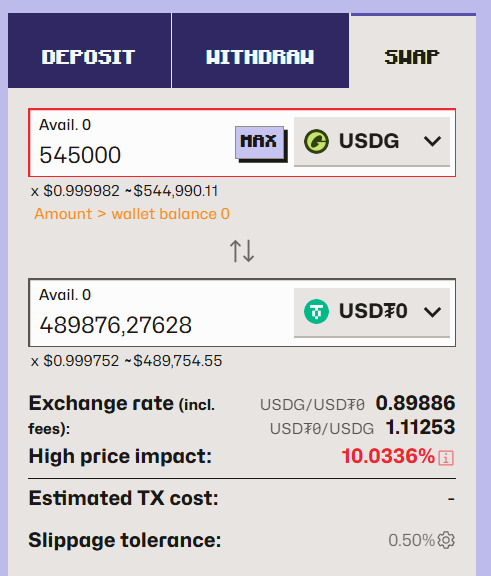
Source: Curve Finance, October 28, 2025
On X Layer, USDG DEX liquidity is concentrated in the newly deployed Curve USDG/USDC pool launched on 24 September, with around 1 million dollars in TVL.
1.1 Liquidity Venue Concentration
Current on-chain liquidity for USDG on X Layer is concentrated in the Curve USDG/USDT0 pool. The active pool functions as the primary depth venue for swaps and routing of USDG against a stable counterpart.
On-chain traces indicate additional venues exist or are being prepared. We identified upcoming Uniswap v3 USDG/WOKB and USDG/xBTC pools in development based on the deployed factory and USDG holdings. We also verified USDG in the Pancake USDG/USDT0 pool contract on X Layer.
1.2 DEX LP Concentration
On X Layer, USDG currently exhibits limited secondary market depth. The primary onchain venue is a USDG/USDC pool on Curve, with current depth liquidity set at $1M in TVL, and the OKX address being the largest Liquidity provider.
Volatility

Source: LlamaRisk, October 28, 2025
November saw a 9.24% deviation event in the first week after USDG trading went live on Kraken and immediately after Paxos’ launch announcement. New listings commonly exhibit thin order books and fragmented price discovery; a single small trade can set the daily “low” that aggregators record.
On January 30, 2025, the “high” appears to be an isolated print rather than a broad market premium. On the core USDG/USD market on Kraken, the 52-week range shows extreme ticks (low ≈$0.91, high ≈$1.606) but day-to-day trading clusters tightly around $1; this pattern is consistent with one-off outliers that lift the aggregator’s daily high without reflecting a sustained move.
Growth
As of October 28, there is limited on-chain data to assess USDG growth on X Layer following its recent launch. The current supply on X Layer stands at 9,026,311 USDG, representing roughly 1.21% of the total USDG circulating supply across other networks.
Price Feed Risk
For USDG pricing on X Layer, we suggest using Chainlink’s USDG/USD price feed as the primary oracle source. This feed operates with 10 underlying oracles and updates every 24 hours, providing better transparency and resilience for the stablecoin valuation. The deviation threshold for this price feed is set to 0.25%.
Multisig Threshold / Signer identity
On X Layer, the USDG contract follows the same access control structure as on Ethereum. Paxos uses four role-based access controls for the USDG contract, each controlled by Paxos defaultAdmin address backed by proprietary offline HSMs that enforce multi-person approvals. The admin address, which sits at 0x3Af3e85f4f97De7AD0f000B724Fb77fE5ffc024B is operated by the Paxos team and governs all four roles, with each role’s functions ultimately controlled by the defaultAdmin address.
- DEFAULT_ADMIN_ROLE: controls governance of the token’s privileges. It can grant and revoke every other role, change role-admin relationships, rotate the IERC-5313 owner, and authorize UUPS upgrades through the contract’s
authorizeUpgradegate. - PAUSE_ROLE: operates the emergency halt. Holders can call
pause()andunpause()to toggle the token’swhenNotPausedguard, which blocks on-chain transfers and any other functions wired to that modifier. - ASSET_PROTECTION_ROLE: enforces account-level controls. Holder can freeze and unfreeze specific addresses and invoke a post-freeze wipe that burns the frozen balance on chain to reflect lawful seizure or forfeiture.
- SUPPLY_CONTROLLER_MANAGER_ROLE: administers mint/burn operators and their limits. Holder can add and remove “supply controllers” that execute mint and burn, and configure guardrails such as per-controller permissions and rate or cap parameters.
Aave V3 Specific Parameters
Aave V3 specific risk parameters for USDG will be presented jointly with Chaos Labs prior to instance deployment.
Price Feed Recommendation
We recommend using Chainlink USDG/USD price feed as the primary oracle source. It is advisable to use a CAPO adapter to prevent misreporting on the upper side.
Disclaimer
This review was independently prepared by LlamaRisk, a DeFi risk service provider funded in part by the Aave DAO. LlamaRisk is not directly affiliated with the protocol(s) reviewed in this assessment and did not receive any compensation from the protocol(s) or their affiliated entities for this work.
The information provided should not be construed as legal, financial, tax, or professional advice.