Summary
This analysis provides an initial risk assessment and recommendation for deploying Aave v3 on the X Layer network. It presents an updated list of initial assets, which has been discussed and finalized in coordination with both the X Layer and TokenLogic teams. The proposed asset set includes: xBTC, xETH, xSOL, xBETH, xOKSOL, WOKB, USDT0, USDG, and GHO. Please note that this analysis does not explicitly cover xBETH and xOKSOL. These assets are currently being deployed and have limited operational history on X Layer. Chaos Labs intends to follow up with dedicated risk assessments for these assets once sufficient on-chain activity, liquidity formation, and operational data are available to support a comprehensive evaluation.
Additionally, we want to address the delayed timelines for deployment and risk analysis, driven primarily by updates to the asset list, completion of on-chain deployments, and the need to align configuration decisions with finalized token implementations and liquidity venues.
As several of the proposed assets, such as USDT0, USDG, and GHO, are already listed across major Aave v3 instances, this analysis does not revisit their fundamental design or long-term risk characteristics. Instead, the assessment focuses on specific implications related to X Layer’s architecture, liquidity conditions, and integration with OKX infrastructure. Overall, this document outlines the technical characteristics of X Layer relevant to Aave’s security, efficiency, and risk management, and provides recommendations for the initial asset configuration, including supply caps, collateral parameters, and E-Mode usage, designed to support a safe and controlled launch of Aave v3 on the network.
In addition, we remain supportive of improving capital efficiency over time through calibrated parameter upgrades, particularly via dedicated stablecoin-borrowing E-Modes and by restricting volatile-to-volatile borrow pathways. Enabling enhanced E-Mode configurations while preventing direct borrowing of volatile assets against other volatile collateral would materially reduce liquidation risk and cross-asset contagion during stress events, while allowing efficient stablecoin borrowing. The conservative base parameters proposed for the xAsset suite primarily reflect the current operational structure, under which issuance, redemption, and reserve management remain fully dependent on OKX-controlled infrastructure. In the absence of an on-chain Proof of Reserve feed and diversified custody arrangements, this introduces substantial issuer and operational concentration risk, which we account for in the assets’ risk parameters. The introduction of robust on-chain PoR feeds, together with a joint custody framework for the underlying reserves, would materially reduce these counterparty and operational risks. Under such conditions, we would be supportive of reassessing collateral parameters and E-Mode configurations through a subsequent governance update, contingent on demonstrated liquidity depth and stable market performance.
X Layer Overview
Technical Architecture
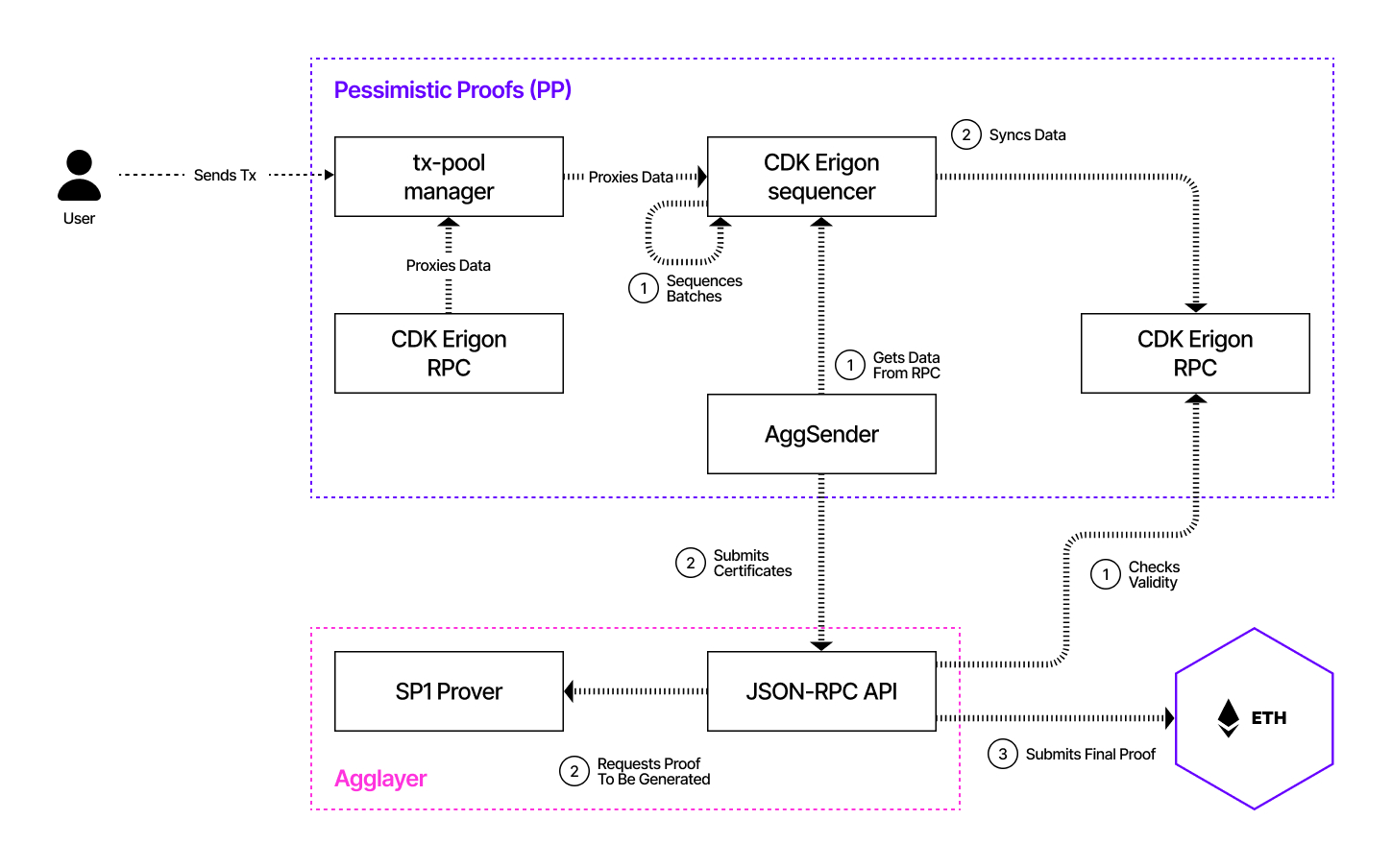
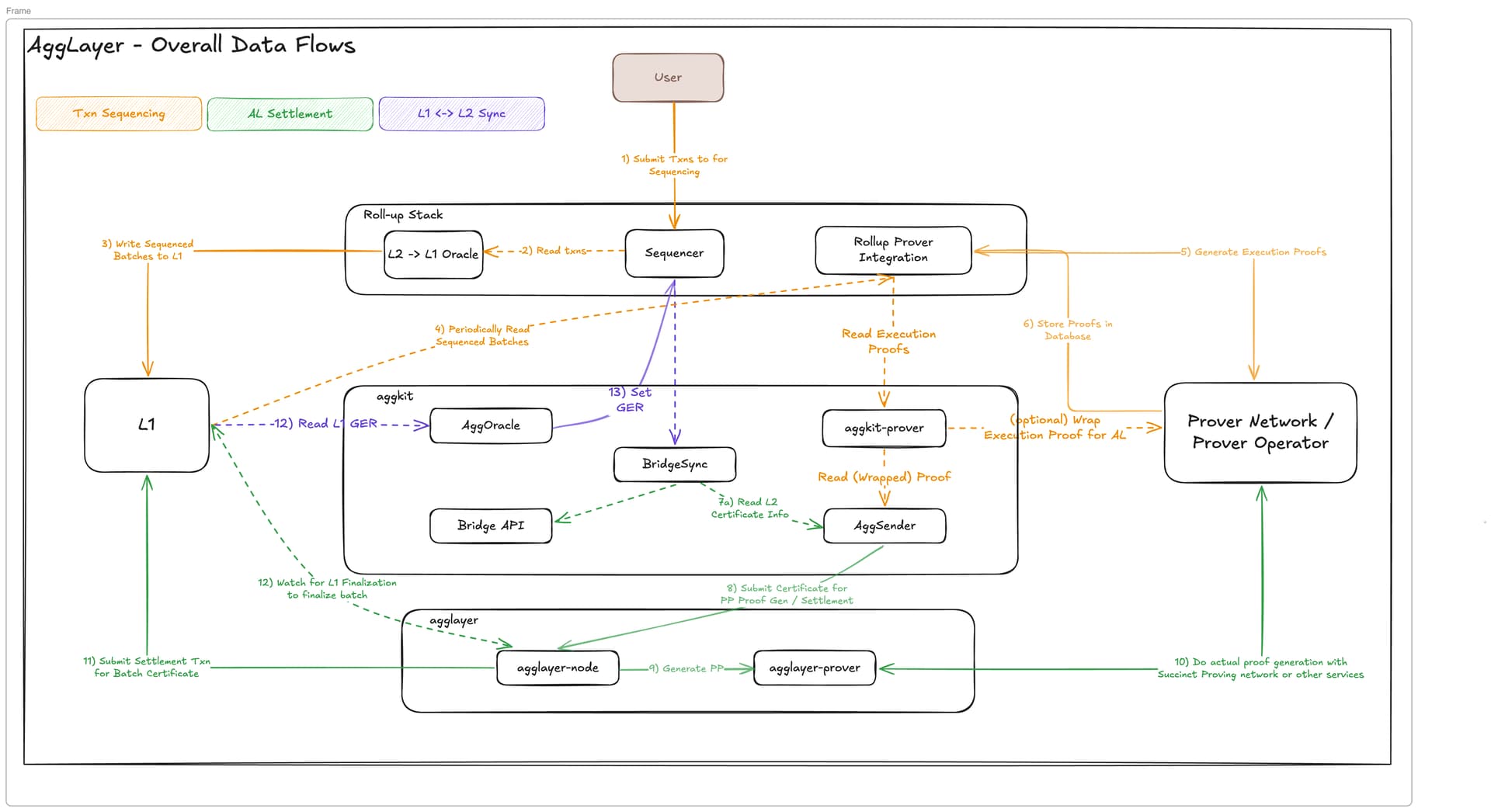
X Layer is an Ethereum Layer 2 network developed by OKX that recently transitioned from Polygon CDK to the OP Stack framework. It provides full EVM equivalence, enabling developers to deploy existing software without substantial modifications. The network follows the Optimistic Rollup architecture, in which transactions are executed and sequenced on Layer 2 and then batched for submission to Ethereum. Transactions are assumed valid by default, with a seven-day fraud-proof window that enables validation through challenge mechanisms.
Bridging
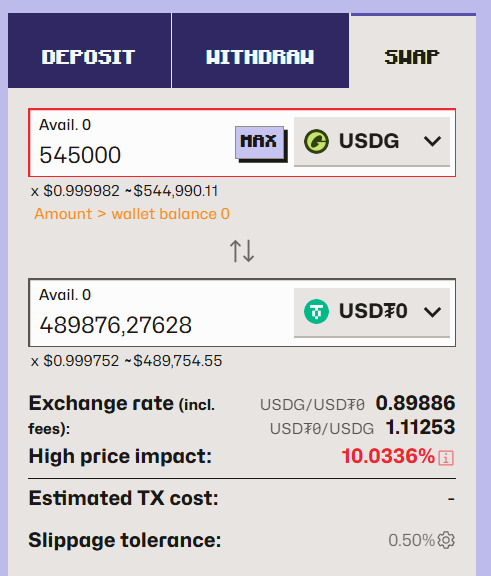
X Layer supports a number of bridging protocols, most notably LayerZero’s widely used OFT standard. One of the assets already bridged to X Layer is USDT0, an OFT representation of USDT that is already live on Arbitrum, Plasma, Ink, and many other chains.
OKX Integration
Given the close connection between the X Layer and OKX, OKX currently serves as the primary on- and off-ramp to the network, enabling substantial flows of both liquidity and users. Additionally, the chain is natively integrated with OKX Wallet, which has substantial potential to onboard retail users.
Tooling
X Layer inherits the Ethereum development environment by virtue of EVM equivalence, providing compatibility with widely used developer frameworks and analytics tools, including:
- Hardhat and Foundry for contract development and testing
- ABI and library compatibility across the existing Ethereum ecosystem
- Public RPC endpoints and block explorer via OKLink
- LayerZero infrastructure for cross-chain interoperability
- Dune integration (in progress)
- Upcoming oracle feeds for on-chain price data
Ecosystem
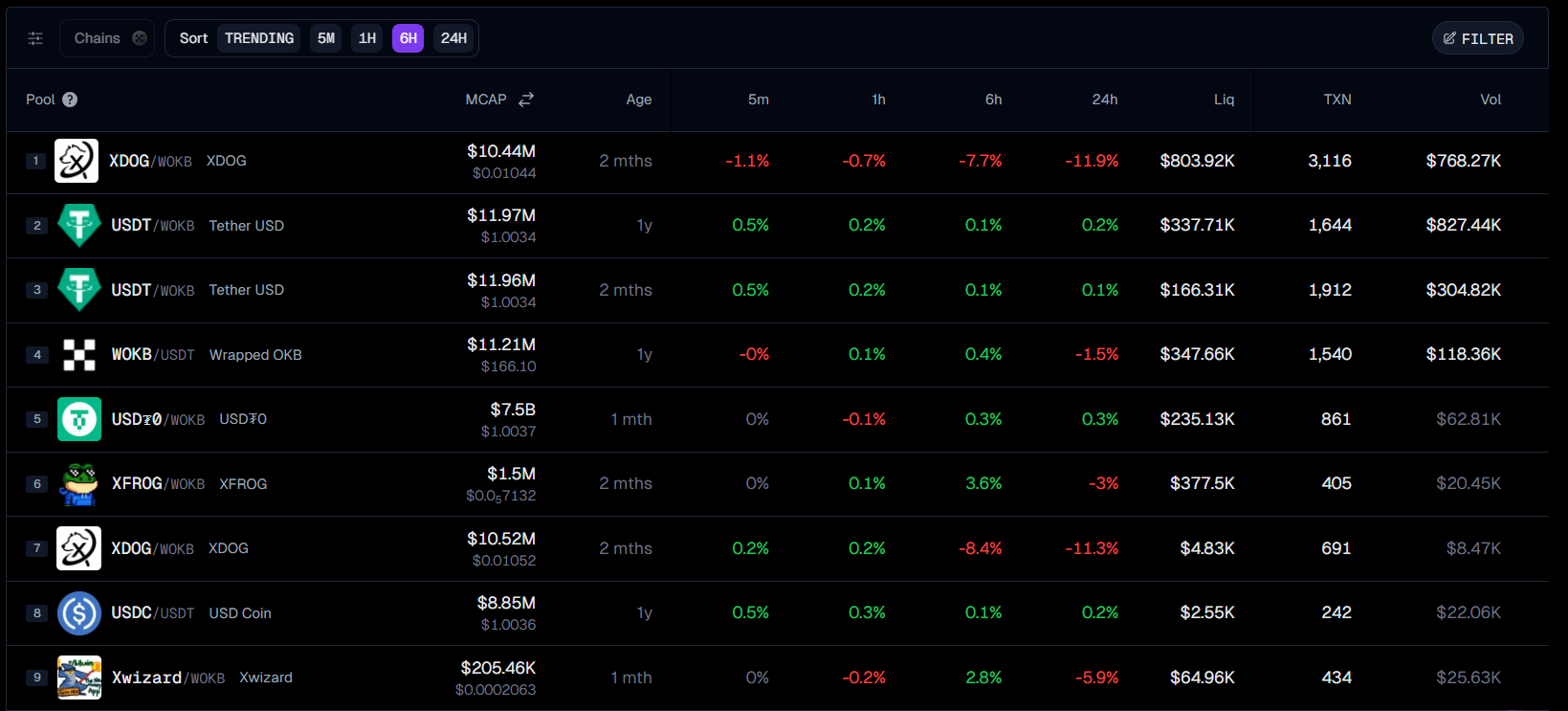
The X Layer ecosystem is in an early phase of development, with activity currently concentrated in a limited set of dApps. At the time of writing, the TVL of the chain is roughly 20 million, according to DefiLlama. The largest project by volume is a pump.fun-like decentralized exchange/launchpad with approximately 10.5 million USD in total value locked. The second largest app is Curve, which currently has a TVL of $5 million split between USDT0 and USDT/USDC/USDG pools. Other protocols in categories such as lending, liquid staking, and DEX aggregation are listed on DefiLlama, but they hardly reach a meaningful TVL.
Initial Asset Listings
USDT0
Technical Overview
USDT is the largest stablecoin by market capitalization, issued by Tether on the Ethereum network. In an effort to expand its services to additional users and networks, Tether adopted LayerZero’s Omnichain Fungible Token (OFT) standard. The OFT model introduces USD₮ (USDT0), a cross-chain representation that uses a 1:1 lock-and-mint process where USDT is locked on Ethereum via an adapter, and an equal amount of USDT0 is minted on the target chain. The asset is already listed on Arbitrum and Plasma instances of Aave, with a supply of over 124 million and 2.16 billion tokens, respectively. An in-depth review of the asset is available here.
A typical deployment of USDT0 implies the availability of the following smart contracts:
TetherTokenOFTExtension which exposes mint and burn functions on the destination chainOUpgradeable - LayerZero’s upgradable OFT module that handles cross-chain messaging, verification, and accounting- Source-side
Adapter, which escrows the USDT on the source chain and initiates a cross-chain transfer
When a user bridges tokens, the adapter locks USDT and sends a LayerZero message to the destination chain. OUpgradeable validates the payload; upon success, it calls TetherTokenOFTExtension to mint the exact amount of USDT0. By locking an equivalent amount of USDT on Ethereum for every USDT0 issued on the destination chain, the system ensures that the total circulating value remains fully collateralized, allowing for the native use of that capital within the chains X Layer, Arbitrum, Plasma, and many more. Given the broad adoption of both the OFT standard and USDT0, the listing of the asset does not imply any additional risk for the instance.
Risk Parameters
We recommend configuring USDT0 with conservative base parameters in order to facilitate potential short strategies where users would be able to recursively borrow volatile assets to achieve a desired level of leverage.
Supply and Borrow Caps
We recommend setting the initial supply and borrow caps at 50 million and 48 million tokens, respectively. Such levels will allow for substantial demand absorption from the other assets included in the initial listing as xBTC, xETH, WOKB, and xSOL.
IR Curve
We recommend aligning USDT0’s interest rate curve with that of the Plasma market. Specifically, we recommend a Slope 1 of 5%, UOptimal at 90%, and Slope 2 at 40%.
Oracle/Pricing
We recommend pricing USDT0 using the USDT/USD price feed. Additionally, we recommend wrapping the Oracle feed with a Capped Oracle, limiting the price of USDT to $1.04 to minimize market deviations from USDT0’s underlying value.
USDG
Technical Overview
USDG is a fiat-backed, Monetary Authority of Singapore-regulated single-currency stablecoin issued by Paxos Digital Singapore (PDS), designed to hold a 1:1 peg to the U.S. dollar via segregated reserves in cash and cash-equivalent assets, with redemption via Paxos. Paxos operates a multi-jurisdictional model: PDS issues USDG under Singapore’s framework, while Paxos Trust Company (NYDFS-regulated) issues USDP, PYUSD, and PAXG, and Paxos Issuance MENA (ADGM-regulated) issues USDL—covering a broad, regulated infrastructure for tokenized dollars and assets. Transparency is supported by monthly reserve reports and independent third-party attestations from Enrome LLP, confirming that reserves meet or exceed the circulating supply.
As of December 12, 2025, the circulating supply was 1,399,832,357 USDG against $1,408,317,257 in liquid reserves, representing a surplus of ~0.61%, which is held in short-term, highly liquid instruments with maturities from January 6 to January 29. Ongoing disclosures are available via the Paxos USDG Transparency Portal and are expected to have a similar low-duration composition.
USDG’s smart contract uses role-based permissions secured by a multisig. PAUSE_ROLE can halt transfers and approvals in emergency situations, while ASSET_PROTECTION_ROLE can freeze and unfreeze addresses and confiscate frozen balances. SUPPLY_CONTROLLER_MANAGER_ROLE assigns SUPPLY_CONTROLLER_ROLE in an external SupplyControl contract that gates supply-related actions. Minting is limited to institutional clients directly onboarded with Paxos, who can choose their funding rails (e.g., SWIFT), network, and destination via the dashboard or API. Upon the arrival of fiat, Paxos mints and transfers tokens on-chain; only wallets holding SUPPLY_CONTROLLER_ROLE can execute mints, and the contract enforces recipient whitelisting/availability, caller authorization, and rate limits before updating balances and total supply. Redemptions mirror the minting process: verified users link an approved bank account, a Paxos-controlled wallet collects tokens, and Paxos burns via burn() or decreaseSupplyFromAddress() calls, emitting Transfer and SupplyDecreased events; fiat payment is then sent to the user’s bank. Additionally, an in-depth analysis of USDG for its listing on the Ethereum Core instance is available here
Price and Volatility
USDG is traded primarily within the tight bands, ranging from 0.9995 to 1.0005, which is typical for a fiat-backed stablecoin. Like USDT, USDG has briefly depegged on October 10 amid extreme volatility, significant liquidations, and market-wide stress, compounded by a number of CEX availability issues. During this period, while USDT traded near 1.003, USDG fell below $0.97 on several CEXs, highlighting substantial secondary market pricing risk under stress.
USDG’s 7-Day annualized volatility is comparable to that of leading stablecoins, such as USDT and USDC, currently at 0.20–0.25% annualized.
Risk Parameters
Given the asset’s limited collateral value, we recommend listing USDG as a borrow-only asset on the X Layer instance.
IR Curve
We recommend aligning USDG’s interest rate curve with that of USDT0 and GHO in order to ensure competitive pricing of stablecoins on the instance. Specifically, we recommend a Slope 1 of 5%, UOptimal at 80%, and Slope 2 at 45%.
Supply and Borrow Caps
Given USDG’s proposed configuration as a borrow-only asset, which implies a lack of collateral utility, liquidation risk is minimized; hence, the asset’s supply and borrow caps should be set to align with expected borrowing demand. Specifically, we recommend supply and borrow caps of 5,000,000 and 4,250,000 tokens, respectively.
Oracle/Pricing
We recommend pricing USDG at $1 to minimize potential temporary fluctuations in the market price of the asset. Additionally, the recommended configuration of the asset does not enable it as collateral, thereby substantially limiting the risk to Aave in case of negative dislocations.
GHO
Motivation
X Layer is positioning itself as a hub of DeFi activity, with strong liquidity and on- and off-ramp venues through OKX. Given the expected configuration of the Aave V3 instance on the network, including GHO in the initial asset list would provide substantial benefits for user adoption and growth in protocol revenue.
GHO Performance
GHO has experienced substantial growth across various markets, increasing its market capitalization by over $120 million in the past month. The main drivers of the observed growth were Ethereum and Plasma, where GHO has been added to a set of E-Modes.
GSM Implementation
We recommend a stataUSDT0-backed GSM on X Layer and expect sufficient USDT0 liquidity at launch. With ample supply and deep markets, stataUSDT0 should serve as an effective stabilization asset, absorbing short-term deviations around GHO’s peg. A larger, more liquid USDT0 market also helps to keep stable lending rates and reduce the probability of abrupt spikes.
Steward Authority Framework
Through the governance framework, GHO Stewards retain the authority to adjust parameters within predefined bounds, allowing for responsiveness in risk controls. Within set limits, stewards can update borrow caps, perform interest rate adjustments, change supply caps, and GSM parameters, enabling timely reactions to market conditions while preserving governance oversight. Prior deployments suggest this approach supports early-phase stability and orderly scaling of GHO.
Risk Parameters
We recommend making GHO effectively a borrow-only asset, similar to other stablecoins planned for listing on the instance.
Supply and Borrow Caps
Considering the expected demand for GHO borrowing, we recommend setting the supply and borrow caps at 5,000,000 and 4,800,000 tokens.
IR
We additionally recommend the initial interest rate configuration, which is aligned with the broader stablecoin market, maintaining competitive pricing at Uoptimal, while being more sensitive to utilization changes before the kink than USDT0. Specifically, we recommend a Slope 1 at 5%, Slope 2 at 45%, and UOptimal at 90%.
Recommendation
Given X Layer’s positioning and the drivers of GHO borrowing, we support listing GHO at launch. The proposed IR curve is aligned with broader stablecoin conditions, while initial caps aim to balance risk controls and growth, enabling meaningful early adoption with substantial room to scale.
WOKB
Technical Overview
OKB is X Layer’s native utility token, primarily used for transaction fees. Unlike bridged assets, OKB is issued natively. WOKB is a wrapped ERC-20 representation of OKB. As X Layer grows, we expect the native gas token to play a progressively more significant role in further ecosystem development; hence, listing the asset is expected to provide additional utility within the deployed instance of Aave v3.
Price and Volatility
Given that OKB is not currently deployed on any EVM chains apart from the X layer, we are using 7-day rolling volatility derived from CEX prices to assess its stability. As can be seen in the chart below, OKB’s volatility profile is mostly similar to those of BTC and ETH over the past six months; however, the substantial spike in late August has resulted in an annualized volatility of over 100%. The key driver behind this spike was the announcement of OKX’s team to burn a substantial share of token reserves, naturally pushing the price up.
Risk Parameters
Given the asset’s slightly elevated volatility profile and its current relatively limited utility, we recommend setting conservative risk parameters within a dedicated stablecoin-borrowing E-Mode in line with those of WXPL on the Plasma instance: LTV at 50%, LT at 55%, and LB at 10%.
Supply Cap
The primary on-chain pricing venue for WOKB on X Layer is currently the USDT0/WOKB Uniswap V3 pool, which, at the time of writing, has a TVL of approximately $1 million. Hence, in order to constrain the protocol’s exposure to the elevated volatility associated with the asset, we recommend a supply cap of 125,000 tokens.
Oracle/Pricing
Given the high efficiency of OKB pricing and minimal dislocations, we recommend pricing OKB with a reliable OKB / USD price feed.
xBTC
Technical Overview
xBTC represents a BTC-backed synthetic asset issued by OKX, functioning as a wrapped representation of native Bitcoin within the Solana, Aptos, Sui, and a number of EVM ecosystems. Each unit of xBTC is fully backed by BTC held in custody on the Bitcoin network, with a proof-of-reserves dashboard publicly available on OKX. The minting and redemption processes are facilitated directly through OKX’s exchange infrastructure, enabling 1:1 conversions between BTC and xBTC. The asset’s peg stability is primarily maintained through continuous arbitrage between OKX and external markets, ensuring pricing efficiency under various market conditions.
Price and Volatility
While xBTC is not currently actively traded on EVM-supported chains, its structural composition and mode of operation are similar to other exchange-issued BTC wrappers like kBTC (Kraken) and cbBTC (Coinbase). As with the aforementioned assets, the primary price discovery venue for each asset is the redemption gate, i.e., the token-issuing exchange; hence, to assess the underlying volatility, we examine the pricing dynamics of the BTC /USD markets on the respective venues.
Presented below are daily closing prices across the venues. As can be observed, the price trajectories align, which reflects uniform mid-term venue-associated pricing of risks along with substantial market efficiency facilitated by cross-exchange arbitrageurs and market makers.
The alignment of 7-Day rolling volatility profiles for the BTC/USD markets on respective exchanges further emphasizes mid and long-term synchronization between the venues.
Convergence of daily closing prices confirms the high market efficiency claim across longer observation periods. To further examine the dynamics, we analyzed 1-second closing prices across the same set of exchanges during the market crash on the 10th of October 2025.
We observe that prices across the venues have been moving synchronously until approximately 21:12 UTC, when signs of divergence initially appeared and have expanded substantially over the next 20 minutes. Prices on OKX have been lower than those on Coinbase and Kraken, resulting in dislocations of 25 to 150 basis points. While dislocation from Coinbase has been substantial, OKX’s market price of BTC was on par with Binance and Kraken, which most likely illuminates the signs of a premium on Coinbase rather than a structural discount on other venues.
Furthermore, the distribution of returns during the high-stress market event provides additional backing for similarities in pricing efficiencies across OKX and alternative venues. Using the distribution densities of 1-second returns, we can assess market efficiency at a smaller scale. As shown, OKX, along with Coinbase, exhibits thinner tails and a denser mid-section of the distribution.
In summary, while the main redemption venues are aligned in pricing and synchronized due to consistent arbitrage, periods of extreme volatility can cause dislocations, leading to divergence in instantaneous pricing and potential inefficiencies. As mentioned, the wrappers are likely to inherit the momentary desynchronization in pricing due to the reliance on centralized venues. While this might pose a challenge in pricing the asset during extreme volatility events, the results observed during the October 10th crash suggest that xBTC’s redemption venue performs on par with other exchanges included in the analysis.
Mint & Redeem
xBTC uses a role-based minting model. Only addresses with MINTER_ROLE can call mint() while the contract is unpaused, and the call succeeds only if receiver matches the stored authorizedReceiver address. This design forces new supply to land in a controlled treasury/bridge wallet rather than arbitrary users, simplifying custody and accounting. Additionally, mints revert when totalSupply() + amount would exceed the hard cap of 21,000,000 xBTC, or if the receiver isn’t the authorized. Operations can be halted with pause() by an address holding DENY_LISTER_ROLE, and the sink itself can be rotated via setReceiver() to support operational changes without redeployment.
Supply contraction is performed by the operator rather than end users: a MINTER_ROLE holder calls burn() to burn the tokens from its own balance, emitting an event and lowering totalSupply. In practice, users deposit xBTC to OKX, which initiates the redemption process; the operator aggregates these funds and executes periodic burns that correspond 1:1 to BTC releases handled off-chain by the custody. As with minting, burns are blocked while paused and inherit deny-list protections through the transfer path. These controls, namely role-gated mint/burn, a single authorized mint sink, pause/deny-list enforcement, and a hard supply cap, ensure that supply changes occur only through explicit operational actions and keep on-chain accounting aligned with the BTC reserves that back xBTC.
Risk Parameters
We recommend configuring xBTC with conservative base parameters in order to account for the low maturity of the asset, along with its high reliance on the OKX infrastructure. This prevents xBTC from being used as high-capital efficient collateral while still allowing its additional usage within dedicated E-Modes. Under the E-Mode configuration, xBTC exposure is constrained to stablecoin borrowing, with parameters calibrated close to the base configuration of cbBTC on Ethereum Core, but discounted to account for issuer and custody risk. As market conditions mature and sufficient on-chain activity, liquidity depth, and liquidation performance are observed, a future revision of these parameters can be considered.
Supply and Borrow Caps
Given the high concentration of xBTC liquidity in the Uniswap v3 USDT0/xBTC pool on X Layer and the lack of long-term historical data, we recommend setting the initial supply cap for xBTC at 150 xBTC to align with current liquidity conditions. Additionally, we recommend a borrow cap of 20 xBTC to accommodate occasional borrowing demand as part of the short leg of potential long-short strategies.
Interest Rate
Considering the low expected demand to borrow xBTC within the instance, we recommend aligning the interest rate model to those of comparable assets. As xBTC borrowing is not expected to reach the optimal utilization ratio, we recommend configuring the asset with a Slope 1 of 2.75%, Slope 2 of 40% and UOptimal of 80%.
Oracle/Pricing
xBTC can be priced using two complementary approaches: a canonical BTC/USD price feed or a pricing framework augmented by Proof of Reserves (PoR) information. A standard BTC/USD oracle reflects the market value of Bitcoin across markets and aligns xBTC pricing with its intended 1:1 economic exposure to BTC. Given the high efficiency of BTC markets and the role of OKX as the primary redemption venue of xBTC, BTC/USD pricing provides a robust and well-established reference for risk management within Aave’s existing oracle framework.
An alternative approach would involve integrating Proof of Reserves into dynamic risk controls, enabling the protocol to explicitly account for the relationship between outstanding xBTC supply and reserve backing. In theory, PoR-based mechanisms can improve transparency, provide early warning signals in the event of reserve shortfalls, and introduce observability and quantification of counterparty risk. However, xBTC does not currently expose an on-chain Proof of Reserves feed. While OKX publishes a public transparency dashboard disclosing xBTC reserves on the Bitcoin networks along with xBTC supply across a set of networks, this information is off-chain and not directly consumable by Aave’s infrastructure without additional enhancements and trust assumptions.
Under current conditions, we therefore recommend pricing xBTC using a BTC/USD oracle. However, the listing of the asset is conditional on the establishment of a Proof of Reserve. As discussed in the Aave governance proposal on Proof of Reserve feeds as foundational risk infrastructure, future integration of which into Aave’s infrastructure will enhance risk monitoring and resilience for custodial assets such as xBTC; nevertheless, such integration is not currently available but is due before the asset’s listing on Aave.
xETH
Technical Overview
xETH is part of OKX’s xAsset suite, which issues centralized ERC-20 tokens backed by OKX reserves. Akin to xBTC, xETH is a 1:1 wrapped token intended to represent ETH on-chain with reserve backing and permissioned issuance and redemption. The core distinction versus canonical WETH is that xETH introduces issuer, custody, operational, and redemption dependencies
Price and Volatility
xETH is expected to inherit ETH/USD volatility. The relevant incremental risk is not directional volatility relative to ETH, but basis risk under stress if the market prices in redemption or issuer risk, or if liquidity fragments across venues. Specifically, venue-focused pricing is analyzed further. As with xBTC, we have utilized 1-second pricing data from a set of comparable exchanges that offer assets structurally similar to xETH.
As can be observed, the less liquid ETH markets have exhibited higher-frequency, more pronounced cross-exchange price dislocations. Specifically, the most significant observed dislocation between ETH/USDT on OKX and Coinbase was 500 basis points. Additionally, we observe a slight divergence in the price trajectories after 21:20 UTC, with OKX trading at a significant discount relative to Coinbase, Binance, and Kraken; specifically, the dislocations began at 21:37, reaching 70 basis points, and then at 21:47, 250 basis points.
The return distribution of ETH/USDT markets exhibits a broadly similar structure across venues, with notable differences in tail behavior. Specifically, OKX shows a higher frequency of large tail price moves than Coinbase, but materially fewer extreme observations than Kraken. This places OKX in an intermediate position in terms of tail pricing risk, suggesting elevated short-term volatility relative to peer venues.
Mint & Redeem
Minting is strictly permissioned and constrained at the contract level. New xETH supply can only be created by addresses holding the MINTER_ROLE, and minting is only permitted when the contract is not paused. Critically, all mint operations are restricted to a single, predefined authorizedReceiver address, ensuring that newly issued xETH is delivered exclusively to a controlled operational account rather than arbitrary recipients.
Additional safeguards ensure that mint amounts must be non-zero and that the post-mint total supply cannot exceed the MAX_SUPPLY, which is configured to the maximum supply of native ETH, preventing accidental or malicious over-issuance. These conditions, taken together, ensure that xETH supply expansion reflects the growth of the reserve balance held on the Ethereum mainnet.
Burn operations follow a similarly constrained model. Only addresses with the MINTER_ROLE are permitted to burn xETH, and burns can only be executed when the contract is not paused. Burning is limited to the caller’s own balance, requires a non-zero amount, and reverts if the caller does not hold sufficient tokens. In practice, this design reflects the operational redemption flow: users return xETH to OKX-controlled wallets, after which OKX executes on-chain burns corresponding to ETH withdrawals processed through its exchange infrastructure. Operationally, this implies redeemed xETH must be consolidated to the Mint & Burn MPC address prior to calling burn(), since burns are executed from the caller’s balance, while new issuance is minted to the separate authorized receiver used for controlled distribution.
Taken together, the mint and burn mechanics enforce a closed lifecycle in which all supply changes are explicitly authorized, bounded, and observable on-chain.
Risk Parameters
Like xBTC, we recommend configuring xETH with conservative baseline parameters. This limits the protocol’s exposure to future non-stablecoin, non-correlated borrowing while preserving baseline collateralization utility, which is further enhanced in the stablecoin-borrowing dedicated E-Mode. This approach aligns with the treatment of WETH across a wide variety of Aave deployments, while explicitly accounting for the additional issuer and counterparty risks associated with xETH through slightly more conservative parameterization.
Supply and Borrow Caps
The majority of xETH is currently concentrated in an Uniswap V3 USDT0/xETH pool with a TVL of approximately $1 million. Given the expected expansion of the pool, we recommend setting the asset’s initial supply cap at 5,000 tokens. Accordingly, we recommend setting the borrow cap of xETH at 1,300, allowing minimal utilization over kink.
Interest Rate
As xETH represents a custodian-wrapped WETH, we recommend aligning the borrow rate models of the asset with the general WETH configurations. Specifically, we propose Slope 1 of 2.5%, Slope 2 of 20%, and UOptimal of 90%. The interest rate model is motivated primarily by the presence of LRTs in comparable markets, which typically account for the absolute majority of WETH borrowing demand; as the X Layer market is expected to have its own LST (xBETH), the alignment of configurations is well rationalized. The less conservative configuration of Slope 2, compared to xBTC, is prompted by the high leverage expected in xETH borrowing; in such markets, even moderate upward utilization deviations can trigger substantial unwinds, as borrowers are highly sensitive to borrowing costs due to leverage.
Oracle/Pricing
During the October 10th market event, ETH pricing on OKX exhibited significant short-term dislocations. While these deviations were transient, they highlight the risks of relying on venue-specific redemption paths, which can exhibit relatively higher stress than the broader market during high volatility events. Nevertheless, as no viable alternative is currently available, we recommend pricing xETH using an ETH/USD oracle. Unlike xBTC, xETH does not currently have a publicly available transparency dashboard exposing reserve balances; however, xETH is deployed exclusively on X Layer, which materially simplifies reserve accounting relative to multi-chain assets and reduces the complexity of potential Proof of Reserves integration in the future. Given the asset’s reliance on OKX’s infrastructure and lack of a third-party Proof of Reserve, its listing is conditional on the provision of an on-chain feed, which would strengthen observability and risk monitoring.
xSOL
Technical Overview
xSOL is part of OKX’s xAsset suite and is a centralized, 1:1 reserve-backed wrapped representation of native SOL. The asset is backed by SOL held in segregated custody under OKX control, with reserves maintained at the Solana address. Structurally, xSOL is implemented analogously to xETH: it is an ERC-20 token with permissioned issuance and redemption, governed through role-based access control behind an upgradeable proxy and timelock. As with xETH, the core distinction versus canonical on-chain SOL representations is the introduction of issuer, custody, operational, and redemption dependencies, which replace protocol-native guarantees with reliance on OKX’s off-chain infrastructure.
Price and Volatility
While the asset is fully 1:1 backed and therefore reflects that of native SOL, periods of market stress may still introduce temporary pricing inefficiencies due to operational frictions, delayed redemptions, or liquidity constraints. As such, xSOL should be treated as economically equivalent to SOL in stable market conditions, but with pricing and redemption risk during extreme market events.
As the asset’s primary redemption venue is OKX, we have analyzed its pricing across a set of comparable venues to assess the incremental counterparty risk associated with OKX. As shown in the chart below, the price of SOL deviated substantially during the market stress event on October 10th. Specifically, the asset has exhibited a substantial discount during the 10 minutes between 21:15 and 21:25, with dislocations reaching approximately 20%, indicating substantial counterparty risk.
Mint & Redeem
xSOL follows the same permissioned mint and burn lifecycle described in the xETH section above. Minting is initiated by OKX following off-chain verification of SOL deposits and executed on-chain by addresses holding the MINTER_ROLE. New supply can only be minted to a predefined authorizedReceiver, ensuring issuance is restricted to controlled operational wallets. Minting is disabled while the contract is paused, requires non-zero amounts, and is capped by a predefined MAX_SUPPLY , which is aligned with the maximum supply of native SOL.
Redemptions follow the inverse operational flow: users return xSOL to OKX-controlled wallets, after which OKX executes on-chain burns via permissioned roles. Burns are restricted to the caller’s balance, require non-zero amounts, and are disabled while paused. As with xETH, redeemed xSOL must be consolidated to the Mint & Burn MPC address prior to burning, since burns execute from the caller’s balance.
Overall, xSOL enforces a closed, operator-mediated supply lifecycle that is aligned with xETH, with all supply changes explicitly authorized, bounded, and observable on-chain, while redemption and backing remain dependent on OKX’s off-chain custody processes.
Risk Parameters
Like xBTC and xETH, we recommend configuring xSOL with conservative baseline parameters. This ensures that xSOL retains its utility as a general-purpose collateral, while limiting the protocol’s exposure to future risky debt accumulation. This structure materially constrains liquidation pathways and mitigates exposure to issuer, custody, and pricing risks, which is particularly important given observed SOL market dislocations during stress events. Additionally, the asset will be included in a dedicated stablecoin borrowing E-Mode, which allows for enhanced capital efficiency in the collateralization of stablecoin debt.
Supply and Borrow Cap
Akin to xBTC and xETH, xSOL’s on-chain liquidity is currently primarily allocated in a Uniswap V3 USDT0/xSOL pool with a TVL of ~$1 million. While the pool is expected to expand to $2 million in TVL, we recommend setting the initial supply and borrow caps at 110,000 and 14,000 tokens, respectively, to constrain potential risks related to the asset’s novelty and reflect expected liquidity conditions.
Interest Rate
Akin to xETH, xSOL is expected to be borrowed primarily in LST looping strategies, prompting an interest rate model configuration aligned with the broader market. Specifically, we recommend a Slope 1 of 5%, Slope 2 of 20% and UOptimal of 80%.
Oracle/Pricing
We recommend pricing xSOL using a SOL/USD oracle consistent with Aave’s standard pricing framework for wrapped assets. Given observed stress dislocations and the issuer- and custody-dependent nature of the xAsset suite, we recommend maintaining a conservative launch configuration and monitoring liquidity formation and price performance post-launch. Given the counterparty risk associated with custodial operations, we recommend listing xSOL, subject to the availability of an on-chain Proof of Reserve feed.
Specifications
| Parameters |
Value |
Value |
Value |
Value |
Value |
Value |
Value |
| Asset |
USDT0 |
USDG |
GHO |
xBTC |
wOKB |
xETH |
xSOL |
| Isolation mode |
No |
No |
No |
No |
No |
No |
No |
| Borrowable |
Yes |
Yes |
Yes |
Yes |
No |
Yes |
Yes |
| Collateral enabled |
Yes |
No |
No |
Yes |
No |
Yes |
Yes |
| Supply Cap |
50,000,000 |
5,000,000 |
5,000,000 |
150 |
125,000 |
5,000 |
110,000 |
| Borrow Cap |
48,000,000 |
4,250,000 |
4,800,000 |
20 |
- |
1,300 |
14,000 |
| Debt Ceiling |
- |
- |
- |
- |
- |
- |
- |
| LTV |
70.00% |
- |
- |
70.00% |
- |
70.00% |
60.00% |
| LT |
75.00% |
- |
- |
75.00% |
- |
75.00% |
65.00% |
| Liquidation Bonus |
7.50% |
- |
- |
7.50% |
- |
7.50% |
7.50% |
| Liquidation Protocol Fee |
10% |
- |
- |
10% |
10% |
15% |
10% |
| Variable Base |
0% |
0% |
0% |
0.00% |
- |
0.00% |
0.00% |
| Variable Slope1 |
5.0% |
5.0% |
5.0% |
2.75% |
- |
2.50% |
5.00% |
| Variable Slope2 |
40.0% |
45.0% |
45.0% |
40.0% |
- |
20.0% |
20.0% |
| Uoptimal |
90.0% |
80.0% |
90.0% |
80.0% |
- |
90.0% |
80.0% |
| Reserve Factor |
10% |
10% |
10% |
10% |
- |
15.0% |
15.0% |
| Stable Borrowing |
Disabled |
Disabled |
Disabled |
Disabled |
Disabled |
Disabled |
Disabled |
| Flashloanable |
Yes |
Yes |
Yes |
Yes |
Yes |
Yes |
Yes |
| Siloed Borrowing |
No |
No |
No |
No |
No |
No |
No |
| Borrowed in Isolation |
No |
No |
No |
No |
No |
No |
No |
| E-Modes |
1,2,3,4 |
1,2,3,4 |
1,2,3,4 |
1 |
4 |
2 |
3 |
E-Mode #1
| Parameter |
Value |
Value |
Value |
Value |
| Asset |
xBTC |
USDT0 |
USDG |
GHO |
| Collateral |
Yes |
No |
No |
No |
| Borrowable |
No |
Yes |
Yes |
Yes |
| Max LTV |
78.00% |
- |
- |
- |
| Liquidation Threshold |
81.00% |
- |
- |
- |
| Liquidation Bonus |
6.00% |
- |
- |
- |
E-Mode #2
| Parameter |
Value |
Value |
Value |
Value |
| Asset |
xETH |
USDT0 |
USDG |
GHO |
| Collateral |
Yes |
No |
No |
No |
| Borrowable |
No |
Yes |
Yes |
Yes |
| Max LTV |
78.00% |
- |
- |
- |
| Liquidation Threshold |
80.00% |
- |
- |
- |
| Liquidation Bonus |
6.00% |
- |
- |
- |
E-Mode #3
| Parameter |
Value |
Value |
Value |
Value |
| Asset |
xSOL |
USDT0 |
USDG |
GHO |
| Collateral |
Yes |
No |
No |
No |
| Borrowable |
No |
Yes |
Yes |
Yes |
| Max LTV |
65.00% |
- |
- |
- |
| Liquidation Threshold |
70.00% |
- |
- |
- |
| Liquidation Bonus |
7.50% |
- |
- |
- |
E-Mode #4
| Parameter |
Value |
Value |
Value |
Value |
| Asset |
WOKB |
USDT0 |
USDG |
GHO |
| Collateral |
Yes |
No |
No |
No |
| Borrowable |
No |
Yes |
Yes |
Yes |
| Max LTV |
50.00% |
- |
- |
- |
| Liquidation Threshold |
55.00% |
- |
- |
- |
| Liquidation Bonus |
10.00% |
- |
- |
- |
Disclaimer
Chaos Labs has not been compensated by any third party for publishing this recommendation.
Copyright
Copyright and related rights waived via CC0