In connection with the forthcoming X Layer deployment, we present our analysis for OKB onboarding.
Summary
As part of our X Layer risk review, we present this assessment of OKB covering token architecture, liquidity profile, pricing infrastructure, and regulatory context. We recommend onboarding OKB to the Aave v3 X Layer instance, provided that reliable oracle coverage and active monitoring are maintained. The main concern is low and fragmented DEX liquidity on X Layer, which increases slippage and execution risk. We expect the X Layer team to supply additional liquidity to improve market depth and ensure a stable and smooth launch.
1. Asset Fundamental Characteristics
1.1 Asset
OKB is the native utility token of the OKX ecosystem, with a fixed total supply of 21 million tokens on X Layer. It serves as an integral component of the platform’s operational and incentive structure. OKB functions as the native fee token on X Layer, where it is used to pay for gas and transaction execution within the network.
1.2 Architecture
OKB on X Layer functions as the network’s fee token. All transactions, computations, and storage on the L2 are metered in OKB and settled within X Layer’s EVM state. The protocol treats OKB as the native asset, so users must hold OKB to pay gas and execute contracts.
Wrapped OKB on X Layer uses the WETH9-style wrapper to present OKB as an ERC-20 compatible token. The wrapper accepts native OKB, issues WOKB one-to-one, and allows redemption back to native OKB. This preserves ERC-20 interfaces for DEXs, vaults, and lending protocols while keeping gas paid in the native unit.
Bridging connects Ethereum and X Layer through the AggLayer and supported third-party routers. Canonical OKB is escrowed on the origin side and released on the destination after finality. Redemptions burn the representation and unlock the escrowed amount.
Supply on the X Layer is a routing of the fixed 21 million OKB total. The L2 does not mint OKB and does not govern supply policy. Any changes to circulating supply occur at the issuer and treasury layer and then propagate to X Layer through deposits and withdrawals.
Pricing relies on oracles that consume centralized and decentralized venues. For protocol safety on X Layer, the recommended feed is Chainlink OKB/USD. Using this oracle as the primary on-chain source is consistent with standard protocol safety practices.
1.3 Tokenomics
OKB total supply was permanently fixed at 21,000,000 tokens following a one-time burn of 65,256,712.097 OKB on August 15, 2025. The burned tokens were sourced from historical buybacks and treasury reserves.
1.3.1 Token Holder Concentration

Source: OKB concentration, October 28, 2025

Source: WOKB token holdings, October 28, 2025
On X Layer, the OKB is almost entirely held under OKX native custody, with only about 0.32% of the total supply issued as wrapped tokens.
Token holdings show a concentrated distribution across liquidity pool (LP) contracts, with the top 10 addresses collectively controlling over 35% of the total supply.
Most top LP positions experienced positive daily changes, suggesting active liquidity provision and potential rebalancing activity. Overall, liquidity remains primarily pool-driven, with on-chain concentration implying dependency on a few active DeFi pools for price stability and depth.
Top 5 holders of OKB:
- Potato LP (DOGSHIT/WOKB) – 6,842.12 OKB (10.02%)
- Potato LP (KINGX/WOKB) – 2,843.27 OKB (4.17%)
- In LP (INS/WOKB) – 2,482.01 OKB (3.64%)
- Potato LP (LABUBU/WOKB) – 2,408.79 OKB (3.53%)
- DYOR LP (XDOG/WOKB) – 2,311.68 OKB (3.39%)
2. Market Risk
2.1 Liquidity

Source: OKX Swap, October 28, 2025
Current depth implies a 9.89% slippage for selling 1750 OKB. Considering OKB’s overall market capitalization and trading activity, this indicates that OKB has low DEX liquidity on X Layer. Large on-chain transactions or forced liquidations could trigger significant price fluctuations on DEXs due to limited liquidity depth.
We proposed to the X Layer team an initial liquidity target of 5 million in USD with expected slippage between 5-8% as a starting point, with additional liquidity to be provided progressively as the market matures and trading activity deepens across decentralized venues.
2.1.1 Liquidity Venue Concentration
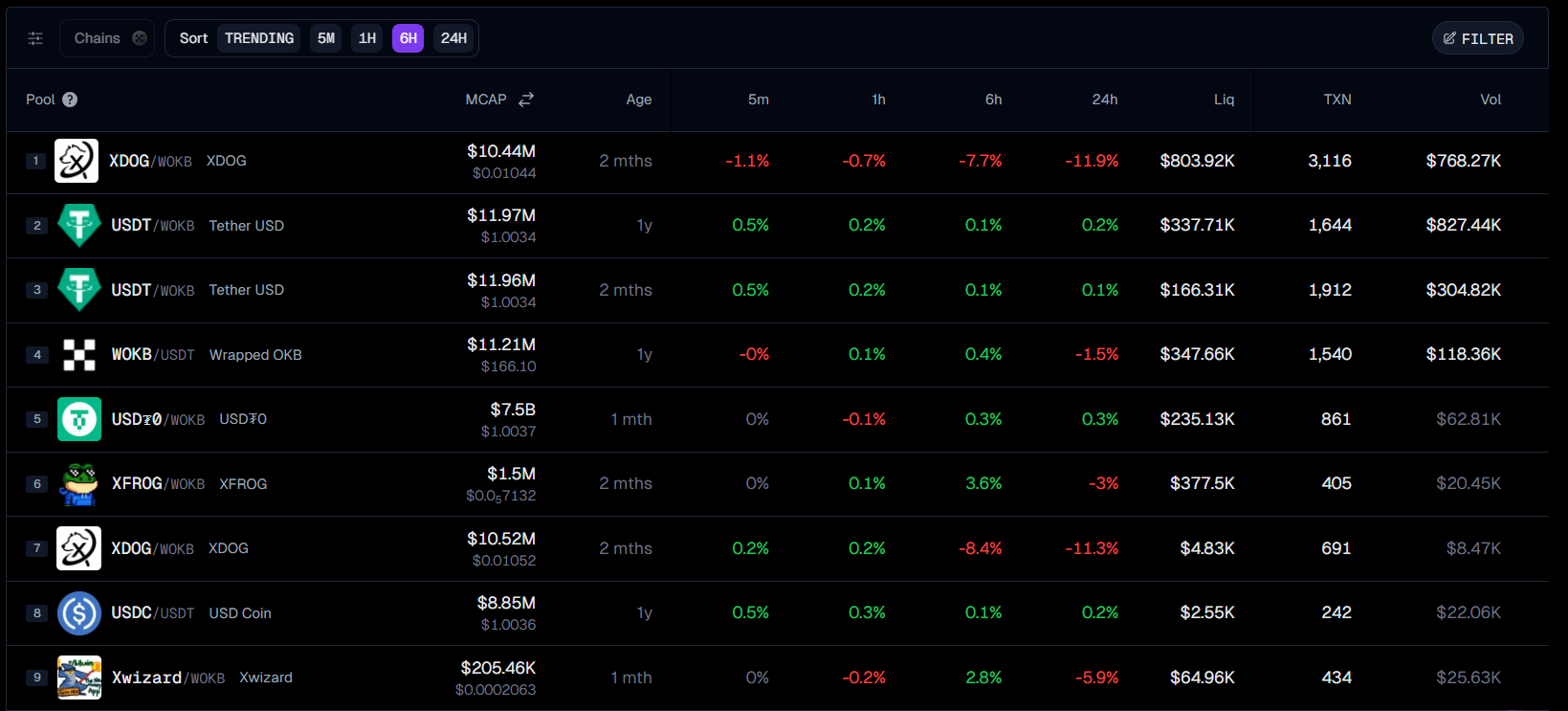
Source: GeckoTerminal, October 28, 2025
Most liquidity sits in memecoin pairs, primarily Potato LPs and DYOR LPs. Total DEX liquidity shown here is about 50k OKB across the top 100 Liquidity Pool addresses. That is roughly 0.238% of a 21m OKB supply.
The biggest stablecoin pools include:
- OkieSwap USDT/WOKB - $233.05K TVL
- QuickSwap USDT/WOKB - 328.46k TVL
- PotatoSwap USDT/WOKB - 344.25k TVL
2.1.2 DEX LP Concentration
OKB DEX liquidity shows low concentration, with liquidity dispersed across multiple small pools, many paired with memecoins. Individual pool depth remains limited, leading to fragmented routing and higher execution costs. Almost all liquidity provision appears to come from the X Layer team and supported protocols.
2.2 Volatility

Source: OKX, October 28, 2025
Following the August token burn, volatility increased sharply, and the price surged up to a peak of 258.44 USD, marking a 472.97% increase over a period of roughly nine days with daily trading volume around 180.85K OKB (21.6M in USD).
2.3 Exchanges

Source: CoinGecko, October 28, 2025
Centralized exchange liquidity for OKB remains dominant, with OKX accounting for roughly 57.8% of total trading volume in the OKB/USDT pair. Depth within ±2% on OKX exceeds $2.05 million combined, which supports tight spreads around 0.01%. Secondary liquidity is distributed across Gate.io, LBank, XT.COM, and Bitunix, each contributing between 4% and 6% of global daily turnover.
Aggregate 24-hour volume across the top ten exchanges totals approximately $33.0 million, indicating moderate but sufficient centralized liquidity for stable price discovery and institutional execution. This depth contrasts with low on-chain liquidity on X Layer, confirming that OKB price formation remains primarily centralized, with OKX dictating benchmark pricing. Note that OKB continues to be absent from onshore regulated exchanges.
2.4 Growth
As the network’s native token, the growth of OKB is expected to correlate with the expansion of activity on X Layer and its associated applications. At the time of writing, approximately 68k WOKB has been wrapped and is circulating on X Layer out of the 21 million total OKB supply, indicating that only a small fraction of total tokens are currently active within the on-chain ecosystem.
3. Technological Risk
3.1 Smart Contract Risk
WOKB is built on the WETH contract framework. The WETH standard was created as an open-source initiative by contributors from MakerDAO, 0xLabs, and Gnosis. Its WETH9 implementation is a proven and broadly adopted model across EVM networks.
As a widely used wrapper implementation, WETH code often forms part of protocol audits that integrate it, for example:
- Sherlock - EdgeLayer (May, 2025)
- Openzeppelin - Scroll (October, 2023)
- Dedaub - Maverick Protocol (March 2023)
3.2 Bug Bounty Program
The OKB token is covered under the OKX bug bounty program on HackerOne. Researchers can report security vulnerabilities related to OKB or its supporting infrastructure through the OKX Bug Bounty Program, with rewards determined by issue severity and payouts reaching up to $1,000,000 for critical findings.
3.3 Price Feed Risk
For OKB pricing, we recommend using the Chainlink OKB/USD price feed as the primary oracle source. The feed aggregates data from 10 underlying oracles and refreshes every 24 hours, offering enhanced transparency and robustness in stablecoin valuation. Its deviation threshold is configured at 0.5%.
3.4 Dependency Risk
The primary dependency risk related to OKB stems from its direct connection to the OKX ecosystem. This dependency is amplified by the high concentration of OKB supply held in OKX custody, with only a small fraction circulating as wrapped tokens. Any negative development, such as legal restrictions, security breaches, or operational interruptions within the OKX ecosystem, would likely have an immediate and significant impact on the liquidity and overall market perception of OKB.
The core use cases of OKB are concentrated within the OKX. The long-term viability of the token, therefore, relies on the sustained global presence and strategic expansion of the OKX ecosystem.
4. Counterparty Risk
4.1 Governance and Regulatory Risk
There is no standalone “OKB Terms of Use” or token-specific contract. In practice, the legal treatment of OKB is subsumed under OKX’s platform agreements, together with any product-level terms that govern where and how the token may be held or used. The baseline instrument is the OKX global Terms of Service, which applies to use of the OKX venue and to all listed “Digital Assets,” encompassing OKB. The current page reflects an original publication date of 29 August 2023 and a last update on 12 May 2025, and it incorporates the platform risk statement, dispute-resolution and arbitration provisions, and other boilerplate that collectively structure the contractual relationship.
The global platform for “all other users” is operated by Aux Cayes FinTech Co. Ltd., a company incorporated in the Seychelles. This entity is named as a counterparty in the global Terms of Service and—critically—is the same entity that entered a U.S. guilty plea in February 2025 for operating an unlicensed money-transmitting business and for AML program failures. The resulting resolution included approximately $505 million in combined criminal fines and forfeiture, together with an obligation to retain an independent compliance consultant through February 2027, which functions as a forward-looking remediation and monitoring commitment.
Within the European Union, OKX’s operations have been consolidated under a MiCA authorization held by OKCoin Europe Limited, licensed by the Malta Financial Services Authority and passported into France. The AMF record evidences a broad scope of services—custody and administration, operation of a trading platform, exchange of crypto-assets for funds and for other crypto-assets, execution of orders, placing, reception and transmission of orders, portfolio management, and transfer services on behalf of clients—signalling a full-stack CASP profile for EU delivery. In parallel, OKX France Technology Company SAS voluntarily deregistered as a PSAN on 28 July 2025 as part of this consolidation. In the European Union (MiCA) specifically, the AMF’s CASP passport entry for OKCoin Europe Limited lists the authorized services verbatim as follows: “Providing custody and administration of crypto-assets on behalf of clients”; “Operation of a trading platform for crypto-assets”; “Exchange of crypto-assets for funds”; “Exchange of crypto-assets for other crypto-assets”; “Execution of orders for crypto-assets on behalf of clients”; “Placing of crypto-assets”; “Reception and transmission of orders for crypto-assets on behalf of clients”; “Providing portfolio management on crypto-assets”; and “Providing transfer services for crypto-assets on behalf of clients.”
In the United Arab Emirates (Dubai), OKX Middle East Fintech FZE holds a VARA VASP license (reference VL/23/12/003) that covers Exchange Services, Lending and Borrowing, and Management & Investment Services, with permission to serve institutional, qualified, and retail clients. OKX publishes Dubai-specific customer documentation aligned to these license buckets—including a trading venue Code of Conduct and product terms under the VA Lending & Borrowing permission—which, among other things, clarify that OKX Dubai does not provide investment advice.
In Singapore, OKX SG Pte. Ltd. operates as a Major Payment Institution under the Payment Services Act, authorized to provide both digital payment token services and cross-border money transfer services. The Monetary Authority of Singapore’s Financial Institutions Directory records the entity and its status.
In Australia, OKX conducts spot services through OKX Australia Pty Ltd as an AUSTRAC-registered digital currency exchange, while derivatives are restricted to “wholesale clients” and provided by OKX Australia Financial Pty Ltd, which holds an Australian Financial Services Licence. OKX’s disclaimer delineates this two-entity model and the client segmentation. In Australia’s local Terms of Service, the permitted activities are set out expressly: “Part B Digital currency exchange … Crypto to fiat, fiat to crypto, and crypto to crypto via Convert and Spot Service,” accompanied by the note that “These Services are not regulated under the Australian financial services licensing regime and [are] not subject to regulation by ASIC.” For derivatives, “Part C Derivatives … These Services are available to wholesale clients only. These are the only Services that are regulated under the Australian financial services licensing regime and subject to regulation by ASIC.” For on-chain yield, “Part D On-Chain Earn … is not regulated under the Australian financial services licensing regime and is not subject to regulation by ASIC.”
In the United States, OKCoin USA Inc. functions as the licensed counterparty. The U.S. site states that OKCoin USA Inc. is registered with FinCEN as a Money Services Business and holds state money-transmitter licences listed via NMLS, with the U.S. Terms of Service governing the platform relationship.
In the United Kingdom, OKX does not hold an MLR registration as a cryptoasset exchange or custodian. Access to the U.K. retail market proceeds under the Financial Conduct Authority’s financial promotions regime. OKX has implemented the mandated risk warning, user categorization, and appropriateness testing and has publicly indicated the use of authorized approvers to lawfully communicate promotions. These are permissions under marketing law rather than conduct or prudential authorizations, and they therefore constrain both what can be offered and the manner in which it may be described to U.K. consumers.
4.2 Access Control Risk
The Wrapped OKB contract is a permissionless, non-upgradeable contract similar to WETH9.
Aave V3 Specific Parameters
Aave V3 specific risk parameters for OKB will be presented jointly with Chaos Labs prior to instance deployment.
Price feed Recommendation
We recommend using the Chainlink OKB/USD price feed as the primary oracle source for reliable on-chain pricing.
Disclaimer
This review was independently prepared by LlamaRisk, a DeFi risk service provider funded in part by the Aave DAO. LlamaRisk is not directly affiliated with the protocol(s) reviewed in this assessment and did not receive any compensation from the protocol(s) or their affiliated entities for this work.
The information provided should not be construed as legal, financial, tax, or professional advice.