Summary
LlamaRisk supports Aave deployment to Monad with specific considerations. The network launched its public mainnet on November 24, 2025, making it roughly 7 months old at the time of writing. While Monad’s parallel EVM execution architecture and full bytecode compatibility reduce deployment friction, the network’s relatively short operational history warrants conservative initial parameters.
Current TVL stands at approximately $359.5m. The ecosystem has attracted established DeFi protocols (Uniswap, Curve, and Morpho) alongside Monad-native applications (Neverland and Kuru), though liquidity remains concentrated in the former. The key risk consideration for Monad is the narrow set of validators (200) and the significant staking weight that the top 3 validators currently have over the network (~45%). Initial strong early usage on the network has compressed, with activity remaining relatively the same until recently, with a marginal uptick in active addresses in April 2026.
1. Network Fundamental Characteristics
1.1 Network Overview
Monad is a Layer 1 Proof-of-Stake blockchain that targets full EVM bytecode compatibility while re-engineering the execution layer for higher throughput. It is not an L2 or rollup; it is an independent L1 with its own validator set and consensus mechanism.
The network’s performance rests on four architectural components:
- MonadBFT: a pipelined, HotStuff-family BFT consensus (HotStuff-style) that separates ordering/finality from execution so validators can agree on block order while execution is performed out of the consensus hot path.
- Optimistic parallel execution: concurrent execution with conflict detection and re-execution for dependent states, rather than strictly sequential EVM execution.
- Asynchronous/deferred execution: consensus and execution are decoupled; block production is not gated on finishing prior-block execution.
- MonadDB: a custom state database layer described as part of the core architecture.
Target throughput is up to 10,000 TPS with 400 ms block times and ~800 ms finality. Current throughput averages are 16-47 TPS and 400.27 ms block times.
Architecture
Monad is designed as an EVM bytecode-equivalent Layer 1 with a performance model built around separating ordering/finality from execution. Transactions are still linearly ordered, but execution is implemented as optimistic parallel execution: independent transactions can be executed concurrently, and conflicts are handled by detecting incorrect reads and re-executing affected transactions; even with parallel execution, state updates are merged sequentially to preserve the deterministic EVM result.
MON is the chain’s native accounting and security asset. Transaction fees are denominated in MON, and the documentation specifies that deductions follow `value + gas_price * gas_limit` (i.e., charging against the declared gas limit). Validator voting weight and leader scheduling are stake-based, with MON staked by validators and delegated by holders, making MON the input to consensus participation and reward distribution.
Consensus is provided by MonadBFT, which targets speculative finality in a single round and full finality in two rounds. This finality structure matters for liquidation and arbitrage flows because actors either price in the small speculative-finality reversion tail or wait for two-round finality before executing size.
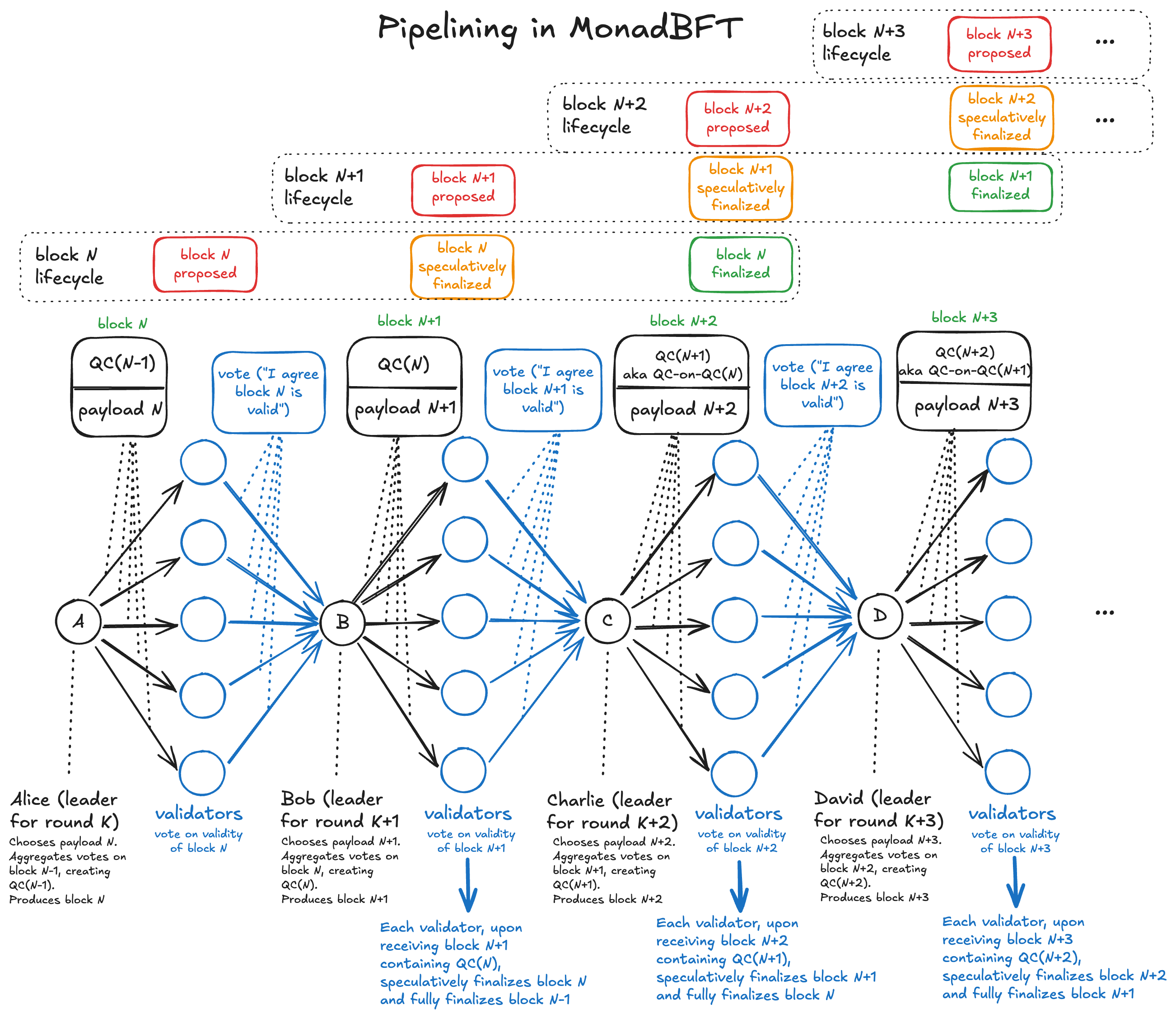
Source: MonadBFT, Monad docs
MonadBFT is a leader-based BFT protocol where a designated leader proposes the next block in each round. The leader rotates each round according to a schedule determined previously using the stake weights. After validators vote on the proposal, the leader aggregates votes into a quorum certificate once a supermajority threshold is reached. The next leader then builds on the highest-certified block, and finality is achieved by accumulating certificates across consecutive rounds, which is why the protocol distinguishes one-round speculative confirmation from two-round deterministic finality.
In the normal (happy) path, the leader is live and messages propagate on time, so validators form a QC (Quorum Certificate) for the proposed block in one round, and the following round extends it, producing deterministic finality on the second round. The unhappy path occurs when a round fails to gather timely votes into a QC, typically due to a non-responsive leader, delayed message propagation, or Byzantine behavior that disrupts vote collection. Timeout handling is round-based: if a validator does not observe a QC before its local timer expires, it stops waiting for that round, emits a timeout signal that carries its highest observed QC, and advances to the next round. The next leader uses the timeout signals to converge on the highest-certified chain tip and proposes a new block extending that highest QC, allowing the protocol to make progress without committing the stalled proposal. This preserves safety under the <1/3 faulty stake assumption but increases latency and can extend the time between speculative confirmation and deterministic finality.
Security
Monad’s security posture is documented through third-party review and a standing, incentivized disclosure program. The MiCA white paper states that the protocol underwent security audits by Zellic and Spearbit and that a public audit competition was completed ahead of the contemplated admission to trading, while also noting that undiscovered vulnerabilities may still exist in the core protocol.
For ongoing vulnerability reporting, the core client repository directs researchers to a Cantina bug bounty. Cantina is the primary disclosure channel for Monad core issues, with max rewards of $1,000,000 (Critical), $150,000 (High), and $35,000 (Medium). Scope is centered on chain-critical components: MonadBFT consensus safety/finality, RaptorCast networking (DoS, propagation delays, signature/Merkle verification), parallel execution determinism/state integrity, transaction + fee model correctness, and high-sensitivity execution components (MonadDB integrity and JIT vs interpreter consistency, including RCE-class risk).
Residual exposure is concentrated in client implementation and upgrade risk: defects introduced through new releases, parameter changes, or edge-case interactions under mainnet load can surface as consensus faults or execution inconsistencies, which would be higher impact than application-layer contract bugs due to their potential to affect chain-wide settlement guarantees.
Fees
Gas fees are near-zero, denominated and payable in MON. Monad transaction fees are EIP-1559 compatible: the effective gas price paid per unit of gas is the sum of a protocol-controlled base fee and a user-specified priority fee, and the amount charged is the transaction gas limit (i.e., deduction is value + gas_price * gas_limit).
Monad sets base_price_per_gas with a controller that targets block fullness rather than using Ethereum’s linear EIP-1559 update. For each block k, it first computes block_gas_k as the sum of gas_limit_tx across all transactions in the block. The next block’s base price is then updated multiplicatively:
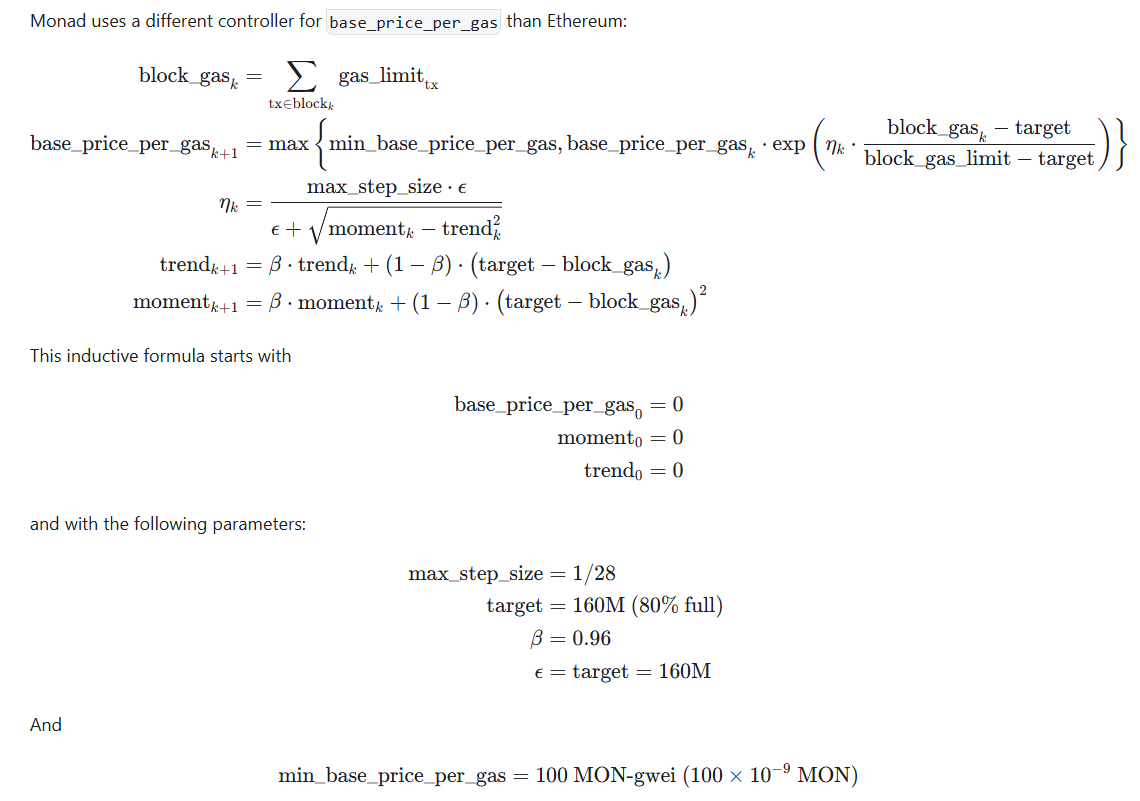
Source: Gas Pricing, Monad docs
The parameters shown imply a utilization target of 80% (target = 160M) under a block_gas_limit of 200M and a minimum base fee of min_base_price_per_gas = 100 MON-gwei. This design hard-floors transaction inclusion cost and sets fee dynamics through a volatility-sensitive controller; liquidation and arbitrage execution quality therefore depends on how quickly base fees reprice as blocks move above target utilization and whether the min base fee and repricing path remain compatible with liquidator margins during congestion. Relative to Ethereum’s base fee controller, Monad’s controller is configured to increase more slowly and decrease more quickly, with the stated objective of reducing the risk of blockspace underutilization caused by an overpriced base_price_per_gas.
1.2 Decentralization and Legal Evaluation
Monad is disclosed as two core entities: Monad Foundation (a memberless Cayman foundation company; ecosystem/governance facilitation) and Category Labs (protocol engineering; rebrand from Monad Labs on Dec 16, 2024). Foundation leadership is described as Keone Hon and Eunice Giarta (co-GMs) with a board including Petrus Basson, Keone Hon, and Marc Piano; Category Labs is led by James Hunsaker (CEO).
Legal Evaluation
Monad’s disclosed legal perimeter follows a common three-entity pattern that separates ecosystem stewardship, software development, and token distribution mechanics. The Coinbase sale disclosure identifies MF Services (BVI) Ltd. as the token sale seller and as a wholly owned subsidiary of the Monad Foundation, indicating that primary distribution activity is routed through a BVI vehicle.
Separately, Monad publishes a MiCA-format white paper, which functions as a disclosure document for EU audiences (issuer/offeror identity, token function, technical description, and risk factors). This improves documentation quality and comparability but does not itself resolve cross-jurisdiction classification risk, as token treatment remains regulator- and fact-pattern-dependent outside the MiCA disclosure framework.
Key legal monitoring items are therefore concentrated in (i) entity boundary clarity (which entity controls token distribution, incentives, and treasury actions), (ii) governance and control disclosures (board/management authority, delegation and upgrade processes), and (iii) disclosure consistency across primary-sale documentation and the MiCA white paper, particularly where representations about token rights, restrictions, conflicts, and distribution discretion affect regulatory interpretation and counterparty diligence.
Upgrades are executed as scheduled hard forks tied to client releases and activation timestamps; protocol “revisions” are activated at a future timestamp, and node operators are expected to upgrade ahead of that activation. MON holders do not currently have direct on-chain voting over upgrades; the white paper states governance participation is expected via validator delegation and notes there are no current plans for on-chain governance with MON.
Validators
As of early 2026, the network is operated by a validator set in which only the top 200 validators by total stake are active each epoch. Validator registration is stake-gated with a 100,000 MON minimum self-stake, and delegation is supported. Validator geographic dispersion spans 29 countries, including the United States (22.9%), the Netherlands (17.88%), Germany (15.5%), Finland (5.44%), and Singapore (5.18%), representing the largest share of delegated stake. Validators stake MON and are subject to penalties primarily through reward loss for downtime; current enforcement is not described as an active slashing regime. Terraswitch Network (19.3%), OVHS SAS (15.8%), and Hetzner Online GmbH (10.4%) are currently the three largest validators by stake. Specific staking parameters and the validator set composition continue evolving.

Source: Monad Validators, gmonads.com, June 8th, 2026
The network relies on a fixed set of 200 validators, with the top validator holding 12% of the stake.
Slashing
Current protocol documentation states that slashing is not live on Monad at this time; the enforced downside for validator downtime is loss of rewards for the validator and its delegators. This makes the present penalty regime primarily yield-based, with no in-protocol capital loss mechanism described as active. The lack of slashing adds an incentive risk layer, given the limited set of validators and the outsized influence the largest stakers can have on operations.
1.3 Activity Benchmarks
This section benchmarks whether Monad’s DeFi footprint is large enough to support a production money market without relying on incentive-driven flows. The focus is on balance-sheet size (TVL and stablecoin float), where liquidity is actually deployed (sector concentration), and whether the chain shows enough transactional throughput to keep liquidations and arbitrage functional during volatility states.
Network TVL
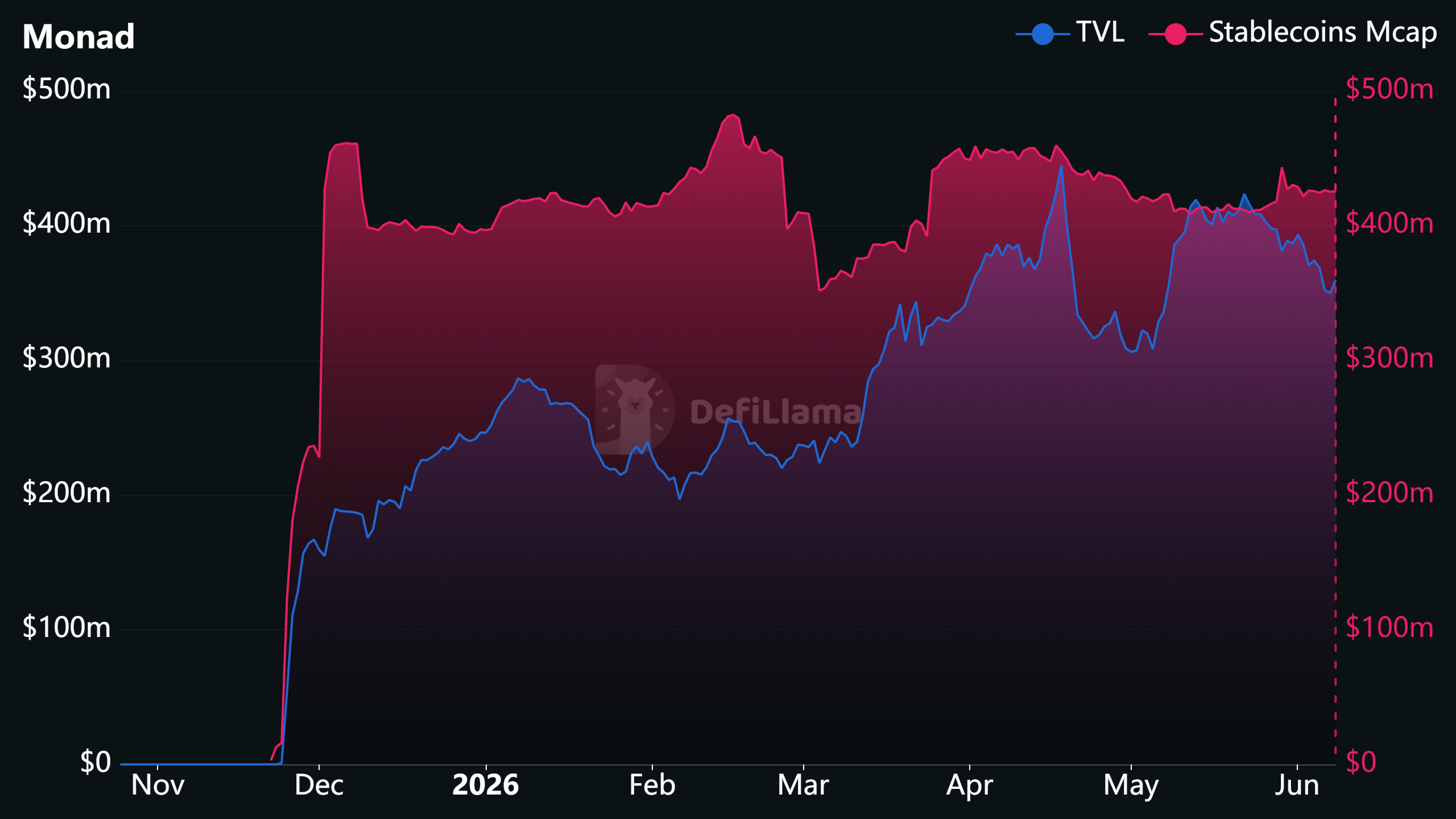
Source: Monad TVL, DefiLlama, June 8th, 2026
There’s currently around $359.5m in DeFi TVL and $425.7m of stablecoin supply on the chain. Bridged TVL is reported at $600m.

Source: Monad DeFi TVL, Dune, June 8th, 2026
At the time of writing, lending is the largest tracked DeFi segment at $328.6m TVL, led by Morpho ($123m), Euler ($86m), Curvance ($56m), and Neverland ($44m), which indicates an existing strong interest in lending-based protocols. Leading DEXs include Balancer v3 ($17m), Uniswap v4 ($14m), and Curve ($10m).
Network Activity
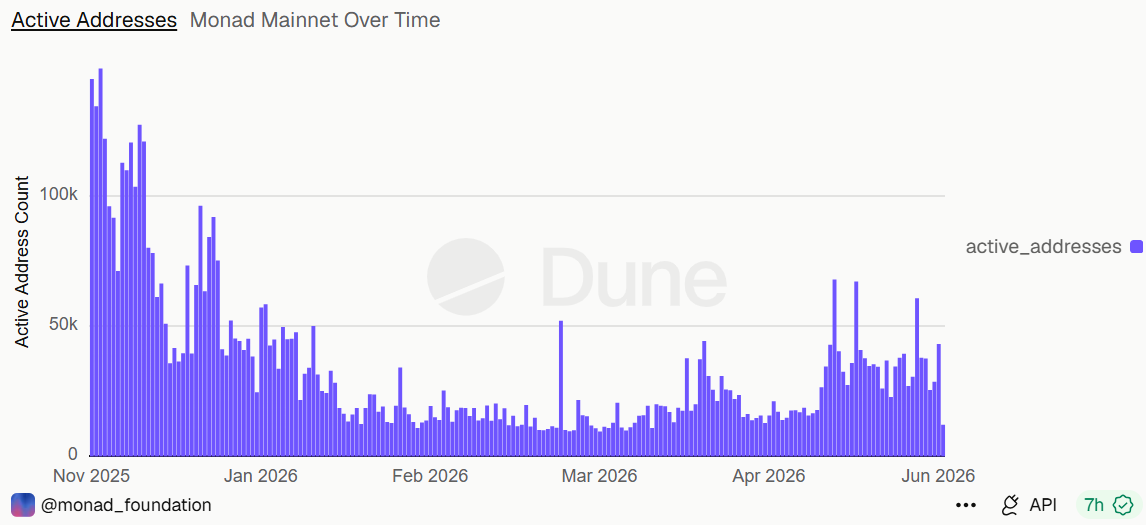
Source: Monad - Active Addresses, Dune, May 29th, 2026
The daily active user trend shows significant fluctuations and irregular bursts, with peaks reaching close to 150,000 users at launch, while the 7-day average remains at 9,000 new users.
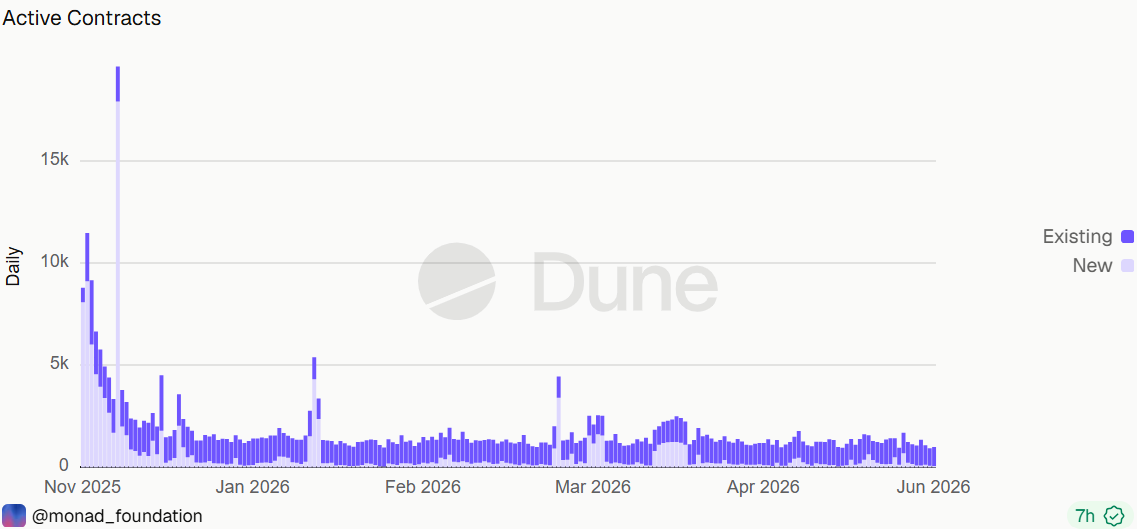
Source: Monad - Active Contracts, Dune, June 8th, 2026
Daily active contracts show a front-loaded spike at launch, with activity briefly reaching the high-teens thousands before rapidly compressing into a lower, steadier baseline.
A notable contract registration spike occurred on December 2nd, 2025, when 17,934 new contracts were created in a single day.
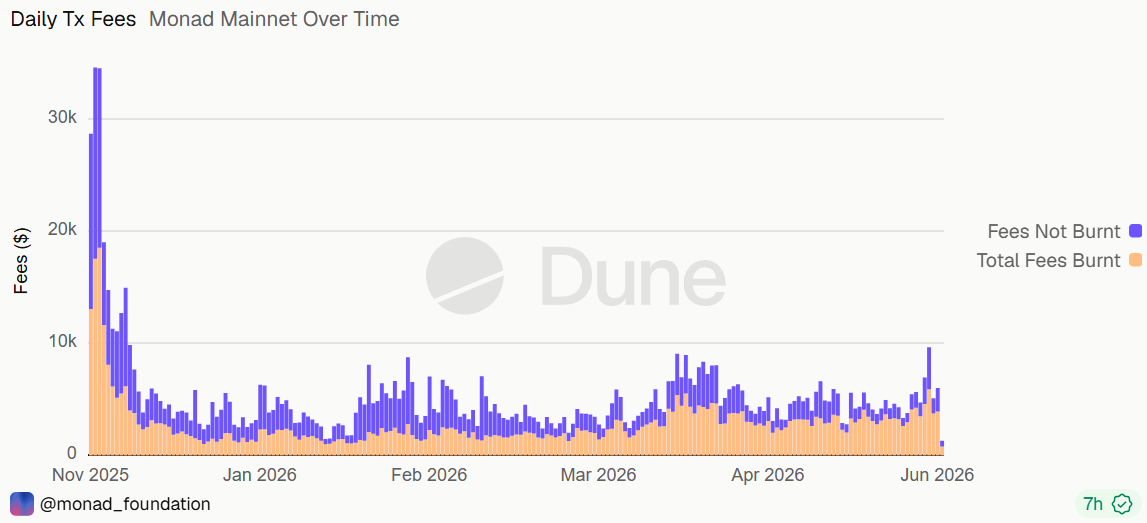
Source: Monad - Daily Tx Fees, Dune, June 8th, 2026
Daily transaction fees show an initial launch-driven spike in late November, where total fee spend briefly reached $35k per day, followed by a rapid compression into a stable baseline. From January onward, fees remain range-bound with intermittent bursts and a modest pickup in volatility around early February, but without returning to the initial launch peak.
1.4 Security
Monad’s infrastructure has undergone multiple independent security audits. 16 audits have been completed to date, including:
- Zellic (August - September, 2025):
- Compiler: 1 informational issue found. Issues were acknowledged and/or fixed.
- RPC: 4 medium, 1 low, and 1 informational issues were found. Issues were acknowledged and/or fixed.
- Consensus: 5 critical, 2 high, 1 medium, and 3 informational issues were found. Issues were acknowledged and/or fixed.
- Database: 3 informational issues were found. Issues were acknowledged.
- Execution: 1 high, 3 medium, 1 low, and 7 informational issues were found. Issues were acknowledged and/or fixed.
- Networking: 4 critical, 2 high, 2 medium, 1 low, and 1 informational. Issues were acknowledged and/or fixed.
- Spearbit (November, 2025): 1 critical, 15 high, 10 medium, 8 low, and 13 informational issues were found. Issues were fixed or acknowledged.
- Code4rena (September, 2025): 4 high and 7 medium risks were found.
- Ottersec (December, 2025 - March, 2026):
- BFT: 4 medium, 5 low, and 5 informational. Issues were acknowledged and/or fixed.
- Execution: 1 medium, 3 low, and 4 informational. Issues were acknowledged and/or fixed.
- JIT: 11 low and 6 informational. Issues were acknowledged and/or fixed.
- RPC: 3 low and 2 informational. Issues were acknowledged and/or fixed.
- DB: 1 high, 3 low, and 1 informational. Issues were either partially or fully resolved.
- Runtime Verification (March, 2026): 4 medium and 2 low severity findings. Issues were either partially or fully resolved.
- Perimeter (January - March, 2026)
- RPC & Execution: 1 high, 1 low, and 3 informational issues were found. Issues were either partially or fully resolved.
- Fuzzing Report: 1 high, 1 low, and 3 informational. Issues were either partially or fully resolved.
2. Network Market Outlook
2.1 Market Infrastructure
Bridges
Cross-chain infrastructure for Monad is available through messaging and bridging protocols, including Chainlink CCIP, which is listed as officially supported cross-chain infrastructure (via MonadBridge), deBridge, and LayerZero for omnichain bridging, alongside additional providers such as Wormhole, Hyperlane, Relay, LI.FI, and Across Protocol. A full provider summary can be found here, covering setups on Monad and links to architectural documentation.
Users should verify official interfaces and contract addresses before transferring assets and consider limiting transfer sizes to manage exposure.
Key assets bridged to Monad, their supported architecture includes:
A full token list of bridged assets can be found [here](GitHub - monad-crypto/token-list · GitHub), which contains all supported assets and the bridging infrastructure used on Monad mainnet.
 {
      "chainId": 143,
      "address": "0xaB6e5a0C3799d020c790D34F7B2C02639e238AF7",
      "name": "Syrup USDC",
      "symbol": "syrupUSDC",
      "decimals": 6,
      "extensions": {
        "coinGeckoId": "syrupusdc",
        "bridgeInfo": {
          "protocol": "Chainlink CCIP",
          "bridgeAddress": "0x33566fE5976AAa420F3d5C64996641Fc3858CaDB"
        },
        "crossChainAddresses": {
          "1": {
            "address": "0x80ac24aA929eaF5013f6436cdA2a7ba190f5Cc0b"
          },
          "8453": {
            "address": "0x660975730059246A68521a3e2FBD4740173100f5"
          },
          "42161": {
            "address": "0x41CA7586cC1311807B4605fBB748a3B8862b42b5"
          }
        }
Source: Monad tokenlist, syrupUSDC, Github, June 8th, 2026
Lending
- Morpho – Largest lending protocol by TVL.
- Neverland – Monad-native, built on Aave v3 architecture. Accounts for a significant portion of native lending activity.
- Gearbox
- Euler V2 – Deployed from day one with RedStone Oracle integration.
- Curvance – Monad’s lending layer for leveraged yield.
- Folks Finance (xChain) – Present on Monad (small in current snapshots).
- TownSquare – additional lending venue on Monad.
DEXs
RPC Node Services
RPC node services on Monad include Alchemy, Ankr, Blockdaemon, BlockPI, Chainstack, dRPC NodeCloud, Dwellir, Envio, GetBlock, OnFinality, Quicknode, Spectrum, Tatum, thirdweb, Triton One, and Validation Cloud.
Oracles
Critically, over 86 Chainlink feeds are available on Monad, including market reference and exchange rate feeds, which are used in Aave pricing schemas.
Wallets
Supported wallet types:
- Software: Phantom, Atomic Wallet, Backpack, Binance Wallet, Bitget Wallet, HaHa, Keplr, MetaMask, OKX Wallet, Rabby Wallet, Safepal, and Trust Wallet
- Hardware: Ledger, Safepal, and Tangem
- Institutional: Porto by Anchorage Digital and Utila
Toolkits
Foundry, Hardhat, and Solonet are currently supported development toolkits.
Indexers
- Common data: Allium, Birdeye Data Services, Codex, Dune Sim, GoldRush (by Covalent), Goldsky, Mobula, Moralis, Quicknode, Rarible, Sequence, SQD, SonarX, thirdweb, Unmarshal, Zerion.
- Smart contract indexers: Envio, Birdeye Data Services, Codex, Dune Sim, GoldRush (by Covalent), Goldsky, Mobula, Moralis, Quicknode, Rarible, Sequence, SQD, SonarX, thirdweb, Unmarshal, Zerion, The Graph
2.2 Liquidity Landscape
| Protocol |
Pairs |
| Uniswap v4 |
AUSD/USDC ($3.9M), MON/AUSD ($3.8M), WBTC/MON ($3.6M), MON/USDC ($2.6M), MON/WETH ($2.5M), USDC/WETH ($1.4M), USDC/cbBTC ($1.3M) |
| Curve |
cbBTC/WBTC/LBTC ($5.5M), AUSD/USDC/USDT0 ($3.4M), shMON/WMON/sMON/gMON ($615K), WBTC/LBTC/BTC.b ($273.1K) |
| Balancer |
wnUSDT0/wnAUSD/wnUSDC ($17.1M), syzUSD/wnAUSD ($625.9K), wnWMON/wnSHMON ($133.6K), wnSMON/wnWMON ($126.5K), wnGMON/wnWMON ($118.2K) |
Depth is concentrated in a handful of core pools on Uniswap v4, Curve, and Balancer, with a steep drop-off outside the top tier and limited redundancy across venues. This structure can support routine trading, but liquidation capacity at scale is constrained by pool-specific depth and the risk that activity bottlenecks through the same few routes during volatility.
It should be noted that the lion’s share of Balancer liquidity is in a single Wrapped Neverland pool (LP tokens), along with the remaining pairs with meaningful liquidity.
2.3 Ecosystem Resilience
As an independent L1, Monad’s security model differs from L2 deployments. It does not inherit Ethereum’s security and must maintain its own validator set and economic security. Key points:
- MonadBFT requires >2/3 honest stake weight. With 200 validators reported, the set is reasonable for a chain at this stage of its mainnet history but remains relatively untested under adversarial conditions.
- The optimistic parallel execution model is architecturally novel. While audited and open-source, production edge cases may still surface.
- TVL concentration in a small number of protocols (Uniswap, Curve, and Neverland account for a majority) means ecosystem resilience is tied to the health of these deployments.
- The open-source codebase (GPL-3.0) is a positive signal for auditability, as it allows independent parties to review, reproduce, and test client behavior.
2.4 Ecosystem Growth Potential
Monad is positioned as a high-throughput, EVM-compatible L1 that reduces integration friction for Ethereum-native applications and tooling. Monad chain supports full EVM bytecode compatibility and performance targets around 10,000 TPS with sub-second finality and very short block times (0.4 seconds per block), which expands the feasible design space for money markets and liquidation infrastructure that are otherwise constrained by latency and throughput.
A relevant consideration is the observed user drop-off after the initial launch period. On-chain activity indicators show an early spike followed by a step-down to a lower, more stable baseline, consistent with incentive- or novelty-driven activation that did not persist at initial levels. This increases reliance on a narrower set of power users and integrated applications for borrow demand, liquidation flow, and arbitrage, and raises sensitivity to changes in incentive schedules and venue-specific liquidity programs.
The network’s native gas token and staking asset, MON, implies a gas-economics model that is not dependent on ETH for fee payment. On ecosystem formation, Monad Foundation has disclosed an application-focused incentive matching program (Monad Momentum) aimed at retention and revenue metrics and tokenomics messaging that earmarks a material allocation for ecosystem development.
2.5 Major and Native Asset Outlook
Monad’s asset base is currently stablecoin-heavy, with ~$425.7m in stablecoin supply and 57.32% USDC dominance. Stablecoin float is large relative to DeFi TVL, implying a meaningful share of liquidity sits outside tracked DeFi venues rather than being intermediated on-chain.
Externally bridged inventory totals ~$600m, led by USDC (~$254m) and USDT0 (~$87m), with additional sizeable balances in major-asset derivatives such as wstETH (~$53m) and wrapped BTC variants including cbBTC (~$16m) and WBTC (~$9m). Native MON liquidity is not the primary driver of balance-sheet size at this stage; the effective risk footprint is therefore driven by stablecoin rails and ETH/BTC derivative liquidity and their ability to absorb stress flows.
2.6 Tokenomics
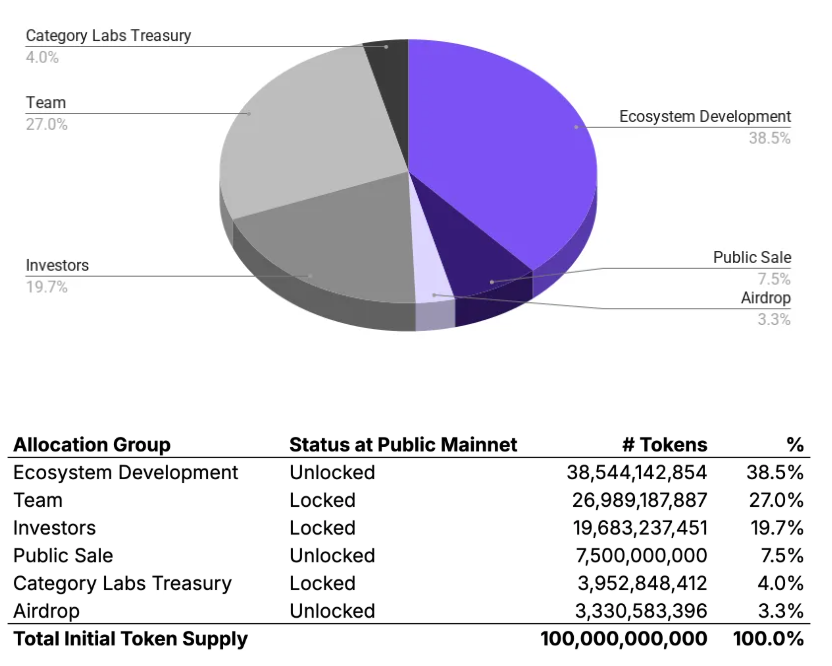
Source: Monad tokenomics, Monad docs, 2026
Monad states an initial supply of 100,000,000,000 MON and states the token will be inflationary via ongoing issuance to validators, with a fee-burning mechanism that can partially offset issuance depending on realized network fee volume. The published initial allocation framework assigns 38.5% to ecosystem development, 27.0% to the team, 19.7% to investors, 7.5% to a public sale, 4.0% to the Category Labs treasury, and 3.3% to an airdrop.
The dominant tokenomics risks are multi-year dilution and unlock overhang from large non-circulating insider and ecosystem allocations, plus discretionary distribution risk from the ecosystem budget; secondary uncertainty is the steady-state inflation outcome because the net supply path depends on usage-driven fee burn versus protocol issuance and staking participation.
3. Onchain discoverability
Monad maintains its official block explorer for real-time transaction, block, and validator monitoring. MonadScan, built by Etherscan via its Explorer-as-a-Service program, provides the standard Etherscan interface with contract verification and developer APIs. Additional explorers include SocialScan and MonadVision.
Network traceability is available on DefiLlama, Dune Analytics, Nansen, and Token Terminal.
4. Access Control
Network-level operations, upgrades, and administrative bounds are handled by the core client source code running on local validator nodes. Upgrades (such as modifying gas token costs, changing virtual machine specifications, or implementing new cryptographic precompiles) are managed via coordinated Software Releases. Revisions on Monad, commonly known as hard/soft forks on other chains, are coordinated with future timestamp activations. This allows validators to choose to accept the revision and upgrade ahead of time. Once the scheduled upgrade timestamp is reached, a supermajority of validators transition to the new behavior simultaneously, allowing the chain to upgrade without interruption.
As stated in section 1.2, Monad Revisions are effectively controlled by Category Labs, thus centralizing access control of the network with the engineering team behind Monad.
The MONAD_NINE upgrade (March 2026) represents the first major governance action post-mainnet, covering EVM memory cost changes (MIP-3), reserve balance checks (MIP-4), and Ethereum Fusaka compatibility (MIP-5). Mainnet change logs can be found here.
5. Impact of AAVE Deployment
The primary risks to Aave on Monad are linked to execution and finality assumptions under stress and to the operational dependencies introduced by cross-chain rails and oracle selection. Monad markets itself as a high-performance, EVM-compatible L1 with parallel execution and sub-second deterministic finality; in practice, parallelism is workload-dependent and degrades when many transactions contend for the same state, which is a relevant failure mode for liquidation-heavy periods where activity concentrates around a small set of collateral and liquidation contracts. Monad’s own materials also distinguish deterministic finality at two slots, which is a direct input into liquidation timing assumptions and MEV-driven execution quality.
The network has established core infrastructure categories required for an Aave deployment. Monad’s infrastructure directory lists multiple oracle providers that are active in the ecosystem, including API3, Band Protocol, Blocksense, Chainlink, Chainsight, Chronicle, Pyth Network, RedStone, Stork, Supra, Switchboard, Terminal 3, UMA Protocol, and others; for Aave this creates optionality but also makes oracle standardization and operational dependency mapping a first-order design input because risk quality becomes feed- and operator-specific.
On bridging, Monad operates a native bridge interface that is powered by Wormhole, and Wormhole states that the bridge uses Wormhole NTT together with Axelar General Message Passing as infrastructure to move assets such as MON and ETH between Monad and Ethereum. This implies that a meaningful share of initial asset inflows and potential stress outflows are coupled to Wormhole and Axelar liveness and security assumptions.
Liquidity depth remains a gating factor for liquidation efficiency and bad-debt outcomes. At launch, the “Aave effect” can itself attract incremental liquidity and accelerate TVL growth, but this effect is not guaranteed to translate into durable secondary-market depth at later stages. Current liquidity indicates meaningful balance-sheet capacity on the chain, but it does not by itself guarantee resilient secondary-market depth in the specific collateral venues liquidators rely on during fast repricings. In this context, supply caps and asset selection would typically be the main control surface to align liquidation feasibility with observed venue depth and oracle coverage, at the cost of constraining early revenue potential.
6. Asset suggestions
6.1 Overview
Individual asset-level risk reviews for each asset will be published in a follow-up post.
6.2 Asset parameters
General Configuration
| Parameter |
USDT0 |
USDC |
GHO |
USDe |
mUSD |
AUSD |
wETH |
cbBTC |
wstETH |
weETH |
syrupUSDC |
sUSDe |
| Isolation mode |
No |
No |
No |
No |
No |
No |
No |
No |
No |
No |
No |
No |
| Borrowable |
Yes |
Yes |
Yes |
Yes |
Yes |
Yes |
No |
No |
No |
No |
No |
No |
| Collateral enabled |
Yes |
Yes |
Yes |
No |
No |
No |
Yes |
Yes |
No |
No |
No |
No |
| Supply Cap |
100,000,000 |
75,000,000 |
20,000,000 |
60,000,000 |
100,000,000 |
20,000,000 |
40,000 |
1,000 |
35,000 |
30,000 |
40,000,000 |
60,000,000 |
| Borrow Cap |
100,000,000 |
50,000,000 |
18,000,000 |
50,000,000 |
50,000,000 |
18,000,000 |
36,000 |
- |
- |
- |
- |
- |
| Debt Ceiling |
- |
- |
- |
- |
- |
- |
- |
- |
- |
- |
- |
- |
| LTV |
75.00% |
75.00% |
75.00% |
- |
- |
- |
80.50% |
73.00% |
- |
- |
- |
- |
| LT |
78.00% |
78.00% |
78.00% |
- |
- |
- |
84.00% |
78.00% |
- |
- |
- |
- |
| Liquidation Bonus |
7.50% |
7.50% |
7.50% |
- |
- |
- |
5.50% |
7.00% |
- |
- |
- |
- |
| Liquidation Protocol Fee |
5% |
5% |
5% |
- |
- |
- |
5.5% |
5.5% |
- |
- |
- |
- |
| Variable Base |
0.0% |
0.0% |
0.0% |
0.0% |
0.0% |
0.0% |
0.00% |
- |
- |
- |
- |
- |
| Variable Slope1 |
4.0% |
4.0% |
4.0% |
4.0% |
4.0% |
4.0% |
2.20% |
- |
- |
- |
- |
- |
| Variable Slope2 |
40.0% |
40.0% |
40.0% |
40.0% |
40.0% |
40.0% |
20.0% |
- |
- |
- |
- |
- |
| Uoptimal |
90.0% |
90.0% |
90.0% |
90.0% |
80.0% |
80.0% |
90.0% |
- |
- |
- |
- |
- |
| Reserve Factor |
10.0% |
10.0% |
10.0% |
25.0% |
10.0% |
10.0% |
15.0% |
7.0% |
5.0% |
45.0% |
10.0% |
10.0% |
| Stable Borrowing |
Disabled |
Disabled |
Disabled |
Disabled |
Disabled |
Disabled |
Disabled |
Disabled |
Disabled |
Disabled |
Disabled |
Disabled |
| Flashloanable |
Yes |
Yes |
Yes |
Yes |
Yes |
Yes |
Yes |
Yes |
Yes |
Yes |
Yes |
Yes |
| Siloed Borrowing |
No |
No |
No |
No |
No |
No |
No |
No |
No |
No |
No |
No |
| Borrowed in Isolation |
No |
No |
No |
No |
No |
No |
No |
No |
No |
No |
No |
No |
| E-Mode |
1, 2, 3 |
1, 2, 3 |
1, 2, 3 |
1, 2, 3 |
1 |
1, 2, 3 |
4, 5 |
- |
4 |
5 |
1 |
2 |
E-Mode 1: Maple syrupUSDC
| Parameter |
syrupUSDC |
USDT0 |
USDC |
GHO |
mUSD |
AUSD |
| Collateral |
Yes |
No |
No |
No |
No |
No |
| Borrowable |
No |
Yes |
Yes |
Yes |
Yes |
Yes |
| Max LTV |
90.00% |
- |
- |
- |
- |
- |
| Liquidation Threshold |
92.00% |
- |
- |
- |
- |
- |
| Liquidation Bonus |
4.00% |
- |
- |
- |
- |
- |
E-Mode 2: Liquid Leverage
| Parameter |
sUSDe |
USDe |
USDT0 |
USDC |
GHO |
AUSD |
| Collateral |
Yes |
Yes |
No |
No |
No |
No |
| Borrowable |
No |
No |
Yes |
Yes |
Yes |
Yes |
| Max LTV |
90.00% |
90.00% |
- |
- |
- |
- |
| Liquidation Threshold |
92.00% |
92.00% |
- |
- |
- |
- |
| Liquidation Bonus |
4.00% |
4.00% |
- |
- |
- |
- |
E-Mode 3: Lido Yield Maximiser
| Parameter |
wstETH |
wETH |
| Collateral |
Yes |
No |
| Borrowable |
No |
Yes |
| Max LTV |
94.00% |
- |
| Liquidation Threshold |
96.00% |
- |
| Liquidation Bonus |
1.00% |
- |
E-Mode 4: EtherFi Yield Maximiser
| Parameter |
weETH |
wETH |
| Collateral |
Yes |
No |
| Borrowable |
No |
Yes |
| Max LTV |
93.00% |
- |
| Liquidation Threshold |
95.00% |
- |
| Liquidation Bonus |
1.00% |
- |
Liquidity Requirements
The liquidity requirement for each proposed asset is defined as exit (swap) liquidity available on-chain, not total value locked. Each requirement is sized as a cover ratio applied to the asset’s supply cap: 10% across the general asset set, 5% for wstETH and weETH (collateral only within E-Mode against wETH). Swap depth is measured along the path a liquidator would realistically execute: stablecoins stable-to-stable, LSTs to wETH, and other volatile assets to the deepest available stablecoin.
| Asset |
Supply cap |
Cap (USD) |
Cover ratio |
Required exit liquidity |
| USDT0 |
100,000,000 |
100.00M |
10% |
10.00M |
| USDC |
75,000,000 |
75.00M |
10% |
7.50M |
| GHO |
20,000,000 |
20.00M |
10% |
2.00M |
| USDe |
60,000,000 |
60.00M |
10% |
6.00M |
| mUSD |
100,000,000 |
100.00M |
10% |
10.00M |
| AUSD |
20,000,000 |
20.00M |
10% |
2.00M |
| syrupUSDC |
40,000,000 |
40.00M |
10% |
4.00M |
| sUSDe |
60,000,000 |
60.00M |
10% |
6.00M |
| wstETH |
35,000 |
72.01M |
5% |
3.60M |
| weETH |
30,000 |
54.51M |
5% |
2.73M |
| wETH |
40,000 |
66.35M |
10% |
6.64M |
| cbBTC |
1,000 |
61.76M |
10% |
6.18M |
| Total |
|
729.63M |
|
~66.64M |
Disclaimer
This review was independently prepared by LlamaRisk, a community-led non-profit decentralized organization funded in part by the Aave DAO. LlamaRisk is not directly affiliated with the protocol(s) reviewed in this assessment and did not receive any compensation from the protocol(s) or their affiliated entities for this work.
The information provided should not be construed as legal, financial, tax, or professional advice.
