[TEMP CHECK] Focussing the Aave V3 Multichain Strategy

[TEMP CHECK] Focussing the Aave V3 Multichain Strategy

Author: ACI

Date: 19/11/2025


Summary

This Temp Check proposes an updated multichain strategy for Aave V3 that:

  1. Increases the Reserve Factor on underperforming instances to boost revenue.
  2. Winds down the zkSync, Metis, and Soneium instances.
  3. Establishes a clear $2,000,000 annual revenue floor for new instance deployments.

Motivation

Aave maintains several V3 instances which each carry operational costs and present risk surface area. It is believed that the revenue generated by several of these instances is not sufficient to offset the costs and risks they incur. Over time the multichain expansion strategy has seen mixed results and as expressed in the recent State of the Union post, we hold the view that it has not been the total success which it was hoped to be. We instead believe that Aave should focus on those chains which present the highest opportunity for revenue generation going forward and take remedial action to improve revenue on instances which are currently underperforming.


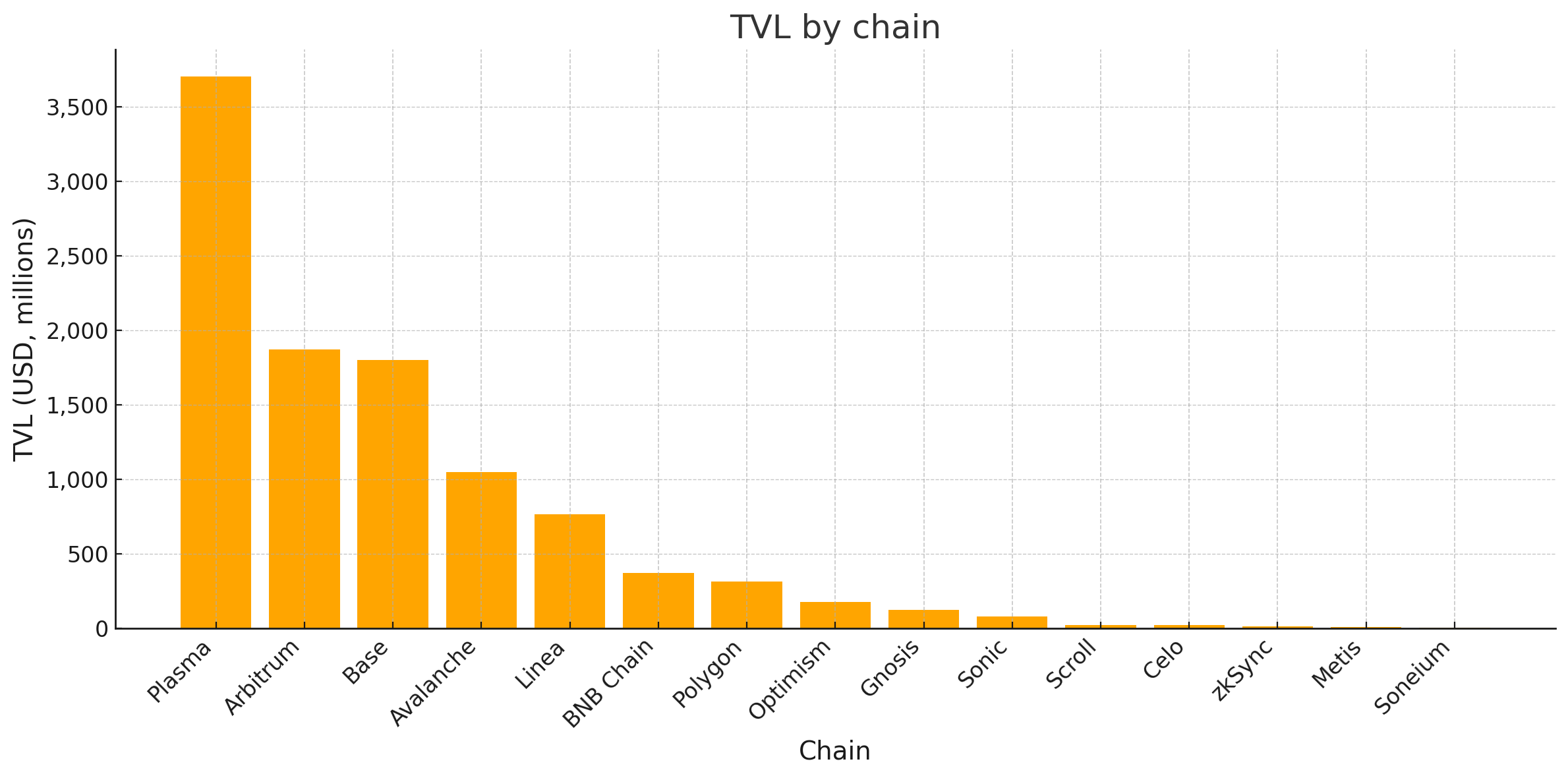
Figure 1 - TVL by chain, as of 11/11/2025 and excluding Ethereum mainnet instances.


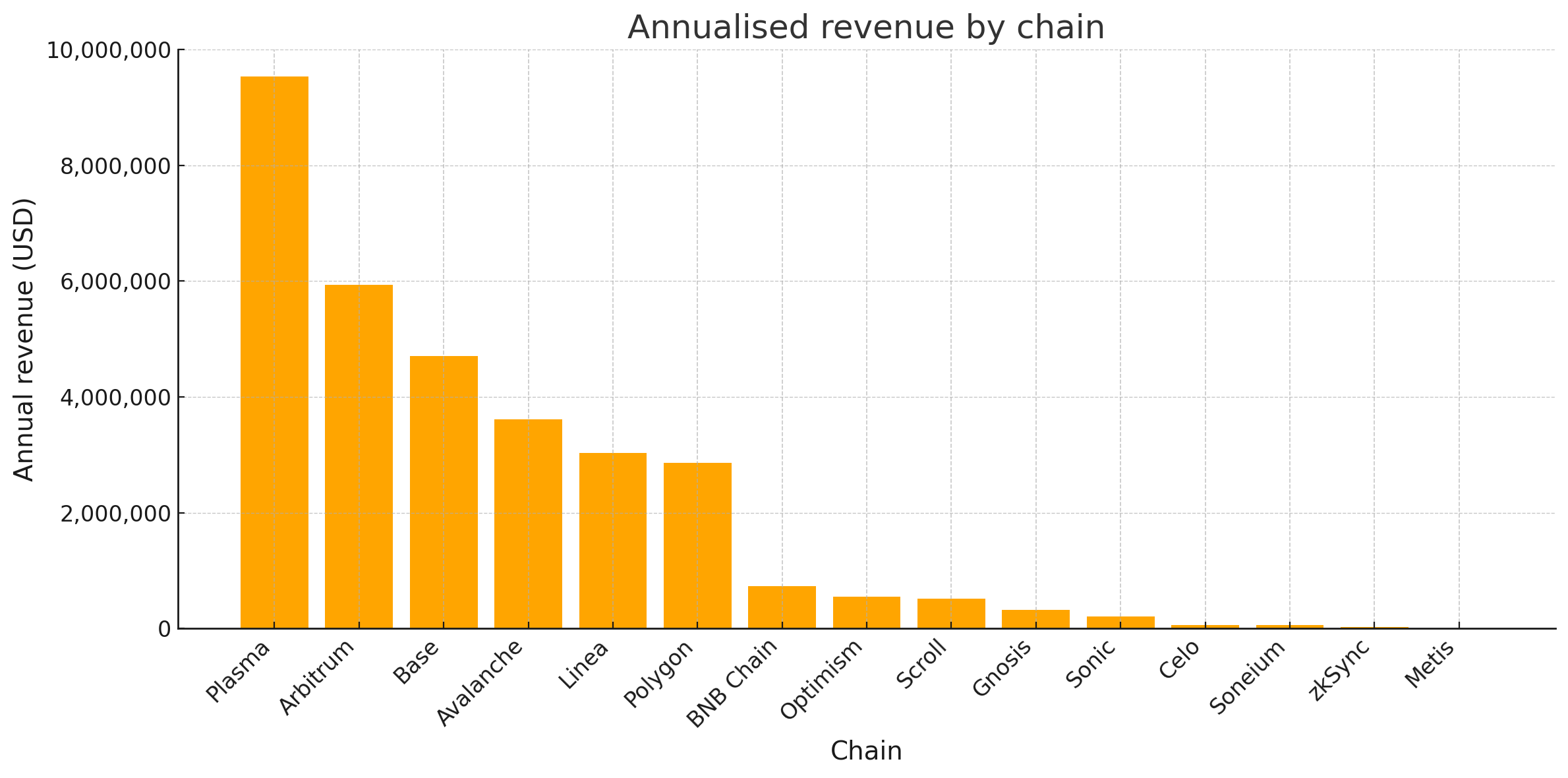
Figure 2 - Annualised revenue by chain, calculated based on past 30 days rolling revenue as of 11/11/2025 and excluding Ethereum mainnet instances.

Table 1 - Contribution of instances to Aave V3 TVL and revenue.

Chain Rolling 30D Revenue (USD) Annualized Revenue (USD) TVL (USD, millions) TVL as % of total Revenue as % of total
Ethereum $11,693,762 $142,274,104 $44,260 81.10% 81.60%
Plasma $783,430 $9,531,732 $3,700 6.78% 5.47%
Base $386,687 $4,704,692 $1,800 3.30% 2.70%
Arbitrum $487,627 $5,932,795 $1,870 3.43% 3.40%
Avalanche $296,886 $3,612,113 $1,050 1.92% 2.07%
Linea $249,104 $3,030,765 $766 1.40% 1.74%
Polygon $235,421 $2,864,289 $315 0.58% 1.64%
BNB Chain $60,121 $731,472 $373 0.68% 0.42%
Optimism $44,914 $546,454 $179 0.33% 0.31%
Scroll $42,398 $515,842 $23 0.04% 0.30%
Gnosis $26,293 $319,898 $123 0.23% 0.18%
Sonic $16,619 $202,198 $81 0.15% 0.12%
Celo $4,796 $58,351 $23 0.04% 0.03%
Soneium $4,269 $51,940 $4 0.01% 0.03%
zkSync $1,682 $20,464 $14 0.03% 0.01%
Metis $275 $3,346 $8 0.01% 0.00%
Total $14,334,284 $174,400,455 $54,589

As can be seen from the above plots and table, there are several instance deployments which are significantly underperforming from both a revenue and TVL point of view.

Reserve Factor Increases on Underperforming Instances

We propose that Reserve Factors will be set at an increased floor on all underperforming instances, currently generating less than $3M annualized revenue, namely: Polygon, Gnosis, BNB Chain, Optimism, Scroll, Sonic, and Celo. Full details of Reserve Factor adjustments for all affected chains and assets will be provided at ARFC stage.

Table 2 - Recommended Reserve Factor floors.

Asset category Reserve Factor
Stablecoins (excl. USDC/USDT) 25%
WETH 20%
USDC / USDT 15%
GHO 10%

If no meaningful improvement in revenue is observed within the next 12 months following these RF adjustments, ACI will consider initiating offboarding procedures for the affected instances in order to focus resources exclusively on current and future high-revenue deployments.

Shutdown of Aave V3 on the three lowest revenue instances

The zkSync, Metis, and Soneium instances have proven to lack product market fit, with annualized revenue of approximately $3,000-50,000. In addition to the low revenue, some of these chains require additional engineering effort for any new asset onboardings, which, given current service provider workload and low pay-off, is not currently feasible.

Policy for Future Aave V3 Deployments

We would like to highlight the significant value an Aave deployment provides to a new chain. As the largest DeFi protocol, the value and stimulating effect on the onchain ecosystem that a properly planned Aave deployment can bring is significant.

The work involved in a deployment and the substantial ongoing effort from service providers and governance participants has at times been under appreciated, yet in light of the above revenue numbers we must bring this back into focus. The upfront and recurring costs mean the DAO must prioritize deployments that generate sufficient revenue to justify the time and risk involved.

We therefore propose that for any new Aave deployment the chain on which we are deploying guarantees a revenue floor of $2m per annum for all new deployments.

Conclusion

We believe that the above remediation measures will help to focus the DAO on high revenue opportunities, ensure Aave shares in upside from successful instance deployments, reduce the number of low value deployments going forward, ensure that Aave is fairly compensated for the value it brings to our partners, and reduce risk and operational overhead by offboarding poor performing instances.

Disclaimer

ACI is not presenting this proposal on behalf of any third party and is not being compensated for creating this proposal.

Next Steps

  1. Period of comment on this TEMP CHECK.
  2. TEMP CHECK Snapshot vote.
  3. If TEMP CHECK is a YAE, publish a standard ARFC, collect community & service providers feedback before escalating proposal to ARFC snapshot stage.
  4. If the ARFC snapshot outcome is YAE, publish an AIP vote for final confirmation and enforcement of the proposal.

Copyright

Copyright and related rights waived via CC0.

11 Likes

While this is a Temp check, we will appreciate @TokenLogic feedback on this proposal as it’s relevant for their scope.

Broader community feedback is also welcome.

2 Likes

Hello and thank you for this (long overdue) proposal.
If I didn’t already know that ACI is working on it, I would have created something myself.

Let’s break it down on the different topics.

  1. Increases the Reserve Factor
    I fully support this measure. From the numbers in this proposal (which you can check live here Aave Analytics | TokenLogic) its clear that the only way to create at least a little bit of revenue, is to increase the RF. If there is no demand, the DAO has to take a bigger cut from the pie.

  2. Winding down instances
    It is absolutely clear that zkSync, Metis and Soneium aren’t a success for the DAO at all. Its only a big cost factor from deployment to asset listing to security checkups. All of them had several months or years to prove themselves. But there is no market fit, and so there is no need to host an Aave instance.
    I would also like to add other instances to the named ones, these are:
    CELO
    EtherFI (whiich is not listed in the table above, but still has an Aave market)

Both are very low revenue and TVL instances.
As of today, Celo is only sitting at roughly 57m.


And the chart from Defillama is showing the general trend for this chain.

For EtherFi the situation is actually different. They pivoted and their TVL is growing, but still the instance does not make sense in the way it exists currently. If EtherFI is interested in creating a special instance for their credit card product, there might be an interesting usecase. But as of now, the instance is not needed and only needs to be maintained by SP.

If EtherFI is interested they should come to the forum and propose a model that is benefitting them but also the DAO.

  1. Establishes a clear $2,000,000 annual revenue floor for new instance deployments
    For many years the DAO has basically accepted every proposal for an instance deployment and L1 and L2s. In the beginning this strategy helped to grow the protocol but overtime it was clear that thousands of L2 aren’t needed at all to scale Ethereum, which also means there is no need to have Aave on every chain out there. Focusing on the winner, like recently on Plasma, is enough.

Overall I support the threshhold of 2m annual revenue floor, although I would increase it to 2.5m$.
But how do we as a DAO make sure this is gonna happen? In my opinion there need to be clear rules around this framework.
We have had many comittments in the past, where teams said they will “bring hundreds of millions in TVL and big amounts of borrowings” which in the end never happened.

Thats why I want to add the following to this proposal @ACI.

A team, that wants to have an Aave deployment needs to guarantee a revenue floor of at least 2m$/2.5m$ per year. If this revenue isn’t there, these teams commit to deliver the rest of 2m$/2.5m$ floor - revenue made so far = Committment from these teams

This committment should should benefit the DAO but also Aave token holder.
Thats why i propose a split payment of 50/50 in GHO and AAVE token bought from the open market and send to the Aave: Treasury Collector V2 | Address: 0x464C71f6...9e5d6e18c | Etherscan or if @TokenLogic thinks another collector is better, then to this one.
The GHO can be used for payments and growth strategies and the Aave token help boost the buyback program.

Many other teams and protocols already charge fixed or flexible amounts of money to come to a chain. Aave should follow. Aave has proven to be the leader in its verticale and any great business out there is charging money, so should we. This will decrease governance workload, but also increase efficiency and hopefully as well revenue.

EDIT: Payment should not happen in a native token, only in stablecoins

8 Likes

Hello,

Sorry for the late answer.

Agreed, zkSync, Metis, and Soneium are not getting traction. Soneium is worse because they committed to a large incentive program and delivered nothing.

Celo has a high user count and is low maintenance; I’m not yet in favor of deprecation of this instance.

Etherfi: I would like to propose to the DAO to give ownership of the current instance to the Etherfi team to host their successful cash product in exchange for a 20% revenue share. They seem to have success there, and it would be a clean wind down for us on this network.

$2.5M is a lot of money and will close a few doors in favor of competitors, but when we look at the numbers, the SPs and our brand aren’t cheap, and $2.5M is barely a couple percent of our global revenue, so it seems like a reasonable floor.
When we consider what Etherscan, Chainlink, and other infrastructure partners charge networks per year, it’s actually a decent pricing.

I’m in favor, with the ability to bend the rules for strategic deployments for Aave (CeDeFi integrations, BD opportunities).

5 Likes

Does 20% of a potential revenue worth the creation of a competitor ? I’m not sure, especially on Ethereum. To me, it can make sense if the instance is not maintained by DAO SPs and if this instance lists assets that do not directly go into competition with the Core instance. Otherwise, it is a waste, getting 20% of the 100% that we can have.

2 Likes

While I agree it is a lot, its still cheap compared to others, like the ones you mentioned for example.
The question we should ask ourselves is, do we want to go the “everyone can afford an Aave deployment” way and hope they get enough traction, or do we say we are the kingmaker and anyone who wants to go with Aave, has to pay a price for the best place to get and park liquidity?
We have seen it multiple times now, anyone choosing Aave, doesn’t matter if its an asset or a chain deployment, experienced the Aave effect.
So I do think its fair to ask for this amount and any chain, that isn’t able to generate (this) substantial revenue, is designated to die anyway.
We have followed the multichain path for several years with always taking the risk upfront, now its time to change this.

I also agree that exceptions can be made if presented to the DAO upfront.

I also would like to know what the rest of the DAO thinks of my proposal that the payment shall be made in GHO and Aave token.

Also want to echo @Nandy.eth comment.
What would be the exact terms for this Etherfi instance? Who will manage it etc?
This needs to be clarified before moving forward.

3 Likes

I agree with these terms. We don’t want to be paid on the chain governance token that is probably worth nothing or drop significantly after a few months.

3 Likes

Hello everyone.
In my opinion, it is stratwgically unwise to reduce the number of supported blockchains. At a time when most dApps aim to be available on as many networks as possible and consider a multichain approach one of their key priorities, the proposal to limit support feels like a step backwards.

If we take a close look at the criterion “to stop supporting a network if annual revenue is below $2,000,000 (or even $2,500,000, as some are already suggesting),” then according to Table 1, as early as next year Aave would have to discontinue support for: Polygon, BNB Chain, Optimism, Scroll, Gnosis, Sonic, Celo, Soneium, zkSync, and Metis.
Additionally, with liquidity mining and incentive programs ending, the revenues for Linea and Plasma will also fall below this threshold.

As a result, instead of the 16 networks supported today, Aave would effectively remain on only 4 networks (ethereum, base, arbitrum, avalanche). This would drastically reduce Aave’s presence across the ecosystem and significantly shrink its potential user base.
Such concentration goes against the broader market trend, where multichain expansion is viewed as a key driver of growth, and most projects are doing everything they can to be available on more chains - not fewer.

1 Like

I’m forward looking and I think about what 2030 looks like and whether Aave still matters. Many of the chains Aave expanded to already lost users, liquidity and purpose. Raising reserve factors won’t bring dead markets back to life. By 2030 most chains we see today will be gone; Aave will survive but only on a few networks that actually matter, like Ethereum, a couple dominant L2s and maybe one or two corporate chains with real distribution.

The real DeFi users by then won’t be people hopping across random multi chains. It will be from real institutional, banks, and large onchain credit markets that prefer to operate on a small number of deep, reliable networks. For Aave to still be strong in that future, it needs to slim down now and avoid repeating the overextended expansion we saw in 2023-2024. So, yeah.. by this logic, as a token holder, I’m fine with 10 more networks winding down next year. We gotta move forward man, I don’t see many chains from 2017 today anymore but users just migrate and we’re still here.

2 Likes

The current proposal has been escalated to TEMP CHECK Snapshot.

Vote will start tomorrow, we encourage everyone to participate.

1 Like

Thank you ACI for initiating this refocus of the Aave multichain strategy.
TokenLogic supports the intent of the proposal and the below provides financial insights into the performance of each respective Aave deployment.

Aave currently operates on 18 chains, supporting 21 instances of which the 9 worst performing instances generated roughly $2M revenue for the DAO year to date.

image
This table represents the cumulative revenue of the 7 instances mentioned above accounting for less than $2M revenue YTD.

Our analysis indicates that a significant share of these deployments are structurally non-viable and collectively represent only ~1.5% of total protocol revenue.
At the same time, they consume meaningful monitoring bandwidth, risk assessment capacity, and security surface that the DAO must ultimately absorb.

Below we present our view about each of the instances.


1. Structural Non-Viability: zkSync, Metis, Soneium

We agree with ACI about those three instances, they can be deprecated.

Across each instance the borrow demand has been persistently very low for the last year. The chart below shows the borrow activity of zkSync spiked during the very short incentive campaign from the chain.

Screenshot 2025-11-23 at 21.37.19
Borrow Demand on zkSync since launch

Under the ongoing risk update from @chaoslabs, core assets of these instances such as ZK and METIS will be deprecated. Future revenue potential is therefore structurally zero, not likely to be a cyclically low and therefore, this instance should be sunset.

Conclusion:
Without a forward path to improving the economic outlook it is unlikely Aave DAO will recover the deployment costs. Current revenue generation is insufficient to support these instances on a standalone basis and therefore, we support deprecating these instances.

Screenshot 2025-11-23 at 21.46.20


2. Celo, Chain With User Value

Celo is a unique case within the multichain strategy. It brings many small, real users to Aave and is currently supported by an incentive program designed to boost liquidity and adoption. This user base provides community value, but from a financial and risk-adjusted perspective the situation is more complex. Borrow demand on Celo has remained minimal for months, and TVL has plateaued at levels that do not appear capable of scaling into sustainable revenue.

image
Borrow volume on Celo since the launch of the instance

With the stricter risk parameters being introduced for CELO, Celo is also set to lose a bit of its little borrowing activity. Compounding this, the chain currently lacks high-quality, large-scale native assets that could redefine its market or generate significant new demand. cUSD and cEUR need to make a big push growth wise.

For these reasons, our view is that Celo should not be removed abruptly, but it requires a time-boxed runway with explicit performance expectations. This should include measurable KPIs around borrow activity, the continuation and scale of incentives from the Celo ecosystem, and potentially the listing of safe, yield-bearing collateral if viable options exist. Without demonstrable progress against such metrics, continued support for the instance becomes economically unjustifiable.


3. Sonic, Potentially Revivable

Sonic has faced challenges in recent months, particularly following the conclusion of its airdrop campaign and the ecosystem-wide impact of the Balancer/Beets exploit. These events temporarily reduced activity and liquidity across the chain, but they do not alter the underlying potential of the ecosystem or its capacity to rebound. Importantly, the Sonic team has remained fully engaged throughout this period and has demonstrated a clear willingness to deploy incentives and work collaboratively to restore momentum.

image
Borrow volume on Sonic instance since launch

Aave itself was one of the largest beneficiaries of Sonic’s recent incentive programs, and the additional support directed toward our markets reflects a strong commitment from the Sonic community. For this reason, we do not believe that too aggressive measures would be constructive or aligned with the spirit of partnership that both sides have shown so far. Instead, this is a moment to coordinate more closely, refine the strategy, and accelerate efforts to rebuild sustainable borrower activity.

Our view is that the Sonic instance remains fully recoverable and can return to profitability with targeted support. To ensure progress, we recommend structuring the next phase around explicit, funded commitments that reinforce liquidity, improve incentives, and enable the listing of strategic collateral where appropriate.


4. Scroll, Revenue Supported by Aggressive RF Settings

Scroll had a lot of traction and a great run up until its TGE, Aave was the best place to get exposure to the airdrop. But on the back of that, everything has been going down and very fast. There hasn’t been any activity from the ecosystem to try to bootstrap and grow some native projects nor to be proactive in the listing of new assets on the protocol.

image
borrowing volume on the Scroll instance

Scroll’s recent uptick in revenue is entirely the result of exceptionally high reserve factors (50%) applied across ETH, wstETH, and USDC, levels far above the adjustments being proposed in this temp check.

image
2025 Revenue from the Scroll instance, we can see the result of the High RF proposal in the chart

This configuration is not indicative of organic growth or borrower demand; rather, it resembles the soft-shutdown mechanism previously used on Aave v2, where extreme RF settings were applied to encourage migration and reduce activity.

In practical terms, the revenue improvement on Scroll is manufactured. It is the predictable outcome of imposing unusually high RF rather than the result of meaningful market traction. And in resulted in outflows at the start of November. Under normal reserve factor conditions, Scroll’s revenue profile would place it alongside zkSync, Metis, and Soneium, chains that are structurally unable to support sustainable lending markets.

Our view is that Scroll’s fundamentals do not justify maintaining the instance in its current form and should be deprecated with zkSync, Metis and Soneium.

5. Optimism: Limited Differentiation, Strong Strategic Importance

Compared to Base or Arbitrum, the Optimism instance currently does not display strong differentiation in terms of collateral, leverage opportunities, or market behaviour. The assets and user profiles largely mirror those found on the larger L2s, but with lower liquidity and more modest borrow activity. As a result, the instance has not yet generated the depth of usage that would naturally justify operating a standalone deployment from a purely financial or liquidity-efficiency perspective.

image
Borrow volume on Optimism has been quite consistent since its inception

That said, Optimism occupies a unique and strategically important position within the broader Ethereum ecosystem. As the foundational chain of the Superchain, it has played a central role in distributing grants and supporting ecosystem growth for the past few years. Navigating this landscape has not always been straightforward for Aave, particularly given that several prominent actors within the Superchain alliance are closely aligned with competing lending protocols. These dynamics have made it more challenging for Aave to expand its footprint and capture meaningful borrow demand on OP Mainnet.

From our perspective, fully shutting down the Optimism market would be counterproductive and would likely strengthen competitors rather than benefiting the DAO. Maintaining a presence within the Superchain is strategically valuable, both to preserve optionality and to ensure Aave remains part of an ecosystem that continues to grow in influence.

We remain committed to supporting and developing activity on Optimism and within the broader Superchain. The DAO has already deployed significant resources across Superchain-linked environments(particularly through Base, and more recently through the Ink network) and we believe continued engagement is the right approach.


6. Gnosis, Valuable Ecosystem, Weak Activation

The Gnosis ecosystem has been a consistent source of innovation, producing novel primitives such as EUR-denominated stablecoin markets. Aave has historically supported this ecosystem, even going so far as to redirect revenue to help bootstrap adoption and stimulate early activity. Despite these collective efforts, borrow demand on Gnosis is scaling very slowly and revenue generated for the DAO remains low.

image
Gnosis borrowing activity since inception, worth noting that it remained close to ATH even after the last few weeks’ crash

There are, however, recent indications within Gnosis governance that the ecosystem is seeking to re-energise growth and expand its economic footprint. It would be interesting to set clear KPIs around borrowing activity, liquidity depth, and the level of ecosystem commitment. To reassess the state of that instance.

image
Gnosis instance revenue, growing but still very small


7. Polygon, Revenue-Positive but Declining

Polygon remains one of the few long-tail chains that continues to deliver more than respectable revenue for the DAO, and for this reason we do not believe it should be included in the scope of this proposal. When considering both the v3 and v2 deployments together, Polygon contributes more than $3.7M in YTD revenue.

image
YTD revenue from both Polygon instances

While it is true that Polygon v2’s revenue is driven only by highly aggressive reserve factor settings, this still represents tangible income for the DAO. Moreover, a significant share of the capital remaining on v2 is either effectively immobile due to key loss or expected to migrate naturally to v3 over time.

In this context, Polygon stands apart from the other chains discussed in the proposal. It already clears the $2M revenue floor comfortably and is better positioned than most ecosystems to meet a potential $2.5M threshold, even without substantial structural changes. The instance continues to demonstrate meaningful user activity, and we believe there is still room for growth, particularly as liquidity consolidates and assets transition to v3.

image
Polygon borrowing volume is holding decently

Our view is that Polygon should remain fully supported and not be grouped with the underperforming or structurally challenged chains referenced elsewhere in this proposal. While ongoing monitoring is always appropriate, Polygon does not exhibit the same economic or strategic concerns and continues to justify its place within the Aave multichain footprint.


8. BNB Chain, Capable of Strong Performance with Foundation Support

BNB Chain benefits from a very large user base, substantial liquidity, and strong trading activity. In theory, these characteristics should create a fertile environment for a lending protocol like Aave. However, none of this potential is currently translating into meaningful revenue for the DAO.

image
YTD revenue on BNB chain instance

The core issue is the absence of meaningful ecosystem or foundation support: there are no liquidity incentives, no coordinated integrations, and no active collaboration to make Aave a relevant component of the chain’s financial infrastructure. Without such partnership, Aave remains strategically peripheral on BNB Chain despite the chain’s scale.

We want to see that market revived with one of the BNB LST listed and some activity on the back of that. Some other lending markets on the chain are doing pretty well and reached a size we should be aiming to overtake. It would also strengthen Aave’s relationship with Binance and develop that.

9. The “Last Chance Collateral” Pathway

For any chain seeking an opportunity to grow back up, we propose a clear and standardized condition. The chain should list a high-quality, yield-bearing asset (subject to risk approval) and complement this listing with ecosystem-funded incentives, liquidity guarantees, and well-defined KPIs. For the moment, only Ethena, Maple and LRTs/LSTs assets meet the required security and risk thresholds. These are the assets we consider appropriate for listing across chains, provided there is meaningful demand and trading activity to support them. It is important to emphasise that such listings are service-provider intensive; they should only be considered if there is genuine, pent-up demand, as adding them without a clear usage path results in wasted operational bandwidth.

For assets not yet listed on Aave, the threshold would be even higher. New listings require significantly more work from service providers and cannot be justified without strong ecosystem commitment and demonstrable utility.

Even with high-quality collateral, these markets will still face liquidity and risk-premium challenges unless accompanied by sustained incentives. If foundations are unwilling to support these efforts financially, Aave cannot reasonably absorb the cost, risk, or opportunity cost of testing the chain’s viability on their behalf.


10. Revenue Floor Guarantees for New Deployments

TokenLogic agrees with the overall direction of the proposed revenue floors, $2M is a good threshold. However, for this requirement to function effectively, we agree with @ezreal that commitments from prospective chains must be enforceable rather than aspirational. A clear mutual understanding is necessary to ensure accountability and protect the DAO from unfunded promises or underperforming markets.
4 Likes