Horizon Weekly Highlights

This week, Horizon’s TVL increased to $628.3m, with over $209.8m in net borrows and $340.7m in stablecoin supply.

Highlights

  • TVL has increased to $628 million, with a total stablecoin supply of $341 million and net borrowings standing at $210 million. RLUSD and USCC remain the dominant supplied assets, driven mainly by previously opened positions and ongoing incentive programs.
  • The incentive programs for RLUSD supply and USDC borrow markets continue to be active, albeit with a capped APR of 4.5% for RLUSD after the renewal.

Incentivize Program

Incentive programs on Horizon stimulate liquidity supply and borrowing activity, with active campaigns for USDC and RLUSD.

  • USDC: The borrowing campaign remains active, offering daily rewards of $2,956, which effectively reduces the borrowing cost by approximately 3.5%.
  • RLUSD: The new lending-focused campaign has began, distributing $24,104 in daily rewards, capped at a 4.5% APR.

Utilization Report

In the nineteen weeks following Horizon’s market activation, the total borrowed amount increased to $209.8m, driven by the opening of new USDC and RLUSD borrowing positions with USCC as the primary collateral asset.


Source: LlamaRisk, January 9, 2026

Parameter changes during this period

  • RLUSD: The supply cap was raised to 216.5m on 6 January and then again to 221.5m on 7 January, immediately filled by large suppliers.

Supply (stablecoins)

The total stablecoin supply on Horizon increased by 9.8% to $340.7m, growth driven by a rise in the supply of both RLUSD and USDC. This Growth followed a 2x increase in the RLUSD supply cap.

  • RLUSD: The supply increased by 10% from $201.5m to $221.5m.
  • USDC: The supply increased by 20.3% from $33m to $39.7m.
  • GHO: The supply hasn’t changed and currently stands at $79.5m, managed by the GHO Steward.


Source: LlamaRisk, January 9, 2026

Supply (RWAs)

The total supply of RWAs increased by 7.9%, holding $2876 million. The increase in supply was driven solely by the expansion of USCC positions, while supply across other assets was broadly unchanged to modestly lower.

The changes in individual RWA supplies were as follows:

  • USCC: Supply decreased by 9.5%, from $266.3m to $278.5m.
  • JTRSY: Supply remained at zero with no assets supplied.
  • USTB: Supply hasn’t changed and currently stands at $392.5k.
  • JAAA: Supply hasn’t changed and currently sits at $2.5m.
  • USYC: Supply remained at zero with no assets supplied.
  • VBILL: Supply decreased by 2.3%, from $6.4M to $6.25M


Source: LlamaRisk, January 9, 2026

Borrow

Total net borrowing on Horizon increased by 5.6% to $209.8m, driven by new demand for borrowing USDC and RLUSD stablecoins.

  • USDC: Net borrows increased by 18.8%, from $26.1m to $31m.
  • RLUSD: Net borrows increased by 5.7%, from $126.3m to $133.5m.
  • GHO: Net borrows haven’t changed and currently sit at $45.3m.


Source: LlamaRisk, January 9, 2026

Stablecoin Utilization

This week, GHO utilization remained flat, while USDC and RLUSD experienced a slight decline over the period, primarily due to new stablecoin supply inflows.


Source: LlamaRisk, January 9, 2026

Stablecoin Supply Rates

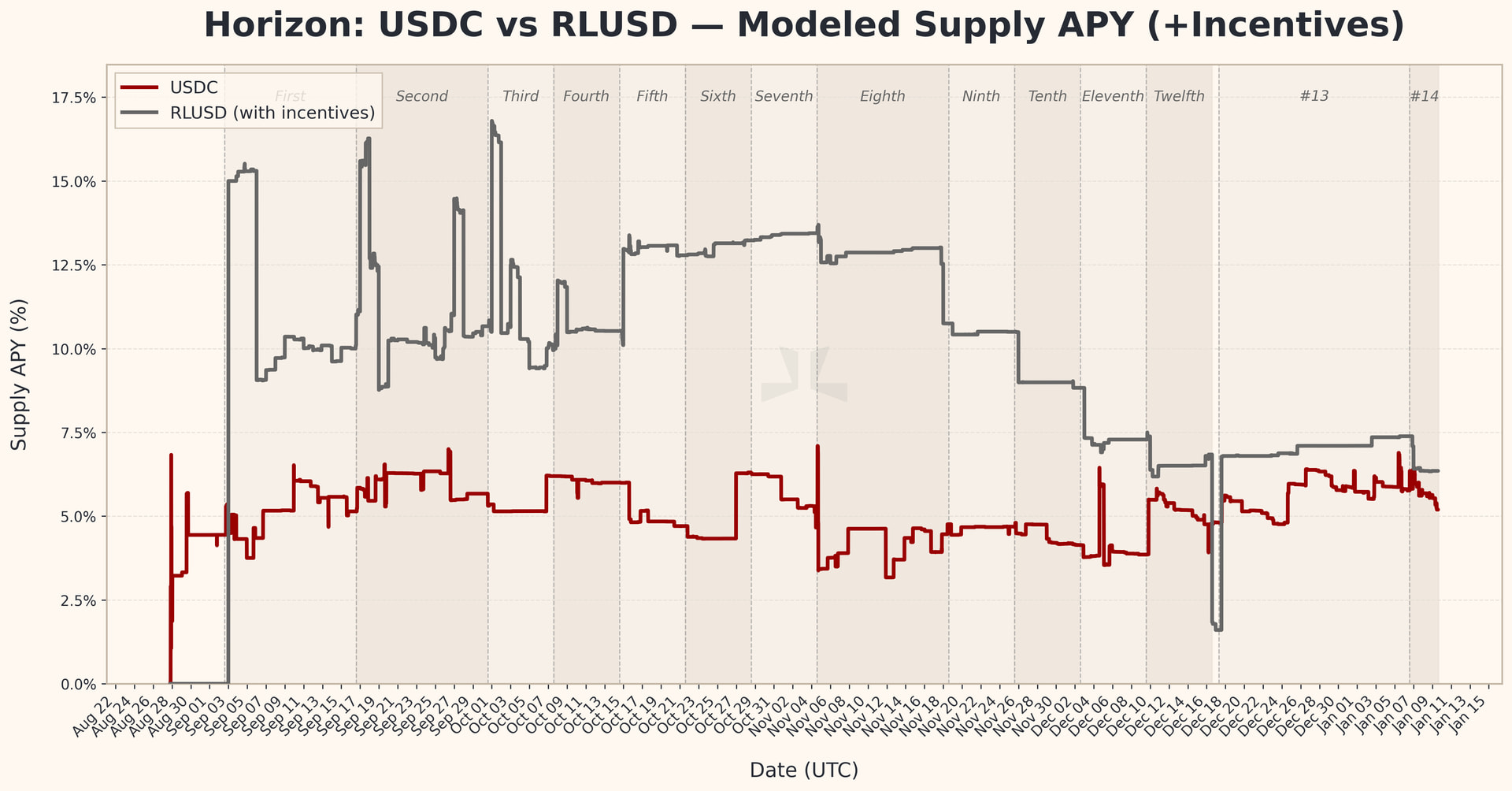
The fourteenth incentive campaign is now live, with the RLUSD supply APY post-incentives being lower, reflecting reduced effective incentives. Overall rate conditions remain stable, with no material spillover observed in USDC markets.

Source: LlamaRisk, January 9, 2026

Stablecoin Borrow Rates

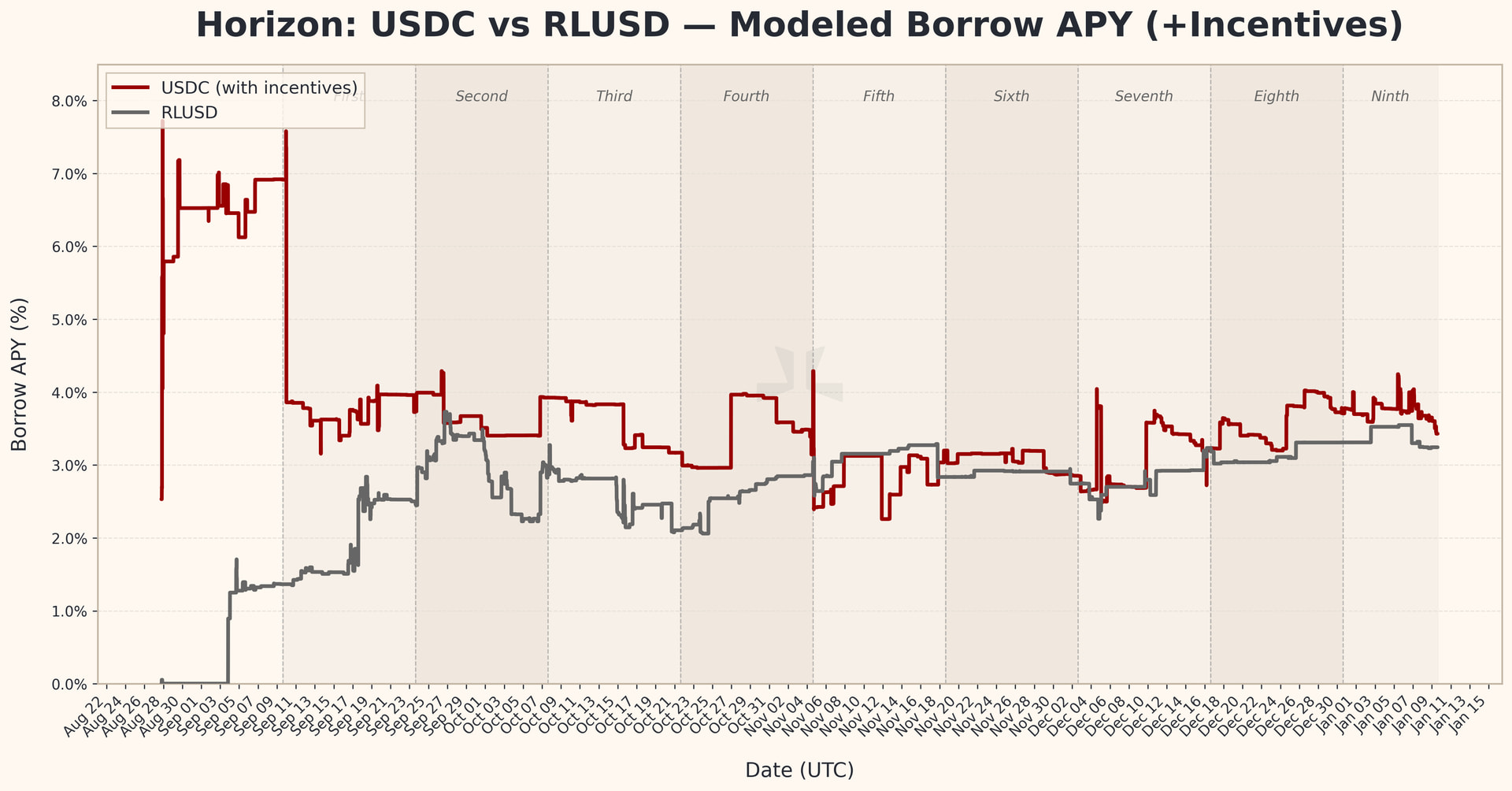
USDC and RLUSD borrowing rates held steady over the week, showing limited volatility and no meaningful trend, as additional stablecoin supply was matched with incremental borrows.

Source: LlamaRisk, January 9, 2026

Profitability heatmaps for leverage looping

USCC and USTB yields both declined over the period, with USCC falling to 4.4% and USTB slipping to 3.59%. Yields remain within a contained range, suggesting limited impact on the broader rate environment.

USCC


Source: LlamaRisk, January 9, 2026


Source: LlamaRisk, January 9, 2026

USTB


Source: LlamaRisk, January 9, 2026


Source: LlamaRisk, January 9, 2026

This week, Horizon’s TVL decreased to $604.3m, with over $193.2m in net borrows and $341.6m in stablecoin supply.

Highlights

  • TVL has decreased to $604.3 million, with a total stablecoin supply of $341.6 million and net borrowings standing at $193.2 million. RLUSD and USCC remain the dominant supplied assets, driven mainly by previously opened positions and ongoing incentive programs.
  • The incentive programs for RLUSD supply and USDC borrow markets continue to be active, albeit with a capped APR of 4.5% for RLUSD after the renewal.
  • A large borrower has executed a $25M GHO debt repayment, withdrawing the USCC collateral shortly after, triggering a notable decline in total borrows.

Incentive Programs

Incentive programs on Horizon stimulate liquidity supply and borrowing activity, with active campaigns for USDC and RLUSD.

  • USDC: The new borrowing campaign has begun, offering daily rewards of $3,065, which effectively reduces the borrowing cost by approximately 3.5% APY.
  • RLUSD: The new lending-focused campaign has begun, distributing $23,570 in daily rewards, capped at a 4.4% APR.

Utilization Report

In the twenty weeks following Horizon’s market activation, the total borrowed amount decreased to $193.2m, primarily driven by the repayment of the largest GHO borrowing position on January 14th.


Source: LlamaRisk, January 16, 2026

Parameter changes during this period

During this week, no parameter changes were proposed nor executed.

Supply (stablecoins)

The total stablecoin supply on Horizon has varied minimally and is currently valued at $341.3m.

  • RLUSD: The supply hasn’t changed and currently stands at $221.5m.
  • USDC: The supply increased by 2% from $39.7m to $40.5m.
  • GHO: The supply hasn’t changed and currently stands at $79.5m, managed by the GHO Steward.


Source: LlamaRisk, January 16, 2026

Supply (RWAs)

The total supply of RWAs decreased by 8.6%, holding $262.8 million. The USCC decrease in supply was driven primarily by a single 3M ($34.30 M) USCC withdrawal that occurred on January 14th, while supply across other assets remained unchanged.

The changes in individual RWA supplies were as follows:

  • USCC: Supply decreased by 8.9%, from $278.5m to $253.6m.
  • JTRSY: Supply remained at zero.
  • USTB: Supply hasn’t changed and currently stands at $392.5k.
  • JAAA: Supply hasn’t changed and currently sits at $2.5m.
  • USYC: Supply remained at zero.
  • VBILL: Supply hasn’t changed and currently sits at $6.25M


Source: LlamaRisk, January 16, 2026

Borrow

Total net borrowing on Horizon decreased by 7.6% to $193.2m, driven primarily by a single GHO debt repayment that occurred on January 14th.

  • USDC: Net borrows increased by 3.5%, from $31m to $32.1m.
  • RLUSD: Net borrows increased by 5.5%, from $133.5m to $140.9m.
  • GHO: Net borrows decreased by 55.4% from $45.3m to $20.21m.


Source: LlamaRisk, January 16, 2026
Stablecoin Utilization

This week, utilization for USDC and RLUSD remained within normal ranges, while GHO experienced a significant drop-down following a recent debt repayment.


Source: LlamaRisk, January 16, 2026

Stablecoin Supply Rates

The fifteenth supply incentive campaign for RLUSD is now live, with no major changes observed during this week. Overall rate conditions remain stable across the board.


Source: LlamaRisk, January 16, 2026

Stablecoin Borrow Rates

Borrowing rates for USDC and RLUSD remained stable throughout the week, characterized by minimal volatility and a lack of directional movement.


Source: LlamaRisk, January 16, 2026

Profitability heatmaps for leverage looping

USCC yields climbed from 3.6% to 5.06% APY by the end of the week, while USTB yields trended lower to 3.54%. The diverging yield movement, specifically for USCC, has caused the aforementioned large repayments of USCC-backed debt.

USCC


Source: LlamaRisk, January 16, 2026


Source: LlamaRisk, January 16, 2026

USTB


Source: LlamaRisk, January 16, 2026


Source: LlamaRisk, January 16, 2026

This week, Horizon’s TVL decreased to $571.1m, with over $172.6m in net borrows and $338.1m in stablecoin supply.

Highlights

  • TVL has decreased to $571.1 million, with a total stablecoin supply of $338.1 million and net borrowings standing at $172.6 million. RLUSD and USCC remain the dominant supplied assets.
  • The incentive programs for RLUSD supply and USDC borrow markets continue to be active, albeit with a capped APR of 4.25% for RLUSD after the renewal.

Incentive Programs

Incentive programs on Horizon stimulate liquidity supply and borrowing activity, with active campaigns for USDC and RLUSD.

  • USDC: The new borrowing campaign has begun, offering daily rewards of $2,482, which effectively reduces the borrowing cost by approximately 3.5% APY.
  • RLUSD: The new lending-focused campaign has begun, distributing $22,729 in daily rewards, capped at a 4.25% APR.

Utilization Report

In the twenty-one weeks following Horizon’s market activation, the total borrowed amount decreased to $172.6m, driven by the lower yield on USCC, which encouraged the unwinding of outstanding positions.

Source: LlamaRisk, January 23, 2026

Parameter changes during this period

During this week, no parameter changes were proposed nor executed.

Supply (stablecoins)

Stablecoin supply on Horizon has held firm at $338.1m. We noted a spike in activity from a sole user executing large RLUSD withdrawals, filled rapidly by new suppliers without impacting the total supply significantly.

  • RLUSD: The supply hasn’t changed and currently stands at $221.2m.
  • USDC: The supply decreased by 7.7% from $40.5m to $37.4m.
  • GHO: The supply hasn’t changed and currently stands at $79.5m, managed by the GHO Stewards.

Source: LlamaRisk, January 23, 2026

Supply (RWAs)

The total supply of RWAs decreased by 11.3%, holding $233 million. USCC supply decreased as yields on the asset declined, weakening return incentives and prompting participants to reduce exposure and withdraw supply.

The changes in individual RWA supplies were as follows:

  • USCC: Supply decreased by 11.8%, from $253.6m to $223.8m.
  • JTRSY: Supply remained at zero.
  • USTB: Supply hasn’t changed and currently stands at $393k.
  • JAAA: Supply hasn’t changed and currently sits at $2.5m.
  • USYC: Supply remained at zero.
  • VBILL: Supply hasn’t changed and currently sits at $6.25m.

Source: LlamaRisk, January 23, 2026

Borrow

Total net borrowing on Horizon decreased by 10.6% to $172.6m, driven primarily by a drop in USCC yields and a subsequent reduction in borrowing demand against it.

  • USDC: Net borrows decreased by 19%, from $32.1m to $26m.
  • RLUSD: Net borrows decreased by 10.3%, from $140.9m to $126.5m.
  • GHO: Net borrows haven’t changed and currently sit at $20.22m.

Source: LlamaRisk, January 23, 2026

Stablecoin Utilization

For this week, utilization levels for USDC, RLUSD, and GHO remained stable with no significant fluctuations, though USDC continues to show a slight downward trend.

Source: LlamaRisk, January 23, 2026

Stablecoin Supply Rates

The sixteenth supply incentive campaign for RLUSD is now live, with no major changes observed during this week. Overall rate conditions remain stable across the board.

Source: LlamaRisk, January 23, 2026

Stablecoin Borrow Rates

Borrowing rates for USDC and RLUSD remained stable throughout the week, characterized by minimal volatility and a lack of directional movement.

Source: LlamaRisk, January 23, 2026

Profitability heatmaps for leverage looping

Both USTB and USCC experienced a decline in yields, prompting additional USCC-backed position closures as the relative yield advantage narrowed. The USCC yield sits at 4.0%, while USTB has edged down to 3.47%.

USCC

Source: LlamaRisk, January 23, 2026

Source: LlamaRisk, January 23, 2026

USTB

Source: LlamaRisk, January 23, 2026

Source: LlamaRisk, January 23, 2026


This week, Horizon’s TVL decreased to $550.3m, with over $151.1m in net borrows and $334.6m in stablecoin supply.

Highlights

  • TVL has decreased to $550.3 million, with a total stablecoin supply of $334.6 million and net borrowings standing at $151.1 million. RLUSD and USCC remain the dominant supplied assets.
  • The incentive programs for RLUSD supply and USDC borrow markets continue to be active, albeit with a capped APR of 4.25% for RLUSD after the renewal.
  • During this week, USDC’s base rate was lowered to 5%, reducing borrowing costs for users.

Incentive Programs

Incentive programs on Horizon stimulate liquidity supply and borrowing activity, with active campaigns for USDC and RLUSD.

  • USDC: The new borrowing campaign has begun, offering daily rewards of $2,258, which effectively reduces the borrowing cost by approximately 3.2% APY.
  • RLUSD: The new lending-focused campaign has begun, distributing $22,676 in daily rewards, capped at a 4.25% APR.

Utilization Report

In the twenty-two weeks following Horizon’s market activation, total borrowed outstanding declined to $151.1m, driven primarily by a single address repaying an additional $10m of GHO debt on 28 Jan (tx1 and tx2), which materially reduced aggregate borrow balances.


Source: LlamaRisk, January 30, 2026

Parameter changes during this period

  • USDC: The baseVariableBorrowRate was reduced from 2.5% to 2.0% on 29 Jan.

Supply (stablecoins)

Stablecoin supply on Horizon decreased by 1.1% to $334.6m. Most of the supply withdrawals this week were concentrated among USDC suppliers, while RLUSD and GHO supply levels remained broadly unchanged.

  • RLUSD: The supply remained stable at $220.8m.
  • USDC: The supply decreased by 9% from $37.4m to $34.2m.
  • GHO: The supply hasn’t changed and currently stands at $79.5m, managed by the GHO Stewards.


Source: LlamaRisk, January 30, 2026

Supply (RWAs)

The total supply of RWAs decreased by 3.3%, holding $225.4 million. USCC supply continued to decline over the week, while VBILL supply recorded a notable increase.

The changes in individual RWA supplies were as follows:

  • USCC: Supply decreased by 9.2%, from $223.8m to $203.3m.
  • JTRSY: Supply remained at zero.
  • USTB: Supply hasn’t changed and currently stands at $393k.
  • JAAA: Supply hasn’t changed and currently sits at $2.5m.
  • USYC: Supply remained at zero.
  • VBILL: Supply increased by 53.6%, from $6.25m to $9.6m.


Source: LlamaRisk, January 30, 2026

Borrow

Total net borrowing on Horizon decreased by 12.5% to $151.1m, driven by repayments of outstanding GHO debt, which materially reduced overall market borrow balances.

  • USDC: Net borrows remained stable at $25.9m.
  • RLUSD: Net borrows decreased by 9%, from $126.5m to $115.1m.
  • GHO: Net borrows decreased by 50.2%, from $20.22m to $10.1m.


Source: LlamaRisk, January 30, 2026

Stablecoin Utilization

This week, RLUSD utilization remained broadly stable. USDC utilization ticked up modestly over the period, while GHO experienced a sharp step-down, driven by the repayment of the largest borrowing position on 29 Jan, which materially reduced outstanding debt and utilization.


Source: LlamaRisk, January 30, 2026

Stablecoin Supply Rates

The seventeenth supply incentive campaign for RLUSD is now live, with no major changes observed during this week. Overall rate conditions remain stable across the board.


Source: LlamaRisk, January 30, 2026

Stablecoin Borrow Rates

Borrowing rates for USDC and RLUSD were largely stable over the week. USDC borrow rates edged higher as short-lived utilization spikes, while RLUSD remained comparatively stable with limited volatility.


Source: LlamaRisk, January 30, 2026

Profitability heatmaps for leverage looping

USTB yields have remained broadly stable at around 3.4%. In contrast, USCC saw a sharp yield spike, climbing to roughly 5.3%, widening the relative yield advantage.

USCC


Source: LlamaRisk, January 30, 2026


Source: LlamaRisk, January 30, 2026

USTB


Source: LlamaRisk, January 30, 2026


Source: LlamaRisk, January 30, 2026

This week, Horizon’s TVL decreased to $501.3m, with over $122.5m in net borrows and $334.6m in stablecoin supply.

Highlights

  • TVL has decreased to $501.3 million, with a total stablecoin supply of $334.6 million and net borrowings standing at $122.5 million. RLUSD and USCC remain the dominant supplied assets.
  • The incentive programs for the RLUSD supply and USDC borrow markets remain active, albeit with capped APRs of 4.25% for RLUSD and 3.2% for USDC.
  • This week, we saw a large decline in RWA supply, with approximately $45 million USCC withdrawn from the Horizon market.

Incentive Programs

Incentive programs on Horizon stimulate liquidity supply and borrowing activity, with active campaigns for USDC and RLUSD.

  • USDC: The borrowing campaign remains active, offering daily rewards of $1,753, effectively reducing the borrowing cost to approximately 3.2% APY.
  • RLUSD: The new lending-focused campaign has begun, distributing $22,429 in daily rewards, capped at a 4.25% APR.

Utilization Report

In the twenty-three weeks following Horizon’s market activation, total borrowed outstanding declined to $122.5m, driven primarily by a large withdrawal of USCC assets (see “RWA Supply” section) and top suppliers closing their stablecoin debt positions.


Source: LlamaRisk, February 6, 2026

Parameter changes during this period

This week, no parameter changes were proposed or implemented.

Supply (stablecoins)

Stablecoin supply hasn’t changed and is currently estimated at $334.6m. Overall stablecoin supply levels remained broadly unchanged this week, with RLUSD maintaining its position as the largest.

  • RLUSD: The supply hasn’t changed and currently stands at $220.5m.
  • USDC: The supply hasn’t changed and currently stands at $34.6m.
  • GHO: The supply hasn’t changed and currently stands at $79.5m, managed by the GHO Stewards.


Source: LlamaRisk, February 6, 2026

Supply (RWAs)

The total supply of RWAs decreased by 26%, holding $166.7 million. USCC experienced one of the largest supply declines in its history this week, with 45.4M USCC withdrawn by large suppliers (ex., tx1 and tx2). Similarly, VBILL saw a reduction in supply, driven by a single user withdrawing their position.

The changes in individual RWA supplies were as follows:

  • USCC: Supply decreased by 22.5%, from $203.3m to $157.6m.
  • JTRSY: Supply remained at zero.
  • USTB: Supply hasn’t changed and currently stands at $393k.
  • JAAA: Supply hasn’t changed and currently sits at $2.5m.
  • USYC: Supply remained at zero.
  • VBILL: Supply decreased by 34.9%, from $9.6m to $6.25m.


Source: LlamaRisk, February 6, 2026

Borrow

Total net borrowing on Horizon decreased by 18.9% to $122.5m, driven by repayments of RLUSD debt by large borrowers as they closed their USCC-backed debt positions.

  • USDC: Net borrows decreased by 14.7%, from $25.9m to $22.1m.
  • RLUSD: Net borrows decreased by 21.5%, from $115.1m to $90.3m.
  • GHO: Net borrows haven’t changed and currently sit at $10.1m.


Source: LlamaRisk, February 6, 2026

Stablecoin Utilization

This week, utilization for both RLUSD and USDC declined due to borrower repayments, while GHO utilization remained broadly stable.


Source: LlamaRisk, February 6, 2026

Stablecoin Supply Rates

The eighteenth RLUSD supply incentive campaign is now live. Supply rates declined slightly this week due to cheaper borrowing costs for stablecoins, with RLUSD supply incentives decreasing to 4.33%.


Source: LlamaRisk, February 6, 2026

Stablecoin Borrow Rates

Borrowing rates for both USDC and RLUSD declined over the week, driven by a noticeable drop in utilization as market participants repaid outstanding debt.


Source: LlamaRisk, February 6, 2026

Profitability heatmaps for leverage looping

Yields for RWA assets on Horizon shifted this week. USTB remained broadly stable, currently sitting at 3.44%, while USCC yields declined to 4.7%, narrowing the spread between the two assets.

USCC


Source: LlamaRisk, February 6, 2026


Source: LlamaRisk, February 6, 2026

USTB


Source: LlamaRisk, February 6, 2026


Source: LlamaRisk, February 6, 2026

This week, Horizon’s TVL decreased to $499.8m, with over $113.5m in net borrows and $335.7m in stablecoin supply.

Highlights

  • TVL has decreased to $499.8 million, with a total stablecoin supply of $335.7 million and net borrowings standing at $113.5 million. RLUSD and USCC remain the dominant supplied assets.
  • The incentive programs for the RLUSD supply and USDC borrow markets remain active, albeit with capped APRs of 4% for RLUSD and 3% for USDC.
  • This week, all outstanding GHO debt has been repaid, with 80 million GHO available to borrow.

Incentive Programs

Incentive programs on Horizon stimulate liquidity supply and borrowing activity, with active campaigns for USDC and RLUSD.

  • USDC: The borrowing campaign remains active, offering daily rewards of $1,997, effectively reducing the borrowing cost to approximately 3% APY.
  • RLUSD: The new lending-focused campaign has begun, distributing $21,104 in daily rewards, capped at a 3.99% APR.

Utilization Report

In the twenty-four weeks since Horizon’s market launch, total outstanding debt fell to $113.5m, largely due to the steady withdrawal of USCC assets.


Source: LlamaRisk, February 13, 2026

Parameter changes during this period

This week, no parameter changes were proposed or implemented.

Supply (stablecoins)

Stablecoin supply hasn’t changed and is currently around $335.7m. Overall stablecoin supply levels remained broadly unchanged this week, with RLUSD maintaining its position as the largest.

  • RLUSD: The supply hasn’t changed and currently stands at $219m.
  • USDC: The supply increased by 7.2%, from $34.6m to $37.1m.
  • GHO: The supply hasn’t changed and currently stands at $79.5m, managed by the GHO Stewards.


Source: LlamaRisk, February 13, 2026

Supply (RWAs)

The total supply of RWAs decreased by 1.6%, holding $164 million. The RWA supply remained almost unchanged this week, seeing only a marginal decrease in USCC.

The changes in individual RWA supplies were as follows:

  • USCC: Supply decreased by 1.7%, from $157.6m to $154.9m.
  • JTRSY: Supply remained at zero.
  • USTB: Supply hasn’t changed and currently stands at $393k.
  • JAAA: Supply hasn’t changed and currently sits at $2.5m.
  • USYC: Supply remained at zero.
  • VBILL: Supply decreased by 34.9%, from $9.6m to $6.25m.


Source: LlamaRisk, February 13, 2026

Borrow

Total net borrowing on Horizon decreased by 7.3% to $113.5m, driven primarily by the last $5m repayment of GHO debt, which fully cleared the remaining balance.

  • USDC: Net borrows increased by 10.4%, from $22.1m to $24.4m.
  • RLUSD: Net borrows remain stable at $89m.
  • GHO: Net borrows have been fully repaid and currently sit at zero.


Source: LlamaRisk, February 13, 2026

Stablecoin Utilization

This week, utilization for both RLUSD and USDC continued to decline due to borrower repayments, while GHO utilization dropped to 0% following the final repayment of GHO debt.


Source: LlamaRisk, February 13, 2026

Stablecoin Supply Rates

With the launch of the nineteenth RLUSD supply incentive campaign, RLUSD supply rates decreased following a cut in incentives. Concurrently, USDC experienced a decline driven by low utilization.


Source: LlamaRisk, February 13, 2026

Stablecoin Borrow Rates

While RLUSD borrowing rates remained quiet this week, USDC experienced an extreme, temporary spike driven by the launch of a new borrow-focused campaign.


Source: LlamaRisk, February 13, 2026

Profitability heatmaps for leverage looping

Yields for RWA assets on Horizon remained largely unchanged this week. USTB held steady at 3.45%, while USCC declined slightly to 4.34%.

USCC


Source: LlamaRisk, February 13, 2026


Source: LlamaRisk, February 13, 2026

USTB


Source: LlamaRisk, February 13, 2026

2 Likes

This week, Horizon’s TVL decreased to $447.7m, with $94.8m in net borrows and $314.5m in stablecoin supply.

Highlights

  • TVL has decreased to $447.7 million, with a total stablecoin supply of $314.5 million and net borrowings standing at $94.8 million. This is primarily due to ongoing lower yields for carry trades and, more generally, in the DeFi ecosystem. RLUSD and USCC remain the dominant supplied assets.
  • The incentive programs for the RLUSD supply and USDC borrow markets remain active, albeit with capped APRs of 4.25% for RLUSD and 1.75% for USDC.

Incentive Programs

Incentive programs on Horizon stimulate liquidity supply and borrowing activity, with active campaigns for USDC and RLUSD.

  • USDC: The borrowing campaign remains active, offering daily rewards of $515.67, effectively reducing the borrowing cost by 1.75% APY.
  • RLUSD: The new lending-focused campaign has begun, distributing $21104 in daily rewards, capped at a 4.25% APR.

Utilization Report

In the twenty-fifth week since Horizon’s market launch, total outstanding debt fell to $94.8m. This decline was largely driven by the steady withdrawal of USCC assets, resulting in the centralization of the remaining USCC supply among a few major holders.


Source: LlamaRisk, February 20, 2026

Parameter changes during this period

  • USDC: The baseVariableBorrowRate was reduced from 2.0% to 1.5% on 18 Feb to adjust to broader rates seen on Aave V3 core market.

Supply (stablecoins)

Stablecoin supply decreased by 6.3%, holding $314.5m. Overall stablecoin supply levels were notably impacted this week, driven primarily by significant USDC withdrawals from various large entities.

  • RLUSD: The supply decreased by 2.2%, from $219m to $214.2m.
  • USDC: The supply decreased by 44%, from $37.1m to $20.8m.
  • GHO: The supply hasn’t changed and currently stands at $79.5m, managed by the GHO Stewards.


Source: LlamaRisk, February 20, 2026

Supply (RWAs)

The total supply of RWAs decreased by 18.8%, holding $133.2 million. The RWA supply decreased this week, with the majority of the decline driven by USCC holders withdrawing their collateral.

The changes in individual RWA supplies were as follows:

  • USCC: Supply decreased by 20%, from $154.9m to $124.1m.
  • JTRSY: Supply remained at zero.
  • USTB: Supply hasn’t changed and currently stands at $393k.
  • JAAA: Supply hasn’t changed and currently sits at $2.5m.
  • USYC: Supply remained at zero.
  • VBILL: Supply hasn’t changed and currently sits at $6.25m.


Source: LlamaRisk, February 20, 2026

Borrow

Total net borrowing on Horizon decreased by 16.5% to $94.8m, driven primarily by large repayments of RLUSD and USDC, with a notable $5.27m repayment of USDC debt on February 19th.

  • USDC: Net borrows decreased by 55.3%, from $24.4m to $10.9m.
  • RLUSD: Net borrows decreased by 6%, $89m to $83.9m.
  • GHO: Net borrows have been fully repaid and currently sit at zero.


Source: LlamaRisk, February 20, 2026

Stablecoin Utilization

This week, RLUSD utilization remained stable, while a large $6.62M USDC withdrawal on February 19th caused a sudden spike in USDC utilization. Meanwhile, GHO currently sits at 0% utilization.


Source: LlamaRisk, February 20, 2026

Stablecoin Supply Rates

With the launch of the twenty supply incentive campaign, RLUSD supply rates remained stable over the week. Meanwhile, USDC saw a temporary spike in supply rates after borrowing costs increased.


Source: LlamaRisk, February 20, 2026

Stablecoin Borrow Rates

While RLUSD borrowing rates remained stable this week, USDC experienced a high, temporary spike driven by a sudden surge in utilization.


Source: LlamaRisk, February 20, 2026

Profitability heatmaps for leverage looping

Yields on RWA assets in Horizon declined this week, with both Superstate assets now below 4%. USTB fell to 3.45%, and USCC declined to 3.92%, leaving a minimal spread between the two assets.

The continuous decline of USCC yield comes from a reduction in yields from crypto CME futures, specifically the notably low yields we see for ETH CME futures (1.37%) and the negative yields on SOL CME futures (-6.94%).

USCC


Source: LlamaRisk, February 20, 2026


Source: LlamaRisk, February 20, 2026

USTB


Source: LlamaRisk, February 20, 2026


Source: LlamaRisk, February 20, 2026

1 Like


This week, Horizon’s TVL decreased to $445.6m, with $98.6m in net borrows and $303.8m in stablecoin supply.

Highlights

  • TVL has decreased to $445.6 million, with a total stablecoin supply of $303.8 million and net borrowings standing at $98.6 million. This is primarily due to ongoing lower yields for carry trades and, more generally, in the DeFi ecosystem. RLUSD and USCC remain the dominant supplied assets.
  • The incentive programs for the RLUSD supply and USDC borrow markets remain active, albeit with capped APRs of 3.53% for RLUSD and 1.75% for USDC.
  • Over the past week, on-chain metrics indicated renewed traction and growing demand for JAAA, driven primarily by its more favorable yields compared to other RWAs.

Incentive Programs

Incentive programs on Horizon stimulate liquidity supply and borrowing activity, with active campaigns for USDC and RLUSD.

  • USDC: The borrowing campaign remains active, offering daily rewards of $667.9, effectively reducing the borrowing cost by 1.75% APY.
  • RLUSD: The new lending-focused campaign has begun, distributing $18,290 in daily rewards, capped at a 3.53% APR.

Utilization Report

In the twenty-sixth week since Horizon’s market launch, total outstanding debt increased to $98.6m. This recovery was largely driven by the recent opening of a $2.8m USDC/JAAA position by a new borrower.


Source: LlamaRisk, February 27, 2026

Parameter changes during this period

  • JAAA: The supply cap was increased to 20m ($20.55m in dollar terms) on February 26th to accommodate the growing demand for JAAA from various LPs.

Supply (stablecoins)

Stablecoin supply decreased by 3.5%, holding $303.8m. Overall stablecoin supply continued to decline this week, mostly driven by RLUSD withdrawals as declining incentives and utilization caused the supply rate on Horizon to underperform the Core market (4.43% on Horizon vs. 4.73% on Core).

  • RLUSD: The supply decreased by 4.1%, from $214.2m to $205.4m.
  • USDC: The supply decreased by 9.4%, from $20.8m to $18.84m.
  • GHO: The supply hasn’t changed and currently stands at $79.5m, managed by the GHO Stewards.


Source: LlamaRisk, February 27, 2026

Supply (RWAs)

The total supply of RWAs increased by 6.5%, holding $141.8 million. The RWA supply saw a boost over the week, driven solely by a new $8.52m JAAA supply from a single institutional investor ($2.81m on Feb 26 and $5.71m on Feb 27). This represents the first JAAA supply in five months, signaling a broader shift in demand from a wider range of investors attracted to private credit.

The changes in individual RWA supplies were as follows:

  • USCC: Supply remained stable and currently sits at $123.4m.
  • JTRSY: Supply remained at zero.
  • USTB: Supply hasn’t changed and currently stands at $393k.
  • JAAA: Supply increased by 370%, from $2.5m to $11.76m.
  • USYC: Supply remained at zero.
  • VBILL: Supply hasn’t changed and currently sits at $6.25m.


Source: LlamaRisk, February 27, 2026

Borrow

Total net borrowing on Horizon increased by 4.1% to $98.6m, mostly driven by a large single borrow of $2.81m USDC on February 26th against newly supplied JAAA collateral.

  • USDC: Net borrows increased by 29.4%, from $10.9m to $14.1m.
  • RLUSD: Net borrows increased by 1%, from $83.9m to $84.6m.
  • GHO: Net borrows have been fully repaid and currently sit at zero.


Source: LlamaRisk, February 27, 2026

Stablecoin Utilization

This week, supply rates for RLUSD and GHO remained almost unchanged, while USDC saw a sudden spike in utilization driven by an increase in borrowing demand from February 26th.


Source: LlamaRisk, February 27, 2026

Stablecoin Supply Rates

With the launch of the twentieth supply incentive campaign, the RLUSD rate has been diluted following Ripple’s withdrawal from the campaign, though it still remains higher than Aave Core rates. Meanwhile, an increase in USDC utilization drove its borrow rate higher, resulting in a temporary spike in supply rates and widening the spread between RLUSD and USDC.


Source: LlamaRisk, February 27, 2026

Stablecoin Borrow Rates

The RLUSD borrow rates remained stable over the week. Meanwhile, an increase in USDC utilization drove its borrow rate higher, widening the spread between RLUSD and USDC rates.


Source: LlamaRisk, February 27, 2026

Profitability heatmaps for leverage looping

Yields on RWA assets in Horizon remained modest this week. USTB fell to 3.46%, while USCC yields at 4.36% after experiencing short drops below 3%. In contrast, JAAA sustained a higher 4.71% yield and lower volatility, as its longer-duration private credit structure resists the rapid carry trade fluctuations typical of other RWA assets (Superstate USCC).

When factoring in maximum leverage, potential profits currently stand at 11.89% for USTB (at 8.33x), 10.96% for USCC (at 6.67x), and 14.94% for JAAA (at 5.26x).

JAAA: The sharp drop in JAAA yield last October was influenced by Federal Reserve rate cuts.

USTB: Yields have trended lower alongside a decline in underlying U.S. Treasury rates, with the current level down to 3.63%. The move reflects a risk-off shift in positioning amid increased economic unpredictability amid evolving tariff policies, and broader geopolitical tensions.

USCC: Superstate Crypto-Carry strategies have continued to see downward pressure on yield, consistent with weaker carry available in listed crypto derivatives. Implied yields have softened across key derivative contracts, including CME SOL Future MAR26 (4.21%), CME ETH Future MAR26 (5.55%), CME XRP Future MAR26 (3.60%), and FalconX SOL Future MAR26 (0.15%).

JAAA


Source: LlamaRisk, February 27, 2026


Source: LlamaRisk, February 27, 2026

USCC


Source: LlamaRisk, February 27, 2026


Source: LlamaRisk, February 27, 2026

USTB


Source: LlamaRisk, February 27, 2026


Source: LlamaRisk, February 27, 2026

1 Like

This week, Horizon’s TVL decreased to $424.6m, with $110.1m in net borrows and $270.7m in stablecoin supply.

Highlights

  • TVL has decreased to $424.6 million, with a total stablecoin supply of $270.7 million and net borrowings standing at $110.1 million. Horizon retains considerate strength considering the current market conditions. RLUSD and USCC remain the dominant supplied assets.
  • The incentive programs for the RLUSD supply and USDC borrow markets remain active, albeit with capped APYs of 4.25% for RLUSD and 1.75% for USDC.
  • New GHO borrows (5.2m) flowed into the Horizon market after a prolonged inactivity.

Incentive Programs

Incentive programs on Horizon stimulate liquidity supply and borrowing activity, with active campaigns for USDC and RLUSD.

  • USDC: The borrowing campaign remains active, offering daily rewards of $420.97, effectively reducing the borrowing cost by 1.75% APY.
  • RLUSD: The new lending-focused campaign has begun, distributing $18,239 in daily rewards, capped at a 4.25% APY.

Utilization Report

In the twenty-seventh week since Horizon’s market launch, total outstanding debt increased to $110.1m. This growth in borrowing was driven by continued demand from a JAAA investor, who borrowed RLUSD and GHO.


Source: LlamaRisk, March 6th, 2026

Parameter changes during this period

  • JAAA: The supply cap was increased to 40m ($41.03m in dollar terms) on March 3rd to accommodate the growing demand for JAAA from various LPs.
  • GHO: The supply and borrow caps were decreased to 55m and 43m, respectively, on March 4th, following the 25m GHO withdrawal. The GHO baseVariableBorrowRate was changed to 3.25% on March 3, reducing the borrow cost from 4.34% to 3.30%.

Supply (stablecoins)

Stablecoin supply decreased by 10.9%, holding $270.7m. Overall stablecoin supply continued to decline this week, mostly driven by a single large 25m GHO withdrawal signed by the GHO Facilitator. Additionally, RLUSD saw a small decline in supply due to withdrawals as incentives declined, while USDC remained mostly unchanged.

  • RLUSD: The supply decreased by 4%, from $205.4m to $197.1m.
  • USDC: The supply increased by 1.4%, from $18.84m to $19.1m.
  • GHO: The supply decreased by 31.4%, from $79.5m to $54.6m.


Source: LlamaRisk, March 6th, 2026

Supply (RWAs)

The total supply of RWAs increased by 8.7%, holding $154.2 million, driven solely by a new JAAA supply from a single investor (8.55m on March 3 and 4.11m on March 4). This highlights the continued demand for JAAA and the borrowing strategies tied to it.

The changes in individual RWA supplies were as follows:

  • USCC: Supply remained stable and currently sits at $122.8m.
  • JTRSY: Supply remained at zero.
  • USTB: Supply hasn’t changed and currently stands at $394k.
  • JAAA: Supply increased by 110.3%, from $11.76m to $24.7m.
  • USYC: Supply remained at zero.
  • VBILL: Supply hasn’t changed and currently sits at $6.25m.


Source: LlamaRisk, March 6th, 2026

Borrow

Total net borrowing on Horizon increased by 11.7% to $110.1m, solely driven by new borrow demand for GHO and RLUSD from JAAA holders, highlighted by a recent $5.2m GHO borrow position executed in 3 transactions ($2.72m, $1.5m, and $1m).

  • USDC: Net borrows decreased by 22.7%, from $14.1m to $10.9m.
  • RLUSD: Net borrows increased by 11%, from $84.6m to $93.9m.
  • GHO: Net borrowings increased up to $5.2m over this week.


Source: LlamaRisk, March 6th, 2026

Stablecoin Utilization

This week, USDC utilization was volatile due to constant borrowing and repayment activity. Meanwhile, RLUSD saw an increase in utilization driven by lower borrowing costs, causing demand for borrowing, and GHO utilization rose due to a combination of new borrowing demand and a large recent GHO withdrawal (see section “Supply (stablecoins)“).


Source: LlamaRisk, March 6th, 2026

Stablecoin Supply Rates

RLUSD supply active remains active as of March 6. This, combined with new borrowing against JAAA, has pushed RLUSD supply rates higher. At the same time, a spike in borrow demand caused a temporary jump in USDC rates last week.


Source: LlamaRisk, March 6th, 2026

Stablecoin Borrow Rates

RLUSD borrow rates were broadly steady over the week. In contrast, the USDC borrow APY moved higher following new USDC borrowing and subsequent repayment activity in favor of GHO and RLUSD by a large JAAA holder. Over the same period, the GHO borrow rate declined from 4.34% to 3.30% after changes in the GhoBaseRate parameter.


Source: LlamaRisk, March 6th, 2026

Profitability heatmaps for leverage looping

Yields on RWA assets in Horizon declined sharply this week. USTB remained unchanged at 3.46%, while USCC dropped below 3%, settling at 2.81%. Meanwhile, JAAA’s yield dropped to 4.29%, reflecting changes in portfolio income.

When factoring in maximum leverage, potential maximum profits currently stand at 10.50% for USTB (at 8.33x), 5.08% for USCC (at 6.67x), and 11.89% for JAAA (at 5.26x).

JAAA: JAAA declined as lower expected short-term rates and tighter AAA CLO spreads reduced the portfolio’s income profile. On March 4, JAAA experienced a 0.21% price decline (from $1.0276 to $1.0255) following the latest Oracle NAV update. Despite this fluctuation, no defaults have been detected within the underlying packaged CLOs comprising the JAAA portfolio.

USTB: Over the week, USTB yield remained unchanged. More broadly, yields have moved lower in line with declining underlying U.S. Treasury rates, with the current daily level at 3.65%. The move appears consistent with a more risk-off market tone amid elevated economic uncertainty linked to shifting tariff policy and wider geopolitical tensions.

USCC: USCC yield declined to below 3%, driven primarily by a drop in SOL futures yield (SOL Future MAR26 (CME) - 2.1% and SOL Forward MAR26 (FalconX) - 2.88%). This reflects a compression in the SOL futures basis, meaning the premium earned from short-futures carry trades narrowed materially over the period. The move resulted from unwinding existing cash-and-carry positions through futures buying.

JAAA


Source: LlamaRisk, March 6th, 2026


Source: LlamaRisk, March 6th, 2026

USCC


Source: LlamaRisk, March 6th, 2026


Source: LlamaRisk, March 6th, 2026

USTB


Source: LlamaRisk, March 6th, 2026


Source: LlamaRisk, March 6th, 2026

3 Likes

Thanks for the weekly updates @LlamaRisk I’d be curious if you have or are interested in doing a more wider outlook review on Private Credit Markets especially as it’s becoming more popular topic around RWAs.

This would help the community to understand the category and also from Aave’s perspective to protect the overall risk engine.

1 Like

This week, Horizon’s TVL decreased to $423.2m, with $109.1m in net borrows and $271.4m in stablecoin supply.

Highlights

  • TVL has decreased to $423.2 million, with a total stablecoin supply of $271.4 million and net borrowings standing at $109.1 million. Horizon demonstrates notable strength despite the current market conditions.RLUSD and USCC remain the dominant supplied assets.
  • The incentive programs for the RLUSD supply and USDC borrow markets remain active, albeit with capped APYs of 4.25% for RLUSD and 1.75% for USDC.
  • The private credit sector is under increasing pressure from redemption requests that exceed fund capacities, emphasizing the need for Horizon to evaluate private credit assets with considerations for stressed liquidity.

Incentive Programs

Incentive programs on Horizon stimulate liquidity supply and borrowing activity, with active campaigns for USDC and RLUSD.

  • USDC: The borrowing campaign remains active, offering daily rewards of $420.97, effectively reducing the borrowing cost by 1.75% APY.
  • RLUSD: The new lending-focused campaign has begun, distributing $18,239 in daily rewards, capped at a 4.25% APY.

Utilization Report

In the twenty-eighth week since Horizon’s market launch, total outstanding debt decreased to $109.1m. Borrowing levels remained unchanged over the past week due to low activity.


Source: LlamaRisk, March 13th, 2026

Parameter changes during this period

This week, no parameter changes were proposed or implemented.

Supply (stablecoins)

Stablecoin supply was unchanged, holding $271.4m. Due to a continued decrease in supply rates, stablecoin supply remained flat. The market is currently utilized at 40%, as the total available supply is approximately 2.5x the total stablecoin debt.

  • RLUSD: The supply increased by 1.7%, from $197.1m to $200.4m.
  • USDC: The supply decreased by 14.1%, from $19.1m to $16.4m.
  • GHO: The supply hasn’t changed and currently sits at $54.6m.


Source: LlamaRisk, March 13th, 2026

Supply (RWAs)

The total supply of RWAs increased by 1.6%, holding $151.7 million. The decrease in RWA supply was due to a global decline in yields for most RWA assets, especially as the USCC yield dropped below 2% over the week, which negatively impacted overall looping profitability for RWA strategies on Horizon (see section “Profitability heatmaps for leverage looping”).

The changes in individual RWA supplies were as follows:

  • USCC: Supply decreased by 2%, from $122.8m to $120.4m.
  • JTRSY: Supply remained at zero.
  • USTB: Supply hasn’t changed and currently stands at $394k.
  • JAAA: Supply hasn’t changed and currently stands at $24.7m.
  • USYC: Supply remained at zero.
  • VBILL: Supply hasn’t changed and currently stands at $6.25m.


Source: LlamaRisk, March 13th, 2026

Borrow

Total net borrowing was almost unchanged with $109.1m, driven by low yields across the current list of RWA collaterals available on Horizon, which kept borrowing flat even though borrow rates are currently lower than on Core.

  • USDC: Net borrows decreased by 18.4%, from $10.9m to $8.9m.
  • RLUSD: Net borrows increased by 1.2%, from $93.9m to $95m.
  • GHO: Net borrowings hasn’t changed and currently stands at $5.2m.


Source: LlamaRisk, March 13th, 2026

Stablecoin Utilization

This week, utilization remained flat across USDC, RLUSD, and GHO, with no significant borrowing or repayment activity to drive fluctuations.


Source: LlamaRisk, March 13th, 2026

Stablecoin Supply Rates

Overall supply rates held steady throughout the week, except for RLUSD, which saw a slight dip due to diminishing liquidity incentives.


Source: LlamaRisk, March 13th, 2026

Stablecoin Borrow Rates

USDC borrow costs have cooled from their recent utilization-driven peak, trending downward amid stagnant borrow demand and ongoing withdrawals from the USDC supply. In contrast, RLUSD borrowing rates have held steady week over week.

Source: LlamaRisk, March 13th, 2026

Profitability heatmaps for leverage looping

Yields on some RWA assets in Horizon experienced a noticeable drop this week. USTB remained broadly stable at 3.45%, while VBILL stood at 3.58%. USCC yield declined sharply over the past week, falling to roughly 1.8% before partially recovering to around 2.5%, leaving the looping yield net negative at current levels. JAAA also moved lower, with yield falling to 4.13%, reflecting changes in portfolio income.

When factoring in maximum leverage, potential maximum profits currently stand at 10.42% for USTB (at 8.33x), 1.4% for USCC (at 6.67x), 10.25% for VBILL (at 8.33%), and 11.35% for JAAA (at 5.26x).

JAAA: The continuous decline in JAAA’s yield is consistent with gradual AAA CLO income compression. As JAAA holds primarily floating-rate AAA CLO debt, portfolio income tends to fall when short-term reference rates move lower, and reinvestment occurs at lower all-in yields. Tight AAA CLO spreads have likely added further pressure by reducing the yield available on new purchases, while sharper step-downs in the series are consistent with periodic distribution resets and portfolio turnover effects.

VBILL: VBILL’s yield profile is consistent with a short-duration U.S. Treasury strategy. As the fund invests in short-term U.S. Treasuries, its yield tends to track moves in front-end government rates, so the decline over the period is broadly consistent with lower short-term Treasury yields and portfolio rollover into securities issued at lower rates. The relatively smooth path also aligns with the underlying asset mix, where income is driven more by Treasury bill levels than by credit spread movements.

USTB: USTB yield held steady over the past week. The broader trend has been a gradual drift lower, tracking the decline in underlying U.S. Treasury rates; the current daily level sits at 3.65%. The move reflects a wider risk-off shift as markets digest ongoing tariff uncertainty and geopolitical friction.

USCC: The decline was primarily driven by compression in the SOL futures basis, which remains the portfolio’s largest source of exposure at more than 44% across two legs. Most notably, the FalconX forward has narrowed to an implied yield of 2.44%, while the CME future stands at 4.12%, both materially below the earned yield on the staked SOL long leg, reducing net carry across the structure.

Current Market Overview: Redemption stress in private credit and non-traded BDCs has moved beyond isolated cases and now appears to be a broader sector liquidity event, with investors across major funds requesting more exits than quarterly liquidity frameworks can realistically support. Blackstone’s $82 billion BCRED received $3.7 billion of redemption requests in Q1 2026, equal to 7.9% of shares, prompting the firm to lift its standard redemption limit from 5% to 7% and invest $400 million alongside employees to satisfy requests. Morgan Stanley’s North Haven Private Income Fund received redemption requests for nearly 11% of shares and fulfilled about $169 million, or 45.8% of requested exits, within its 5% repurchase cap. Together, these cases show that periodic-liquidity fund structures remain constrained when outflows rise against illiquid multi-year private credit portfolios.

In the Horizon market, that dynamic weakens the informational value of headline liquidity terms and supports viewing private-credit exposure through a stressed-liquidity lens, where exit capacity, valuation stability, and cash conversion are less certain than fund documentation may imply.

JAAA


Source: LlamaRisk, March 13th, 2026


Source: LlamaRisk, March 13th, 2026

VBILL


Source: LlamaRisk, March 13th, 2026


Source: LlamaRisk, March 13th, 2026

USCC


Source: LlamaRisk, March 13th, 2026


Source: LlamaRisk, March 13th, 2026

USTB


Source: LlamaRisk, March 13th, 2026


Source: LlamaRisk, March 13th, 2026

1 Like

This week, Horizon’s TVL decreased to $381.2m, with $110.7m in net borrows and $229.8m in stablecoin supply.

Highlights

  • TVL has decreased to $381.2 million, with a total stablecoin supply of $229.8 million and net borrowings standing at $110.7 million. The Horizon market declined this week amid ongoing global events and worsening macroeconomic conditions. RLUSD and USCC remain the dominant supplied assets.
  • The incentive programs for the RLUSD supply and USDC borrow markets remain active, albeit with capped APYs of 4% for RLUSD and 1.75% for USDC.
  • The Straight of Hormuz crisis reignited inflation and forced the Fed to pause rates, exposing fragility across the $2 trillion private credit market amid surging energy costs that are compressing corporate margins.
  • The FOMC held rates at 3.5–3.75% on March 18, as policymakers await clearer signals on the broader economic outlook.

Incentive Programs

Incentive programs on Horizon stimulate liquidity supply and borrowing activity, with active campaigns for USDC and RLUSD.

  • USDC: The borrowing campaign remains active, offering daily rewards of $433.61, effectively reducing the borrowing cost by 1.75% APY.
  • RLUSD: The new lending-focused campaign has begun, distributing $14,069 in daily rewards, capped at a 4% APY.

Utilization Report

In the twenty-ninth week since Horizon’s market launch, total outstanding debt increased to $110.7m. Over the past week, borrowing levels remained largely stable due to low activity in the Horizon market and reduced yields on the RWA side.


Source: LlamaRisk, March 20th, 2026

Parameter changes during this period

  • GHO: Supply and Borrow caps were decreased to 45m and 35m, respectively, on 15 March. The GHO baseVariableBorrowRate decreased from 3.25% to 2.75% on 18 March. Both changes reflect a strategic effort to limit GHO exposure on Horizon.

Supply (stablecoins)

Stablecoin supply decreased by 15.3%, holding $229.8m. This sharp contraction was driven by a massive 15.6 million RLUSD withdrawal by Ripple on 16 March, followed by several smaller withdrawals, each exceeding $1 million, which may be a response to the reduced supply incentives (+2.93% on Horizon compared to +3.2% on Core).

Adding to the overall decline in market supply, the GHO facilitator also executed a substantial withdrawal of 20 million GHO on 17 March.

  • RLUSD: The supply decreased by 10.9%, from $200.4m to $178.5m.
  • USDC: The supply increased by 1.8%, from $16.4m to $16.7m.
  • GHO: The supply decreased by 36.7%, from $54.6m to $34.6m.


Source: LlamaRisk, March 20th, 2026

Supply (RWAs)

The total supply of RWAs hasn’t changed and currently stands at $152 million. A prolonged decline in USCC yields, which remain below USTB, has significantly reduced the profitability of leverage looping, a strategy that was historically the main driver of USCC supply growth. Meanwhile, other RWAs are struggling to attract demand, as they are currently offering yields below the risk-free rate of 4.37% (US 10-Year Treasury Note).

The changes in individual RWA supplies were as follows:

  • USCC: Supply hasn’t changed and currently stands at $120.6m.
  • JTRSY: Supply remained at zero.
  • USTB: Supply hasn’t changed and currently stands at $394k.
  • JAAA: Supply hasn’t changed and currently stands at $24.8m.
  • USYC: Supply remained at zero.
  • VBILL: Supply hasn’t changed and currently stands at $6.25m.


Source: LlamaRisk, March 20th, 2026

Borrow

Total net borrowing was almost unchanged at $110.6m, and even though Horizon currently offers lower borrowing rates for stablecoins than the Core market (20-40 bps discount), borrowing activity remained flat due to the unappealing yields across its available RWA collateral assets (see section “Profitability heatmaps for leverage looping“).

  • USDC: Net borrows decreased by 3.5%, from $8.9m to $9.2m.
  • RLUSD: Net borrows increased by 1.3%, from $95m to $96.2m.
  • GHO: Net borrowings haven’t changed and currently stand at $5.2m.


Source: LlamaRisk, March 20th, 2026

Stablecoin Utilization

Utilization rates for both GHO and RLUSD increased, driven by the large supply withdrawals from these assets (see section “Supply (stablecoins)“). Meanwhile, USDC experienced a temporary spike in supply due to multiple large deposits from a single user, which was subsequently offset by a 2.45 million USDC withdrawal on 17 March.


Source: LlamaRisk, March 20th, 2026

Stablecoin Supply Rates

Supply rates were almost unchanged over the week for both RLUSD and USDC. The current spread between the two is 1.95%, including the ongoing 2.93% APY incentive for RLUSD.


Source: LlamaRisk, March 20th, 2026

Stablecoin Borrow Rates

Borrow rates for USDC and RLUSD rose slightly over the week, mirroring their recent spikes in utilization. However, GHO diverged from this trend. Its borrow rate declined to 2.79% following the reduction of the [GHObaseVariableRate](https://etherscan.io/tx/0xfd3e5ddd5d5ca88a13f12bf440b9d7d7ca2a1c5c9889fc9424fa9a7aafcc93c9) on 15 March.


Source: LlamaRisk, March 20th, 2026

Profitability heatmaps for leverage looping

RWA Yields: Yields on RWA assets in Horizon continue to follow their downward trend this week. Current rates reflect this ongoing decline, with USCC at 3.53% and USTB dropping to 3.44%. Additionally, JAAA has moved higher to 4.22%, alongside VBILL, which stands at 3.46%.

Maximum profitability: When factoring in maximum leverage, potential maximum profits currently stand at 9.09% for USTB (at 8.33x), 8.4% for USCC (at 6.67x), 10.25% for VBILL (at 8.33x), and 10.83% for JAAA (at 5.26x).

Macroeconomic Overview: U.S. strikes on Iran’s Kharg Island and the blockade of the Strait of Hormuz have disrupted roughly 20% of global oil consumption. Crude flows through the strait plummeted from 19.5 mb/d to near zero. While roughly 4 mb/d can be rerouted via existing pipelines, an estimated 16 mb/d remains at risk, prompting Gulf nations to cut total production by at least 10 mb/d as onshore storage fills up. The coordinated G7 strategic reserve release delivers only 1.2 million bpd, covering just 7.5% of the 16 mb/d shortfall. JPMorgan warns that sustained reliance on this would leave reserves critically depleted. Meanwhile, crude futures remain in pronounced backwardation, signaling expected near-term scarcity rather than a permanent supply loss.

On March 18, the FOMC voted 11-1 to hold rates at 3.5–3.75%. The Committee revised its 2026 headline and core PCE inflation forecasts upward to 2.7%. Rate projections also shifted more hawkish, with seven of nineteen participants now expecting no cuts this year, while those projecting cuts greater than 25 basis points fell to five. Ultimately, the Fed adopted a wait-and-see approach regarding Middle East developments without signaling a hike as its base case.

The energy shock is amplifying pre-existing stress in the private credit market. With the Fed holding rates at 3.50–3.75% amid oil-driven inflation, a $1.35 trillion corporate maturity wall must now be refinanced at punitive yields. BDCs are reporting rising borrower stress, payment-in-kind (PIK) interest has climbed from ~5% of income in 2022 to over 11%, and several managers have gated redemptions. High-yield spreads have widened to ~470 bps, and analysts warn that if oil stays above $100, the liquidity squeeze could evolve into a broader default cycle through end-2026.

RWAs Performance


Source: LlamaRisk, March 20th, 2026


Source: LlamaRisk, March 20th, 2026

1 Like

This week, Horizon’s TVL decreased to $368m, with $110.4m in net borrows and $218.6m in stablecoin supply.

Highlights

  • TVL has decreased to $368 million, with a total stablecoin supply of $218.6 million and net borrowings standing at $110.4 million. The Horizon market declined this week amid ongoing global events and worsening macroeconomic conditions. RLUSD and USCC remain the dominant supplied assets.
  • The incentive programs for the RLUSD supply and USDC borrow markets remain active, albeit with capped APYs of 3.5% for RLUSD and 1.75% for USDC.
  • New USTB inflows mark a significant reversal after nearly six months of market inactivity, with $19.45 million entering the Horizon market over the week.

Incentive Programs

Incentive programs on Horizon stimulate liquidity supply and borrowing activity, with active campaigns for USDC and RLUSD.

  • USDC: The borrowing campaign remains active, offering daily rewards of $433.1, effectively reducing the borrowing cost by 1.75% APY.
  • RLUSD: The new lending-focused campaign has begun, distributing $12,662 in daily rewards, capped at a 3.5% APY.

Utilization Report

In the thirty weeks since Horizon’s market launch, total outstanding debt stands at $110.4m. Over the past week, borrowing levels remained largely stable as new USTB-backed GHO borrowing entered the market shortly after the repayment of a large JAAA-backed debt from Resolv (see section “Borrow“).


Source: LlamaRisk, March 27th, 2026

Parameter changes during this period

This week, no parameter changes were proposed or implemented.

Supply (stablecoins)

Stablecoin supply decreased by 4.9%, holding $229.8m. Overall stablecoin supply decreased due to withdrawals of RLUSD and USDC, driven by the decline in RLUSD’s incentives (which dropped from 2.97% to 2.8%) and persistent low utilization across both markets, at 57.73% for USDC and 52.68% for RLUSD. In contrast, GHO supply remained stable throughout the week.

  • RLUSD: The supply decreased by 5.9%, from $178.5m to $167.9m.
  • USDC: The supply decreased by 4.8%, from $16.7m to $15.9m.
  • GHO: The supply hasn’t changed and currently stands at $34.6m.


Source: LlamaRisk, March 27th, 2026

Supply (RWAs)

The total supply of RWAs decreased by 1.5%, holding $149.4 million. Growth was largely neutralized as $19.45 million in USTB was supplied across four transactions by just two investors, helping counterbalance a $22.2 million JAAA withdrawal from Resolv following the March 22 exploit. Specifically, a single user supplied $5 million in USTB on March 26, while a second user followed with three consecutive transactions ($5m, $5m, and $4.45m) on March 27, totaling $14.45 million in USTB. Currently, USCC’s supply remains entirely inactive.

The changes in individual RWA supplies were as follows:

  • USCC: Supply hasn’t changed and currently stands at $120.7m.
  • JTRSY: Supply remained at zero.
  • USTB: Supply increased by 4949%, from $394k to $19.9m.
  • JAAA: Supply decreased by 89.7%, from $24.8m to $2.55m.
  • USYC: Supply remained at zero.
  • VBILL: Supply hasn’t changed and currently stands at $6.25m.


Source: LlamaRisk, March 27th, 2026

Borrow

Total net borrowing also remained almost unchanged at $110.4 million, as flat activity was the result of a direct counterbalance between significant $16.75 million repayments of JAAA-backed debt by the Resolv protocol and new USTB-backed debt, including $12.75 million in GHO borrowings across three transactions ($4.4m, $4.4m, and $3.95m) from a single user on March 27 and an additional $4.6 million RLUSD borrow from another user on March 26.

  • USDC: Net borrowings remain unchanged at $9.2m.
  • RLUSD: Net borrows decreased by 8.1%, from $96.2m to $88.5m.
  • GHO: Net borrows increased by 145.2%, from $5.2m to $12.8m.


Source: LlamaRisk, March 27th, 2026

Stablecoin Utilization

While RLUSD and USDC utilization haven’t changed much over the week, GHO saw a big increase in utilization due to the new $12.75 million borrowing demand on March 27, which outweighed the $5.23 million GHO repayment from the Resolv side on March 22. This surge was largely influenced by the fact that GHO remains the cheapest borrowing asset on Horizon (with a 2.79% borrow APY), offering an 18 bps discount compared to RLUSD and a 27 bps discount compared to the USDC borrow cost.


Source: LlamaRisk, March 27th, 2026

Stablecoin Supply Rates

Supply rates for USDC and RLUSD have remained almost unchanged over the week, though the RLUSD incentive APY declined from 2.97% to 2.8%. This adjustment has narrowed the current gap between the two assets to 1.72%.


Source: LlamaRisk, March 27th, 2026

Stablecoin Borrow Rates

Borrow APY also remained almost unchanged for USDC, while RLUSD borrowing rates saw a slight increase as utilization declined. This shift has solidified GHO as the cheapest borrowing asset on Horizon, with its APY currently capped at 2.79%.


Source: LlamaRisk, March 27th, 2026

Profitability heatmaps for leverage looping

RWA Yields: Yields on RWA assets in Horizon were mostly higher this week: USCC yield increased to 4.46%, USTB to 3.43%, and JAAA to 4.26%. Conversely, the VBILL yield dropped to 3.46%.

Maximum profitability: When factoring in maximum leverage, potential maximum returns currently stand at 8.12% for USTB (at 8.33x), 13.94% for USCC (at 6.67x), 8.37% for VBILL (at 8.33x), and 10.53% for JAAA (at 5.26x).

Market Overview: The CLARITY Act, introduced on March 20, includes a bipartisan yield provision proposing a ban on any arrangements “economically equivalent to interest” for passive stablecoin balances. This provision effectively threatens the pass-through model issuers use to fund user yield programs. Following the news, Circle shares fell 20% on March 24, marking their worst session since listing.

Despite the equity sell-off, stablecoin supply hit $316 billion, growing by a third over the past year as it decouples from broader crypto volatility. If the provision survives the late-April committee markup, it will likely consolidate the market, stripping emerging yield-bearing competitors of their main advantage against the USDT/USDC duopoly. While the status of DeFi-native mechanisms like Sky Savings Rate or sGHO remains unresolved, institutional bets on the payments use case continue, evidenced by Mastercard’s $1.8 billion acquisition of BVNK and PayPal’s expansion of PYUSD to 70 markets.

The private credit sector entered a period of defensive repositioning this week as major managers shifted their focus from new deal-making to portfolio management. Ares gated its $10.7 billion fund on March 25, joining Apollo, Blue Owl, and Blackstone in restricting redemptions. While the headline default rate remains under 2%, the effective default rate, including selective defaults and liability management, is currently approaching 5%.

Transmission risk is rising, as UBS estimates that 25–35% of Business Development Company (BDC) portfolios are exposed to sectors with high AI-disruption risk, such as legacy IT services and business services. With roughly $40 billion in BDC assets overlapping with public loan markets, a redemption shock in private vehicles could trigger significant forced selling in syndicated loan markets.

RWAs Performance


Source: LlamaRisk, March 27th, 2026


Source: LlamaRisk, March 27th, 2026

This week, Horizon’s TVL decreased to $354.8m, with $106.3m in net borrows and $206.5m in stablecoin supply.

Highlights

  • TVL has decreased to $354.8 million, with a total stablecoin supply of $206.5 million and net borrowings standing at $106.3 million. The Horizon market saw a decline in stablecoin supply this week, driven primarily by significant RLUSD withdrawals. RLUSD and USCC remain the dominant supplied assets.
  • The incentive programs for the RLUSD supply and USDC borrow markets remain active, albeit with capped APYs of 3.5% for RLUSD and 1.75% for USDC.
  • Market expectations for the Federal Reserve have shifted from anticipating two rate cuts to predicting two rate hikes. This change is primarily driven by rising inflation risks stemming from disruptions to oil supply.

Incentive Programs

Incentive programs on Horizon stimulate liquidity supply and borrowing activity, with active campaigns for USDC and RLUSD.

  • USDC: The borrowing campaign remains active, offering daily rewards of $286.3, effectively reducing the borrowing cost by 1.75% APY.
  • RLUSD: The new lending-focused campaign has begun, distributing $13,082 in daily rewards, capped at a 3.5% APY.

Utilization Report

In the thirty-one weeks since Horizon’s market launch, total outstanding debt decreased by $106.3 million. Over the past week, borrowing levels decreased this week, driven primarily by the significant $3.14m repayment of USDC debt by the Usual protocol. (see section “Borrow“).


Source: LlamaRisk, April 3rd, 2026

Parameter changes during this period

  • JAAA: The supply cap was decreased by 10m on March 30th, influenced by Resolv closing its largest JAAA position on the Horizon market.
  • USTB: The supply cap was increased by 36m on March 30th, addressing new USTB demand on the market.
  • GHO: The supply cap was decreased by 35m on March 30th to stabilize the current 34.59m GHO supply and prevent further large-scale increases.

Supply (stablecoins)

Stablecoin supply decreased by 5.5%, holding $206.5m, likely reflecting RLUSD withdrawals as participants react to recent ecosystem exploits or potentially pivot to other strategies. USDC also saw a $1 million withdrawal following a significant drop in utilization on April 2nd, which compressed supply yields (see section “Borrow“). In contrast, GHO supply remained unchanged throughout the week.

  • RLUSD: The supply decreased by 5.9%, from $167.9m to $158m.
  • USDC: The supply decreased by 12.9%, from $15.9m to $13.9m.
  • GHO: The supply hasn’t changed and currently stands at $34.6m.


Source: LlamaRisk, April 3rd, 2026

Supply (RWAs)

The total supply of RWAs hasn’t changed and currently stands at $148.4 million. Overall RWA supply remained flat this week as recent protocol exploits and global market uncertainty limited new capital deployment. With RWA yields ranging from 3.41% (USTB) to 4.17% (JAAA) against borrow costs of 2.26–3.19%, the unleveraged spread of 70–120 bps remains too narrow to incentivize fresh onboarding. However, the recent drop in USDC borrow costs could catalyze new demand by significantly boosting net profitability for leveraged strategies (see section “Stablecoin Borrow Rates“).

The changes in individual RWA supplies were as follows:

  • USCC: Supply hasn’t changed much and currently stands at $119.6m.
  • JTRSY: Supply remained at zero.
  • USTB: Supply hasn’t changed and currently stands at $19.9m.
  • JAAA: Supply hasn’t changed and currently stands at $2.55m.
  • USYC: Supply remained at zero.
  • VBILL: Supply hasn’t changed and currently stands at $6.25m.


Source: LlamaRisk, April 3rd, 2026

Borrow

Total net borrowing on Horizon decreased by 3.7% to $106.3 million, driven by a $3.14 million USDC debt repayment backed by USCC. This large-scale deleveraging caused utilization to plunge from 60.2% to 43.91%, subsequently lowering the nominal borrow APY from 4.84% to 4.02%. The move was likely motivated by the diminishing returns of USCC looping: at maximum leverage, the position’s net profitability had compressed to just 8.82%, making the risk-adjusted return unattractive to users.

  • USDC: Net borrows decreased by 33.9%, from $9.2m to $6.1m.
  • RLUSD: Net borrows decreased by 1.1%, from $88.5m to $87.5m.
  • GHO: Net borrowings remain unchanged at $12.8m.


Source: LlamaRisk, April 3rd, 2026

Stablecoin Utilization

Following the recent $3.14 million USDC debt repayment by the Usual protocol, USDC utilization dropped sharply from 60.2% to 43.91%. This sharp decline caused USDC utilization to flip below GHO levels for the first time since December 2025, particularly as a significant rise in demand for GHO-funded USTB strategies pushed utilization higher over the past week. Meanwhile, RLUSD utilization remained flat, though it continues to offer a 43 bps supply premium compared to the Core market.


Source: LlamaRisk, April 3rd, 2026

Stablecoin Supply Rates

RLUSD supply rates remained nearly stagnant this week due to minimal market activity. Conversely, the USDC supply rate dropped significantly, following the borrow rate to a historical low as utilization collapsed.


Source: LlamaRisk, April 3rd, 2026

Stablecoin Borrow Rates

RLUSD borrow costs remained nearly unchanged this week due to stagnant market activity. In contrast, USDC saw a significant drop in utilization, pushing the USDC borrow rate to a historical low of 2.25%, which factors in the 1.75% Merkle incentive APY.


Source: LlamaRisk, April 3rd, 2026

Profitability heatmaps for leverage looping

RWA Yields: Yields on RWA assets in Horizon saw mixed movements this week: VBILL yield edged higher to 3.47%, while JAAA decreased slightly to 4.17%. Conversely, both USTB and USCC saw declines in their 30-day APYs, dropping to 3.41% and 3.95%, respectively.

Maximum profitability: Current low USDC borrowing costs are driving higher net profitability for leveraged strategies, effectively offsetting the fact that underlying RWA yields are currently lower. When factoring in maximum leverage, potential maximum returns currently stand at 11.84% for USTB (at 8.33x), 13.53% for USCC (at 6.67x), 12.34% for VBILL (at 8.33x), and 12.31% for JAAA (at 5.26x).

Market Overview: Rate markets underwent a dramatic repricing this week as the Iran conflict and surging oil prices revived stagflation fears across major economies. Money markets are now overwhelmingly pricing in zero rate cuts from the Federal Reserve for the rest of the year, with futures traders briefly pushing the probability of a rate hike to 52% last week. Before the war, markets had expected one or two rate cuts this year.

Despite the hawkish repricing, this week’s Fed communications leaned clearly dovish. Chairman Powell, speaking at Harvard University, signaled that the Fed is inclined to “look through” the supply-driven inflation shock, noting that monetary policy works with long lags and that, by the time tightening takes effect, the oil price shock would likely be over. Goldman Sachs echoed this view, arguing that hike pricing is too hawkish and maintaining its baseline of two cuts in 2026.

For RWA markets, the macro uncertainty presents a double-edged dynamic. On one hand, stagflation fears and the possibility of rate hikes rather than cuts compress the attractiveness of on-chain carry trades relative to TradFi alternatives, as rising risk-free rates narrow the spread between RWA yields (3.41–4.17%) and institutional funding costs.

The CLARITY Act’s yield provision remains the key regulatory overhang for stablecoin markets, with the late-April committee markup approaching as the next catalyst.

RWAs Performance


Source: LlamaRisk, April 3rd, 2026


Source: LlamaRisk, April 3rd, 2026

2 Likes


This week, Horizon’s TVL increased to $364.8m, with $111.7m in net borrows and $212.6m in stablecoin supply.

Highlights

  • TVL increased to $364.8 million, with a total stablecoin supply of $212.6 million and net borrowings standing at $111.7 million. The Horizon market saw a decline in stablecoin supply this week, driven primarily by significant RLUSD withdrawals. RLUSD and USCC remain the dominant supplied assets.
  • The incentive programs for the RLUSD supply and USDC borrow markets remain active, albeit with capped APYs of 3.5% for RLUSD and 1.75% for USDC.
  • Markets posted significant gains following the US-Iran ceasefire announcement, though persistent regional strikes and maritime bottlenecks in the Strait of Hormuz continue to sustain underlying macro volatility.
  • The private credit liquidity crisis intensified as Carlyle, Barings, and BCRED imposed redemption caps, prompting Moody’s to downgrade the sector’s outlook to negative. Despite these retail withdrawal pressures, Blackstone, Ares, and Blue Owl raised $23 billion in opportunistic funds.
  • RWA perpetual volume rose from 0.2% to 4.9% of traditional futures in 90 days. Weekend trading now predicts Monday’s market gap direction with 89% accuracy.

Incentive Programs

Incentive programs on Horizon stimulate liquidity supply and borrowing activity, with active campaigns for USDC and RLUSD.

  • USDC: The borrowing campaign remains active, offering daily rewards of $286.5, effectively reducing the borrowing cost by 1.75% APY.
  • RLUSD: The new lending-focused campaign has begun, distributing $13,084 in daily rewards, capped at a 3.5% APY.

Utilization Report

In the thirty-two weeks since Horizon’s market launch, total outstanding debt increased by $111.7 million. Over the past week, borrow activity saw an uptick as a new $4.52 million RLUSD debt position backed by USTB was opened. A new USDC debt position backed by USCC further contributed to the uptick over the week.


Source: LlamaRisk, April 10th, 2026

Parameter changes during this period

This week, no parameter changes were proposed or implemented.

Supply (stablecoins)

Stablecoin supply trends shifted upward this week, primarily driven by a significant influx into RLUSD, which saw a notable boost following an $8 million supply from Ondo Finance on April 7th. In contrast, USDC supply experienced a $2.73 million withdrawal on April 3rd, though these outflows were partially covered by new supply later in the week as USDC rates stabilized. Meanwhile, GHO supply remained untouched throughout the period.

  • RLUSD: The supply increased by 5.4%, from $158m to $166.6m.
  • USDC: The supply decreased by 17.3%, from $13.9m to $11.5m.
  • GHO: Supply remained unchanged at $34.6m.


Source: LlamaRisk, April 10th, 2026

Supply (RWAs)

The total supply of RWAs increased by 2.6%, holding $152.7 million. RWA supply increased due to a new $5.14 million USTB supply position opened by an existing Horizon USTB holder. This collateral currently backs a new 4.52 million RLUSD debt position, notably without affecting the health factor of the total position. The rest of the assets remained unchanged, with USCC, the largest real-world asset by supply on Horizon, showing no visible change, as basis rates for CME futures remain low.

The changes in individual RWA supplies were as follows:

  • USCC: Supply remained largely unchanged and currently stands at $118.4m.
  • JTRSY: Supply remained at zero.
  • USTB: Supply increased by 25.6%, from $19.9m to $25m.
  • JAAA: Supply remained unchanged at $2.55m.
  • USYC: Supply remained at zero.
  • VBILL: Supply remained unchanged at $6.25m.


Source: LlamaRisk, April 10th, 2026

Borrow

Total net borrowing on Horizon increased by 5% to $111.7 million. Borrowing activity increased this week, driven primarily by new RLUSD borrows. This growth was anchored by a significant $4.52 million RLUSD borrow position against USTB, complemented by several smaller new borrow positions opened against USCC. In contrast, USDC borrowing was volatile but ended the week with little net change. This was due to a single user repeatedly borrowing and repaying USDC debt ($1.94 million borrowed followed by $1.88 million repayment). Because of the asset’s small market size, the USDC rate curve was highly sensitive, leading to significant shifts in interest rates during large transactions.

  • USDC: Net borrowings remain unchanged at $6.1m.
  • RLUSD: Net borrows increased by 6.1%, from $87.5m to $92.8m.
  • GHO: Net borrowings remain unchanged at $12.8m.


Source: LlamaRisk, April 10th, 2026

Stablecoin Utilization

Utilization rates showed varied behavior this week: RLUSD utilization remained steady overall, experiencing only a brief decline following the $8 million supply influx from Ondo Finance before quickly rebounding as new borrow demand absorbed the liquidity. USDC utilization was highly volatile due to a single user’s repeated borrowing and repayment of USDC debt. This triggered significant rate fluctuations due to the asset’s limited market size and its heightened sensitivity to utilization changes. Meanwhile, GHO utilization remained stable throughout the period.


Source: LlamaRisk, April 10th, 2026

Stablecoin Supply Rates

In the supply rate section, it is notable that as the borrow rate surged following a $3.54 million USDC borrow transaction on 7 April ($1.6 million and $1.94 million), pushing utilization toward 70%, the supply rate was affected as well. However, the supply rate quickly normalized alongside the borrow rate following the subsequent repayment. In contrast, both RLUSD and GHO rates remained stable throughout the week.


Source: LlamaRisk, April 10th, 2026

Stablecoin Borrow Rates

Following volatility in USDC utilization, the asset’s borrow rate spiked sharply but briefly. The rate quickly returned to normal levels following a rapid repayment transaction that reduced the strain on the pool (see sections “Borrow” and “Stablecoin Utilization”). In contrast, both RLUSD and GHO borrow rates remained stable and unaffected throughout the week.


Source: LlamaRisk, April 10th, 2026

Profitability heatmaps for leverage looping

RWA Yields: Yields on RWA assets in Horizon moved in mixed directions this week. VBILL and JAAA yields both trended lower, reaching 3.41% and 4.09%, respectively. In contrast, while the USTB 30-day APY declined to 3.42%, USCC saw a notable increase, rising to 4.29%.

Maximum profitability: When factoring in maximum leverage, potential maximum returns currently stand at 8.04% for USTB (at 8.33x), 12.79% for USCC (at 6.67x), 7.96% for VBILL (at 8.33x), and 9.63% for JAAA (at 5.26x).

Macroeconomic Overview: The US-Iran ceasefire triggered an immediate relief rally, with the S&P 500 gaining 2.51% and the Dow soaring over 1,300 points for its best day in a year. While the Nasdaq surged 2.8%. Treasury yields fell, with the 10-year dropping 9 basis points to 4.253%. Iran announced its military would regulate passage through the Strait of Hormuz to maintain a unique geopolitical position, even as Israel launched its largest strikes yet on Lebanon and Saudi infrastructure faced new attacks. Although WTI crude plunged to $94.41, it remains well above pre-war levels. Traffic through the Strait has not yet improved, leading analysts to warn that prolonged closures will make it harder to unwind supply-side disruptions. Experts describe the current situation as a relief rally against an exceptionally fragile macro backdrop.

Credit Markets: Redemption Waves and Widening Spreads

The private credit redemption crisis escalated this week with three major funds imposing withdrawal caps in rapid succession. Carlyle’s $7 billion fund capped withdrawals at 5% after investors sought to pull 15.7% of shares, disbursing fewer than a third of requested redemptions. Barings’ $4.9 billion fund was capped at 5% after 11.3% redemption requests, holding onto roughly $180 million that investors wanted back. On April 8, Moody’s downgraded its Business Development Company (BDC) outlook to negative, specifically citing this wave of redemption requests. Despite these retail pressures, institutional interest remains strong. Blackstone recently closed an oversubscribed $10 billion opportunistic credit fund, Ares raised a similar amount, and Blue Owl secured $2.9 billion for a comparable portfolio. This suggests that institutional capital is moving into the gap left by retail investors. Additionally, Morgan Stanley filed on April 3 for a new interval fund designed to invest predominantly in private credit.

In public credit, Nomura published its March high-yield review this week: US high yield ended March at a 7.44% yield / 328 bps spread, with B-rated bonds outperforming while BBs lagged on rising Treasury yields and CCCs underperformed on disruption fears. European HY spreads widened sharply from 287 to 349 bps amid heightened energy dependence, amplifying the impact of the Iran conflict. Energy and aerospace/defense emerged as the clear beneficiaries of the current geopolitical environment. In contrast, airlines, cruise lines, and housing-related issuers faced the most pressure.

Crypto-Native Perpetuals Emerge

Crypto-native perpetuals are steadily encroaching on traditional futures markets. The volume ratio of RWA perps to their traditional equivalents climbed from 0.2% to 4.9% in 90 days, with daily volumes reaching $8.6B in March. Gold perpetuals now average 3.6% of COMEX volume, while silver has reached 13.6% and WTI crude 2.3%. Binance Research indicates that weekend perpetual trading correctly predicts Monday’s futures gap direction 89% of the time, capturing 57% of the move. These markets proved their structural value during the late February geopolitical escalation, with weekend volumes surging to 116% of weekday averages. Since 2024, a diversified 50/20/20/10 perpetual-based allocation has reduced maximum drawdowns by 8% and increased total returns by 7–8% compared to pure Bitcoin.

RWAs Performance


Source: LlamaRisk, April 10th, 2026


Source: LlamaRisk, April 10th, 2026

3 Likes