Chaos Labs Risk Report: Insights from Recent Market Events - 10/11/25

Overview

Following President Trump’s announcement of new tariffs on Chinese imports, financial markets underwent one of the most severe and rapid drawdowns in recent history. Within a span of just 30 minutes, Bitcoin’s price declined by over 12%, falling from $116,500 to $102,700. Ether experienced an even sharper correction of approximately 20%, while numerous other assets depreciated by more than 50-60% in just a 10 minute span during the same period. This abrupt market dislocation triggered widespread liquidation cascades across both DeFi and CeFi platforms. Notably, alongside significant liquidation bonus accrual, of which highly outpaced deficit accrual, Aave concluded the event with a net profit of $1.5 million, facilitating over $180M in liquidations.

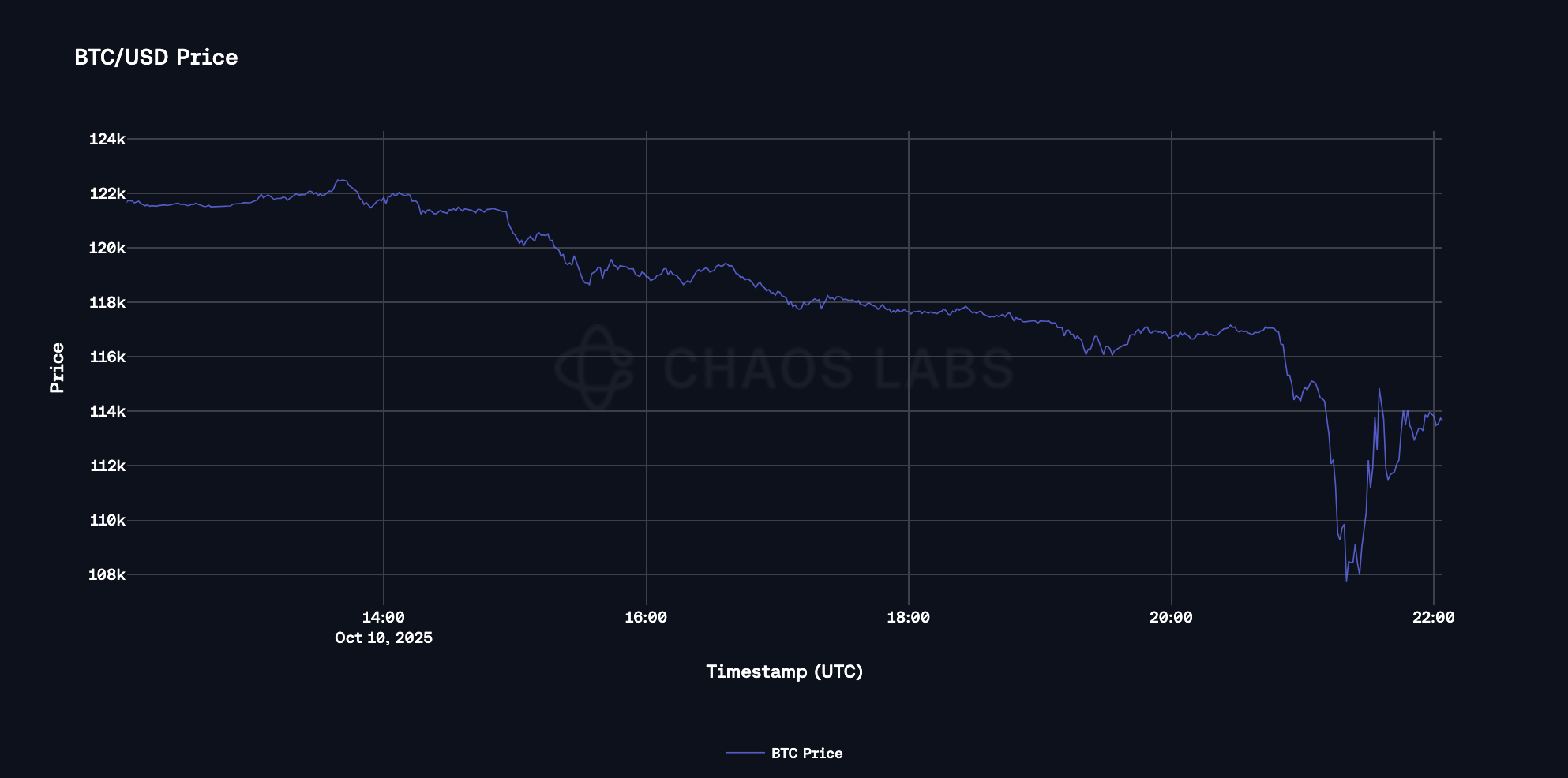
Liquidation Volume

The market downturn triggered a broad wave of liquidations across Aave instances, primarily concentrated in BTC, ETH and WSTETH markets. Total onchain liquidation volume reached approximately $180 million.


The event generated approximately $10 million in liquidation bonuses, of which $1 million was paid to the DAO treasury as liquidation fees.

Bad Debt

In accordance with the market downturn, certain positions failed to clear due to thin liquidity and gas spikes, alongside significant oracle delays. As of writing, the protocol accrued approximately $400,000 in deficits outstanding. The majority of this deficit originated from CRV and ENS debt positions, which faced limited onchain liquidity during the drawdown and thus enabled effective arbitrage by an entity simply based on the ability to utilize the ETH generalized config (83% LT) to borrow assets whereby the price oracle had not updated sufficiently relative to onchain prices, leading to bad debt.
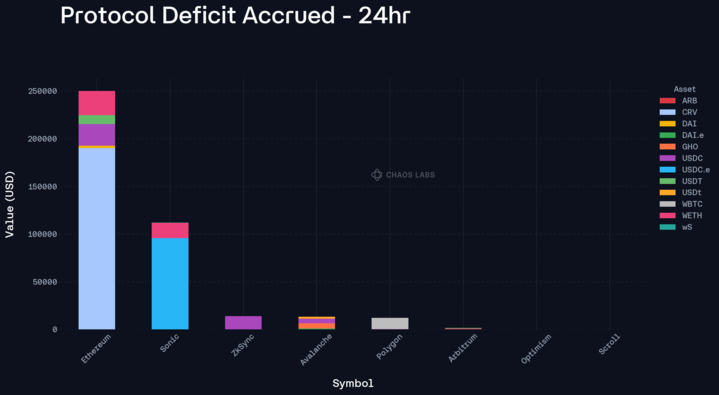
One notable ENS debt position, backed by only $2 in ETH collateral against roughly $88k in ENS debt, remains unliquidated due to its unprofitable liquidation conditions. As a result, this position is not reflected in the aggregated deficit data, among another $10K in external non-deficit expected bad debt.

Additionally, collateral contributions to the deficit mostly stemmed from LINK, wS and UNI exposures.

These positions represent a manageable shortfall as market conditions stabilize.

SVR

SVR liquidations generated approximately $1 million in additional revenues for the DAO, across $35M in liquidation volumes primarily stemming from WETH and BTC feeds.

However, the event temporarily impacted oracle performance, with the price updates delayed by 5 blocks for some markets. During the delay, onchain prices for AAVE and LINK SVR feed deviated by 45% and 32%, respectively, from their purported newTransmission value, while ETH exhibited a 6.51% dislocation. Specifically, this implies that, during severe price deviations such that oracle prices attempted to update nearly every block, the lagged state of the SVR feed until the cutoff window of 5 blocks made it such that the ultimate singular relative price update led to 30-40% price dislocations, and thus instantaneous reporting of collateral/debt value at levels of deficit accrual.

Since market prices rebounded shortly after, the delayed oracle updates did not result in further losses. Nonetheless, in a scenario where price declines had persisted, the lag could have led to an increase in bad debt due to delayed liquidations.

Conclusion

Overall, the flash crash resulted in approximately ~$500k in bad debt and expected deficit, primarily driven by illiquid CRV and ENS positions and SVR oracle delays. While this represents a moderate negative outcome, it was offset by liquidation activity that generated around $1 million in liquidation fees and an additional $1 million from SVR liquidations.

The protocol remained overall net positive, with an estimated net profit of $1.5 million following the event.

16 Likes

Great analysis, and indeed, it’s good to see that the protocol resulted in a net profit of $1.5M. A couple of observations: the core market should reduce its exposure to long-tail governance tokens (there could be a separate spoke-and-hub model for V4 to address this, following the Emergence market idea), mainly due to the lack of demand for these assets and their limited profitability.

Another observation is to explore asset pricing strategies to mitigate similar flash crash scenarios in the future. Overall, the asset pricing strategies worked very well and proved more resilient compared to liquidations in centralized trading and lending venues.

9 Likes

Great analysis and Aave handled it very well. Regarding the delay Chaoslabs was talking about, I do recall that in the initial ARFC for the activation of SVR there was a delay announced of 3-5 blocks initially. So from my understanding the system worked as intended, even for Aave or Link as an asset. Additionally I assume these delays will be removed over time for these assets as well. Right now these have the fallback oracle in place, also stated in the initial ARFC. If the fallback oracle isn’t needed anymore the delay should be gone as well.

Then I do agree with Stani here, these long tail assets should be reduced and off boarded eventually from Aave V3. Their usecase and revenue is low, but their risk is high. V4 may be something different with the spokes model, but currently not good. I think it’s clear that Aave V3 is focused on Stablecoins, ETH and BTC correlated assets.

8 Likes

Thanks for this insightful report on the Oct 10-11 market events.

As a user impacted, I suspect a Chainlink oracle discrepancy led to my over-liquidation on Aave V3 Ethereum. Tx: 0x25ac1401d415e3affec85bec4ba0b13fad504b99004b6254024d04c237b8a02e (block 23,549,995, Oct 10, 21:25 UTC).

Request: Can @ChaosLabs check the LINK/USD feed at that block? It implied ~$9.74/LINK (vs. market ~$17+), causing significant excess seizure. If confirmed as an outlier (e.g., Binance wick), is there a refund process?

2 Likes

I was also affected by the October 10 incident. I’m preparing my claim to Aave through this channel to see if there’s any refund process, as what happened shouldn’t occur to active and loyal users of the protocol.
Unfortunately, there’s no direct channel to contact Aave about this case.
I’d truly appreciate it if you could reach out or let me know how to formally submit this claim — I lost all my life savings. :folded_hands:t2:

2 Likes

Hi,
im sorry for your financial loss here, but there is nothing that can be done.
Its up to every user to manage their position and keep them safe.

Do you think they’ll even review my incident? Objectively, it appears that way too much collateral was taken from me….

1 Like

Sorry Bruce. I’ll keep you posted if I get any good intel. Feel free to dm me on discord rich019232 .

1 Like

This is scary. I have checked the chainlink’s own price history, as well as coingecko.

There isn’t any place that indicated the price was below $10/LINK.

The LPs and community need an explanations.

What happened on this hash can happen in other assets.

2 Likes

Checking the data onchain the lowest price I could find was 9.38$ at block 23549988.
This was just a quick and dirty lookup.
Asset link
Mainnet Aave V3 core

1 Like

Even at that price it doesn’t explain the surplus of collateral wiped out. I thought these systems were to guard against the minority exchanges having a flash crash. I knew my risk, but this just doesn’t seem right or fair.

I assume you are talking about the liquidation penalty that is visible to everyone for each asset? For Link it’s 7%.

1 Like

Thanks for clarifying the 7% liquidation bonus for LINK—that helps explain part of the surplus collateral seized.

To double-check with my specific numbers from the tx (0x25ac1401d415e3affec85bec4ba0b13fad504b99004b6254024d04c237b8a02e at block 23549995):

  • Debt repaid: ~$157,266 USDC

  • Collateral seized: ~16,960.64 LINK

Accounting for the bonus, the implied oracle price comes out to approximately $9.92 (calculated as (debt repaid × 1.07) / collateral seized).

This is above the absolute lowest oracle price of $9.385 you found at block 23549988, which aligns since my liquidation happened 7 blocks later—prices were volatile and likely recovering slightly.

That said, from what I’ve seen on major exchanges and data providers like CoinGecko/Binance, LINK’s market low during the crash was around $10.10-10.20, not sub-$10. The report here mentions significant oracle delays (up to 5 blocks) and a 32% price dislocation specifically for the LINK SVR feed during the event.

Could this dislocation or lag have caused the oracle to reflect an outdated/minority exchange wick, leading to an undervalued price and thus more collateral seized than necessary? Even a small discrepancy in such a rapid crash amplifies the impact.

Additionally, given that my HF likely dropped below 0.95 quickly, it enabled a near-full close (98% of debt repaid) rather than a partial 50% liquidation that might have left me with a repositioned position. Is there room to revisit the close factor thresholds or add mechanisms for more gradual liquidations in extreme volatility to better protect users?

@ChaosLabs (or anyone with access), could you verify the exact LINK/USD oracle value from Chainlink at block 23549995 and compare it to spot prices on major exchanges at the timestamp (Oct 10, 2025, 21:25 UTC)? If there was an anomaly due to the reported delays, is there any process for reviewing over-liquidations or potential refunds, especially since the protocol netted a profit overall?

Appreciate any insights—this event wiped out a big chunk of my position despite monitoring health factor closely, and I’d like to understand if it was truly unavoidable or if safeguards could be improved.

Thats a screenshot from Binance:


Reporting a price of as low as 7.90$.
Looking at other similiar exchanges like Bitget, the price there was around 8.20$.
So im not sure where you have those numbers from, but all major exchanges and the Chainlink Oracle showed a price of under 10$ for several minutes/blocks.

Regarding your delay…
This delay even could have saved you, as by the time the price got updated after 5 blocks, it may have been above your liquidation price. But it seems like your position was long enough with a HF below 1.
Liquidations for v3 will likely stay the same and won’t change. Aave v4 will introduce softer liquidation auctions.

And Im sorry to say it, but we are all responsible for our actions. If you got liquidated during this event, there is nothing that can be done.
I myself had to secure my positions as well, as I did not expect a sharp drop that like.

1 Like