[Direct to AIP] Onboard syrupUSDC to Aave V3 Base Instance

[Direct to AIP] Onboard syrupUSDC to Aave V3 Base Instance

Author: ACI

Date: 2025-10-09

Proposal updated with Risk Parameters provided by Risk Service Providers 2025-12-23

Summary

This ARFC proposes to onboard syrupUSDC to Aave V3 Base Instance.

This proposal will be a Direct to AIP.

Motivation

With the recent approval of syrupUSDC on the Core Instance following BGD Labs’ updated technical review we now propose to onboard syrupUSDC to the Base Instance. We propose this under the Direct to AIP framework.

We believe that the Base instance has strong growth prospects and with an increase in high demand collateral assets we will see rate of growth pick up. syrupUSDC is a good candidate for onboarding to Base for these reasons.

We recommend an eMode be created with USDC and GHO as borrow assets.

Specification

Specification

Configuration

Parameter Value
Isolation Mode No
Borrowable Yes
Collateral Enabled No
Supply Cap 50,000,000
Borrow Cap -
Debt Ceiling -
LTV 0.10%
LT 0.05%
Liquidation Bonus 4%
Liquidation Protocol Fee 10%
Variable Base -
Variable Slope1 -
Variable Slope2 -
Uoptimal -
Reserve Factor -
Stable Borrowing Disabled
Flashloanable Yes
Siloed Borrowing No
Borrowable in Isolation No
E-Mode Category syrupUSDC/Stablecoins

E-Mode Configuration

Parameter Value Value Value
Asset syrupUSDC USDC GHO
Collateral Yes No No
Borrowable No Yes Yes
Max LTV 90.00% - -
Liquidation Threshold 92.00% - -
Liquidation Bonus 4.00% - -

CAPO

maxYearlyRatioGrowthPercent ratioReferenceTime MINIMUM_SNAPSHOT_DELAY
8.04% monthly 7
syrupUSDC: Syrup: syrupUSDC Token | Address: 0x66097573...0173100f5 | BaseScan

Useful Links

Disclaimer

ACI is not directly affiliated with Maple and did not receive compensation for the creation of this proposal.

Next Steps

  1. Publish proposal to gather community and Service Providers feedback.
  2. Publish an AIP vote for final confirmation and enforcement of the proposal.

Copyright

Copyright and related rights waived under CC0

2 Likes

LlamaRisk does not recommend onboarding syrupUSDC on Base at this stage, as the network currently holds only 108 syrupUSDC in supply. We are in contact with the Maple team and will revisit the proposal once the token’s supply and liquidity have been bootstrapped following the commercial launch.

2 Likes

Overview

Chaos Labs supports listing syrupUSDC on Aave V3’s Base instance. Below is our analysis and risk parameter recommendations for the initial listing.

Technical Overview

Chaos Labs has conducted a comprehensive technical evaluation of syrupUSDC on Ethereum; the full assessment can be found here. At a high level, syrupUSDC is Maple Finance’s yield-bearing representation of USDC deposited into the Maple credit pool. It is an ERC-4626 vault token that tokenizes a pro-rata claim on a diversified portfolio of institutional loans originated and managed by Maple Direct. Users mint syrupUSDC by supplying USDC to the pool and receive vault shares whose value increases as interest accrues on both fixed-term and open-term credit exposures.

The syrupUSDC on Base is bridged using Chainlink CCIP, which burns syrupUSDC on the source chain and mints it on the destination chain. When a user initiates a transfer, the CCIP Router sends their syrupUSDC to the chain’s designated token pool, which is authorized to destroy the tokens. CCIP then relays a verified cross-chain message to the destination network, where the corresponding token pool, holding the minting rights, creates the same amount of syrupUSDC for the recipient. Any minor price deviations of bridged syrupUSDC on Base are expected to be corrected by cross-chain arbitrage.

Technical Implementation

The MaplePool contract is an immutable ERC-4626 vault that holds USDC and mints or redeems syrupUSDC, while delegating control, permissions, and accounting to its paired PoolManager. The PoolManager gates all state-changing Pool entry points via its canCall hook, deploys liquidity into loans through LoanManager modules, coordinates withdrawals through a queue-based WithdrawalManager, and maintains pool accounting by aggregating on-chain cash, outstanding principal, and accrued interest net of fees. Pool value accrues through an increasing exchange rate rather than rebasing, with deposits priced at the deposit exchange rate and redemptions settled at the withdrawal exchange rate. When users request redemption, their shares are escrowed in the WithdrawalManager and processed FIFO as liquidity becomes available, with payouts calculated using the exit exchange rate (totalAssets − unrealizedLosses) / totalSupply.

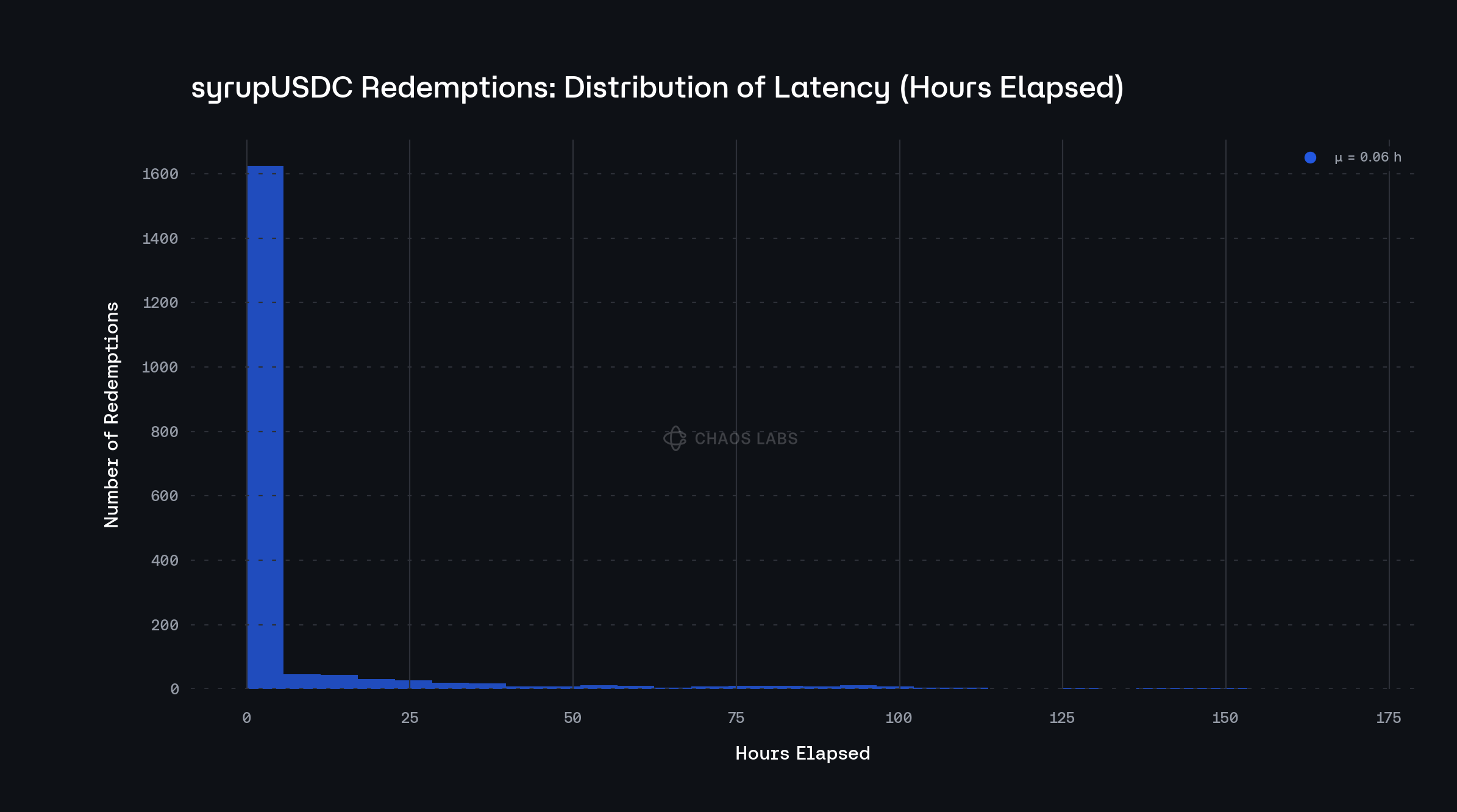
In our initial visit, we analyzed all redemption events from July 2024 through June 2025 and observed that most redemptions were processed within roughly one hour. The updated dataset shows the same behavior: even very large redemptions exceeding $10M move quickly through the queue and are executed promptly by the PoolManager.

As illustrated in the chart, 81.03% of all redemptions complete within one hour and 91.19% settle within 24 hours. The distribution is highly skewed toward fast processing, with a median redemption latency of 0.06 hours.

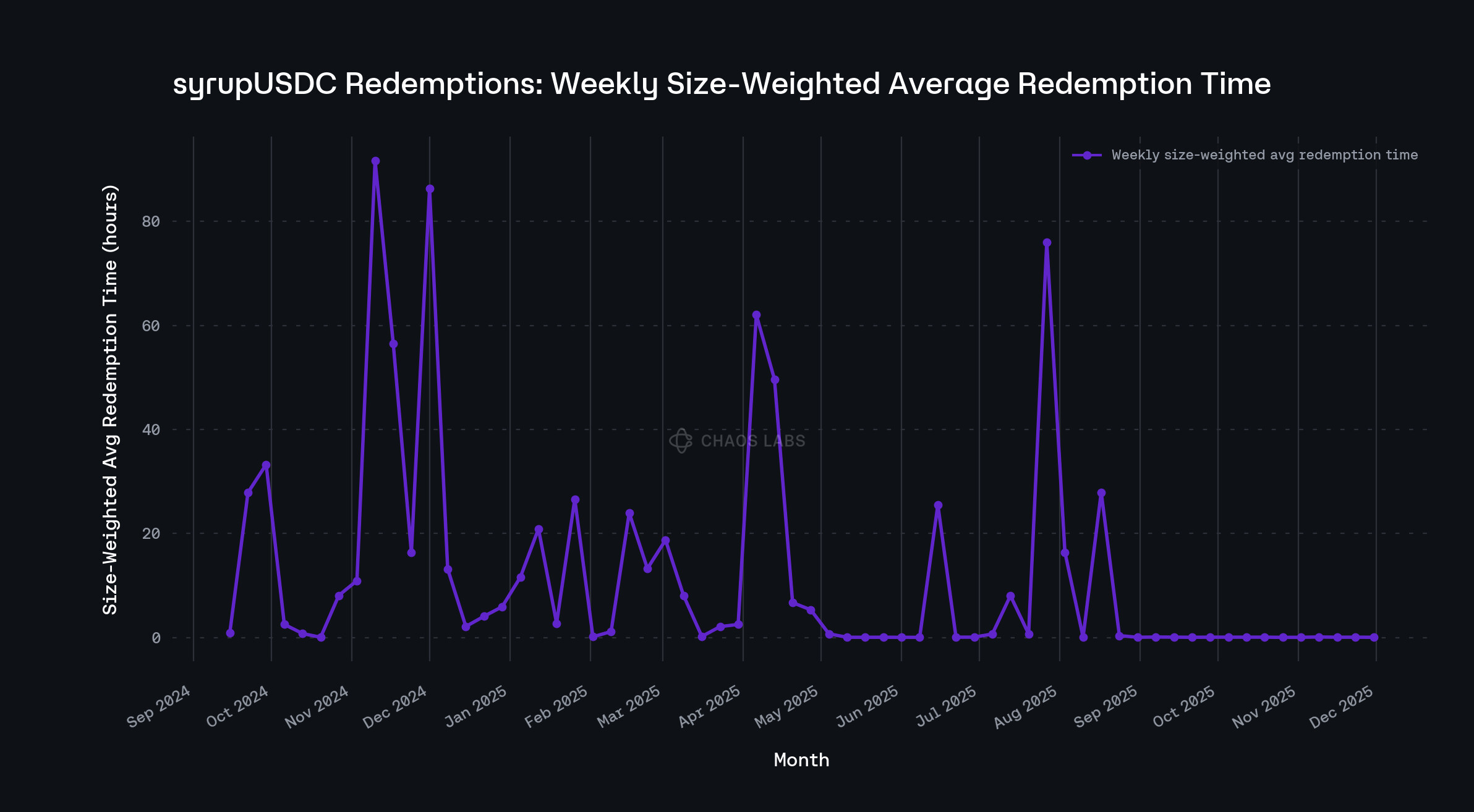
Then, examining weekly redemption dynamics, the chart below reports the average processing time for all events between September 2024 and December 2025. While modest week-to-week fluctuations are observable, redemption latency remains generally low throughout the period. Notably, over the past three months, the average redemption time for syrupUSDC has remained firmly below one hour.

Reserve Backing Update

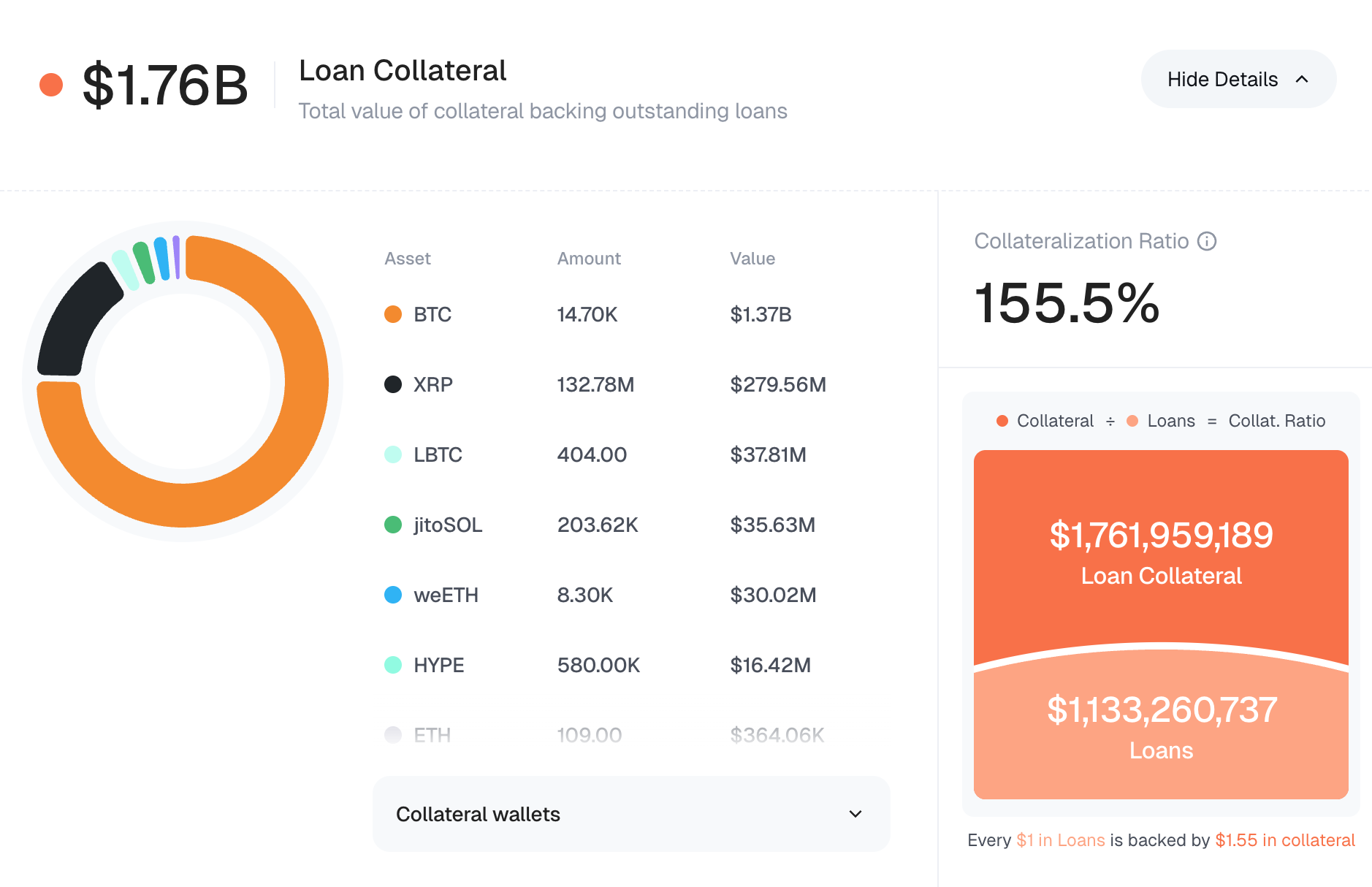
Collateral backing Maple’s USDC and USDT loan books currently totals $1.76B, against $1.15B in outstanding stablecoin loans, implying an aggregate collateralization ratio of 153%. BTC remains the dominant form of collateral at 77.4% of the total, or roughly $1.37B. In addition to loan collateral, Maple pools hold approximately $1.17B in DeFi liquidity deployed across secondary strategies; these positions function as liquid reserves that can be recalled to facilitate redemptions and have grown meaningfully since our prior review. Unlike syrupUSDT, none of syrupUSDC’s backing is deployed on Aave, so it does not carry the reflexive liquidity risk discussed in our syrupUSDT analysis.

In addition, after discussions with the Maple team, we further explained in this post their collateralized credit-lending risk-parameter framework and the systemic linkage between syrupUSDC and syrupUSDT. This outlines how risk and collateral mechanisms are configured across pools and how, under extreme conditions, the two syrupUSD pools could potentially transmit risk from one to the other.

Market Cap & Liquidity

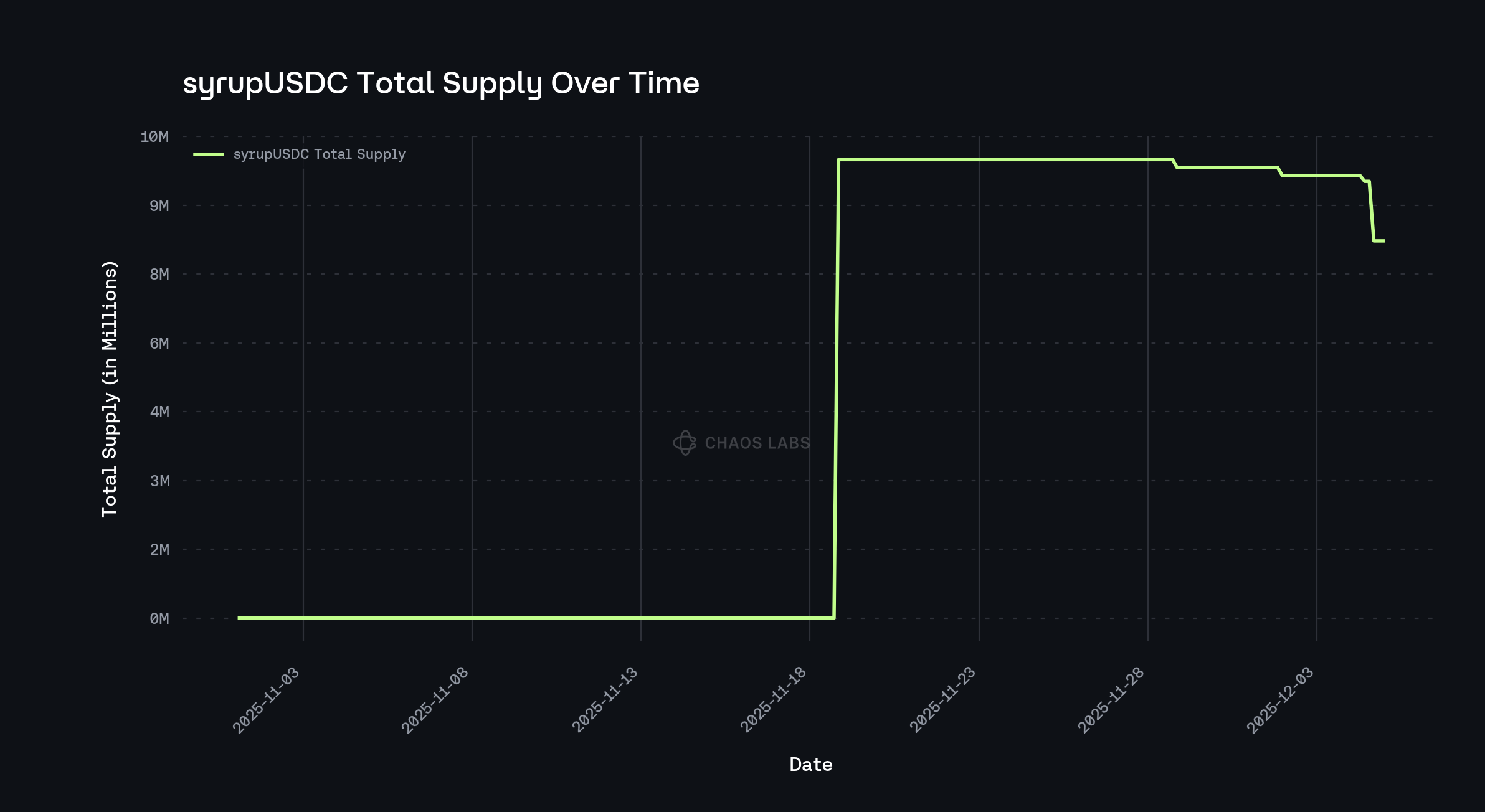
syrupUSDC’s total supply on Base showed significant growth in November 2025, reaching approximately 10M in mid-November. As of this writing, the total supply stands at 9.8M, translating to a market cap of $11.3M and indicating a strong upward trend.

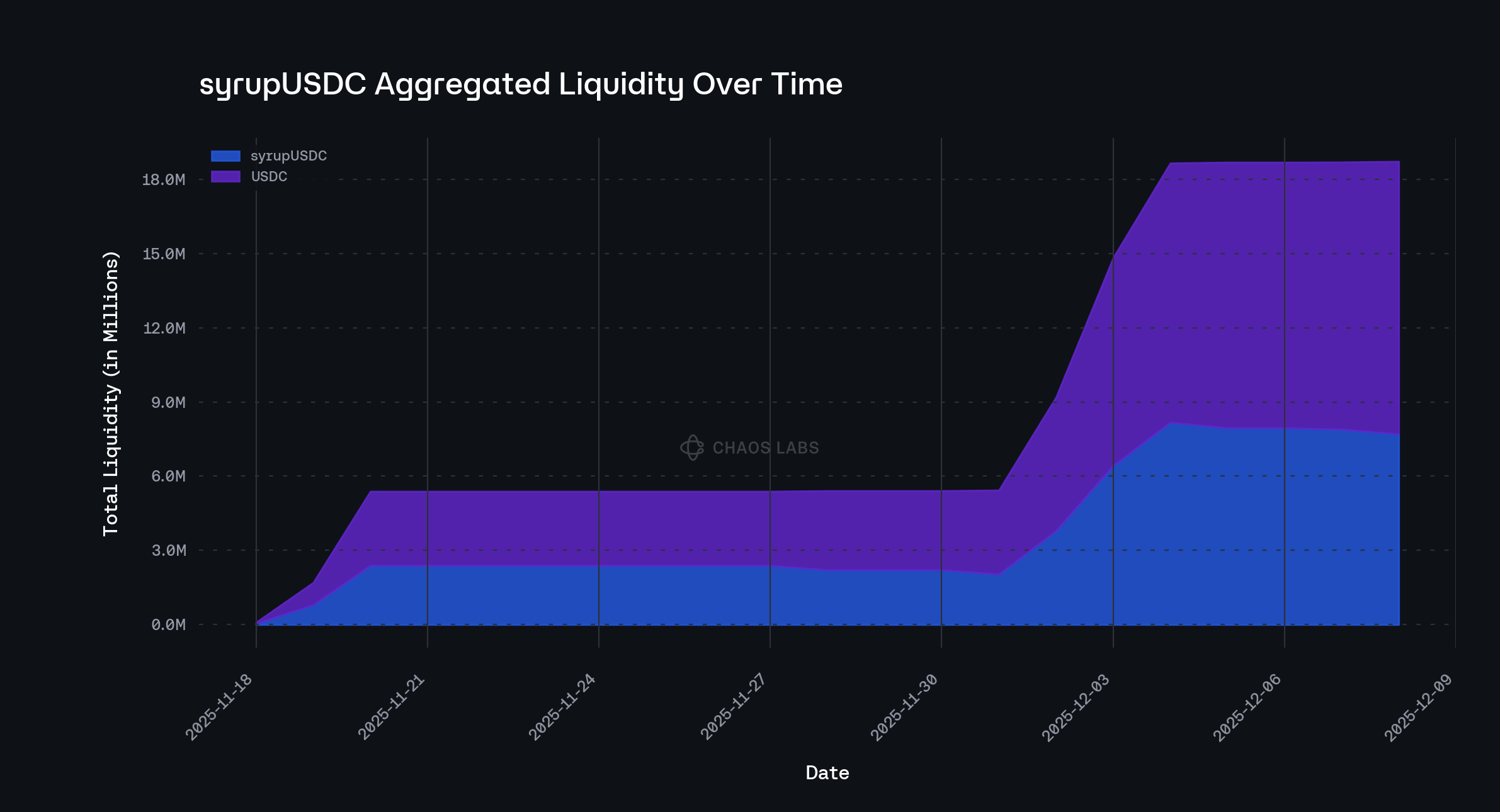
syrupUSDC’s liquidity is currently concentrated in two primary venues: the Fluid syrupUSDC/USDC liquidity pool with a $10M TVL and the Aerodrome syrupUSDC/USDC liquidity pool with a $9.8M TVL. Together, these two pools account for 99% of the total syrupUSDC supply on Base. Below, we show the aggregated liquidity of syrupUSDC across these two pools. As illustrated, syrupUSDC liquidity has been on a steady upward trend, with a notable increase toward the end of November 2025.

Peg Stability

Peg stability evaluates whether the exchange rate users receive through syrupUSDC’s internal exit path is strongly aligned with the exchange rate available through secondary-market exit paths. Below, we present the syrupUSDC-to-USDC market exchange rate from the syrupUSDC/USDC Aerodrome liquidity pool, alongside syrupUSDC’s internal exchange rate fetched from the convertToExitAssets function.

As shown, syrupUSDC’s internal exchange rate and market exchange rate have consistently maintained a robust peg, with maximum deviation at 14 bps. This demonstrates that the protocol’s internal exit exchange rate is tightly aligned with secondary-market liquidity and that syrupUSDC maintains strong redeemability across both exit paths.

Parameter Recommendations

E-Mode

Given syrupUSDC’s nature as a yield-bearing stablecoin, its primary practical use case on a lending market is expected to be leverage looping: using syrupUSDC as collateral to borrow stablecoins and amplify exposure to the underlying yield. Therefore, we recommend enabling syrupUSDC only as collateral and restricting its collateral usage exclusively to E-Mode following the implementation of the Aave 3.6 update.
In anticipation of the update, we recommend adopting minimal temporary collateral parameters, making the asset unattractive for usage outside its designated E-Mode.

Supply Cap

Considering the ample liquidity, its consistently upward trajectory since creation, and the orderly redemption behavior, we believe a higher supply cap for syrupUSDC is justified. Specifically, we recommend setting the supply cap at 50M.

Oracle Implementation & CAPO

Consistent with the implementation used for syrupUSDC on Ethereum, Chaos Labs recommends utilizing a USDC/USD price feed augmented with the convertToExitAssets() value from the syrupUSDC contract. In the event that any practical deficit is observed within a Maple debt position following liquidation, this exchange rate will be adjusted to account for the underlying shortfall.

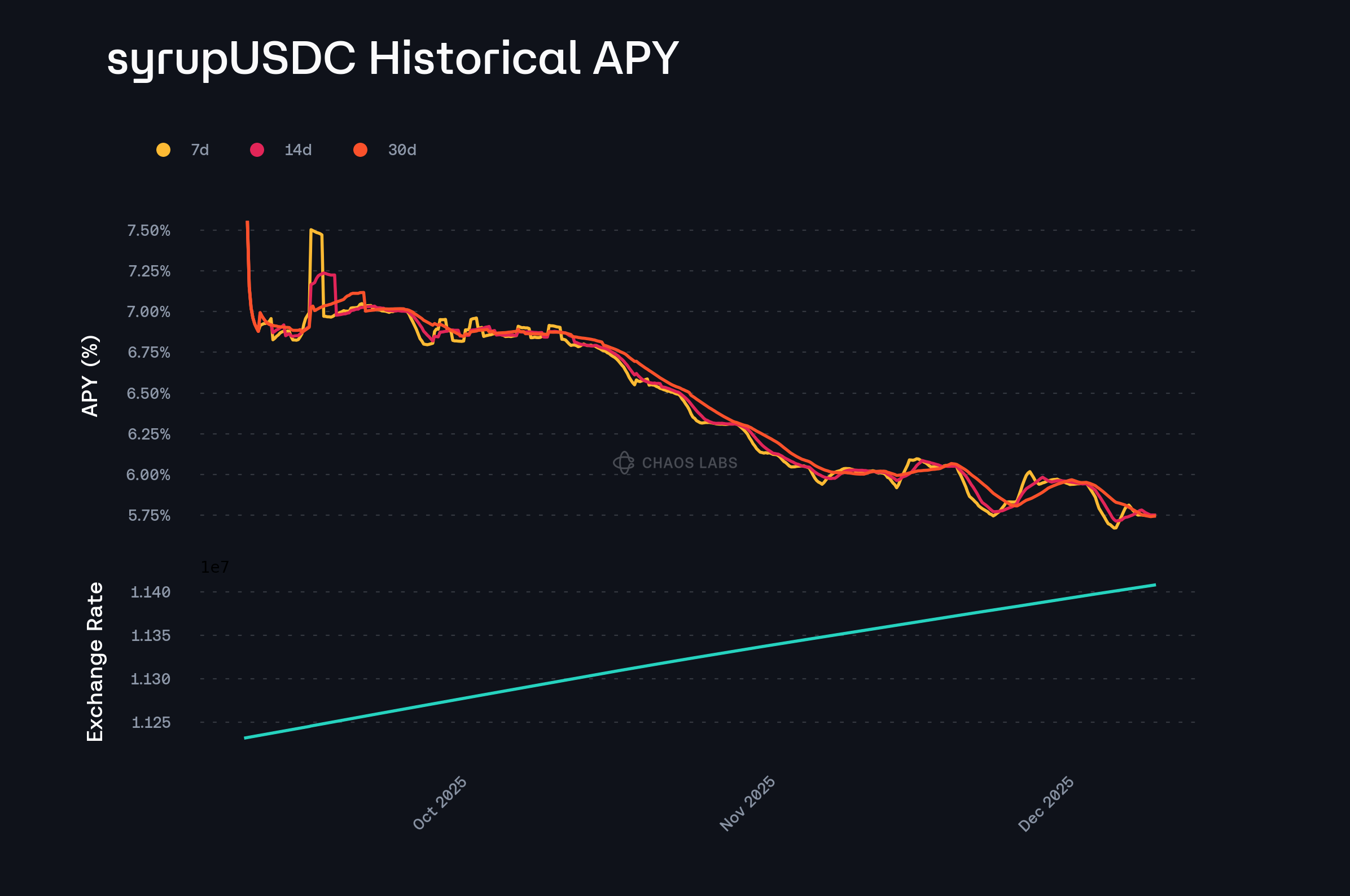
This mechanism will also be protected through CAPO. As shown below, syrupUSDC’s yield has exhibited minor volatility over the past three months. Taking this into consideration, we recommend setting the Snapshot Delay to 7 days and the maxYearlyGrowthRatio to 8.04%.

Specification

Configuration

Parameter Value
Isolation Mode No
Borrowable No
Collateral Enabled Yes
Supply Cap 50,000,000
Borrow Cap -
Debt Ceiling -
LTV 0.05%
LT 0.10%
Liquidation Bonus 4%
Liquidation Protocol Fee 10%
Variable Base -
Variable Slope1 -
Variable Slope2 -
Uoptimal -
Reserve Factor -
Stable Borrowing Disabled
Flashloanable Yes
Siloed Borrowing No
Borrowable in Isolation No
E-Mode Category syrupUSDC/Stablecoins

E-Mode Configuration

Parameter Value Value Value
Asset syrupUSDC USDC GHO
Collateral Yes No No
Borrowable No Yes Yes
Max LTV 90.00% - -
Liquidation Threshold 92.00% - -
Liquidation Bonus 4.00% - -

CAPO

maxYearlyRatioGrowthPercent ratioReferenceTime MINIMUM_SNAPSHOT_DELAY
8.04% monthly 7

Disclosure

Chaos Labs has not been compensated by any third party for publishing this recommendation.

Copyright

Copyright and related rights waived via CC0.

2 Likes

https://governance.aave.com/t/23234

Summary

LlamaRisk recommends onboarding syrupUSDC on Base at this stage, as supply has successfully bootstrapped over the past month and currently exceeds $10M. SyrupUSDC on Base is supported by approximately $20M of DEX liquidity, fully supplied by the Maple team. Consistent with our previous assessments of syrupUSDC and syrupUSDT, no new structural concerns are identified.

syrupUSDC on Base has robust administrative controls in place, with a 1-day delay on contract upgrades enforced via a GovernorTimelock controlled by Maple’s 4-of-8 threshold multisig and an EOA (if not MPC-based, a multisig configuration is recommended). 44.6% of the USDC backing syrupUSDC is deployed into Open Term Loans at a 146.9% collateralization ratio, with loans primarily collateralized by BTC and XRP. The remaining USDC is maintained as active liquidity to support syrupUSDC redemptions and is deployed across various DeFi protocols by Maple.

1. Asset Fundamental Characteristics

1.1 Asset

According to the Asset Classification Framework (AAcA), syrupUSDC is classified as a yield-bearing stablecoin backed by overcollateralized institutional loans underwritten and managed by Maple Direct. The syrupUSDC ERC-4626 vault currently manages 1.64B USDC, representing the sum of all USDC deposited into the pool and managed by various syrupUSDC strategies. A portion of this backing is allocated to maintain readily available liquidity for redemptions. This liquidity is deposited across various DeFi protocols on Ethereum, including Aave. Consequently, the underlying yield is derived from both the active loans and the DeFi yield generated on the liquidity reserves.

The current open term loan composition shows that the USDC backing syrupUSDC is lent out to loans primarily composed of BTC ($338M) and XRP ($253M). The overall collateralization ratio for USDC-based loans stands at 146.9%, with a total of $732M USDC lent out.


Source: LlamaRisk, December 18, 2025

1.2 Architecture

The primary architecture of syrupUSDC was discussed in detail during the V3 Core onboarding, and no changes have been made to its design or functionality. The core operations of syrupUSDC, including fixed-rate loan underwriting and liquidity management, are managed on Ethereum by Maple.

Issuance of syrupUSDC on Base is facilitated through Chainlink’s CCIP bridge, employing a lock-and-mint mechanism in which tokens remain locked in the LockReleaseTokenPool contract on Ethereum while syrupUSDC is bridged to Base. Conversely, transfers from Base back to Ethereum follow a burn-and-unlock mechanism.

1.3 Tokenomics

The loan underwriting infrastructure for syrupUSDC resides on Ethereum; therefore, its supply on Base remains capped by the total amount of syrupUSDC minted on Ethereum, i.e., 1.43B. As of December 18, 2025, the total supply of syrupUSDC on Base stands at 10.68M.

1.3.1 Token Holder Concentration


Source: BaseScan, December 18, 2025

The top 3 holders of syrupUSDC on Base are:

These three holders collectively control over 99.99% of syrupUSDC’s supply on Base. This high utilization across DEXs is generally positive and provides a safe liquidity buffer to support Aave supply logistics.

2. Market Risk

2.1 Liquidity


Source: syrupUSDC/USDC Swap Liquidity, Odos, December 18, 2025

On Base, users can swap up to 7.3M syrupUSDC worth $8.34M for 8M USDC within a price impact of 4%.

2.1.1 Liquidity Venue Concentration


Source: syrupUSDC DEXs on Base, GeckoTerminal, December 18, 2025

syrupUSDC liquidity on Base is concentrated in two venues: Fluid syrupUSDC/USDC pool ($9.99M TVL) and Aerodrome syrupUSDC/USDC pool ($9.93M TVL).

2.1.2 DEX LP Concentration

syrupUSDC liquidity on Base is highly concentrated in the two DEX venues, with the liquidity provider being Maple themselves. This concentration reduces the likelihood of an abrupt liquidity withdrawal, as protocol-controlled liquidity is generally more stable and less prone to sudden outflows. Below is the LP concentration breakdown for the two pools on Base (as of December 18, 2025):

  • Fluid syrupUSDC/USDC: The top supplier is Maple with ~100% share of the pool’s liquidity.
  • Aerodrome syrupUSDC/USDC: The top supplier here is also Maple with ~100% share of the pool’s liquidity.

2.2 Volatility


Source: LlamaRisk, December 18, 2025

The syrupUSDC Fluid pool on Base has consistently traded within a 10 bps range with respect to the syrupUSDC-USDC exchange rate since December 1, 2025, when the liquidity was bootstrapped by Maple, with the current composition of the pool being $4.57M in syrupUSDC and $5.46M in USDC.

2.3 Exchanges

syrupUSDC is exclusively traded on DEXs and is not currently listed on any centralized exchange.

2.4 Growth


Source: LlamaRisk, December 18, 2025

To date, a total of 1.44B syrupUSDC has been minted on Ethereum, out of which 10.68M is currently supplied to Base via a lock-and-mint mechanism as the token is only natively issued on Ethereum. Its total supply on Base remains capped by the available circulating supply on Ethereum, which stands at 1.43B.

3. Technological Risk

The technological risks associated with syrupUSDC on Ethereum, including smart contract risk, bug bounty coverage, and dependency risk, remain unchanged from our syrupUSDC Core onboarding review and are omitted here for brevity, as the underlying architecture is identical. On Base, however, an additional dependency exists on Chainlink CCIP due to its role in facilitating cross-chain transfers of syrupUSDC between Ethereum and Base.

4. Counterparty Risk

4.1 Governance and Regulatory Risk

The regulatory risk has been previously discussed in detail as part of the syrupUSDC Core onboarding review. As there have been no material changes, that assessment remains applicable here.

4.2 Access Control Risk

4.2.1 Contract Modification Options

Here are the syrupUSDC controlling wallets on Base:

The following contracts power the syrupUSDC architecture on Base:

  • syrupUSDC: Immutable ERC20 contract for the syrupUSDC token controlled by the GovernorTimelock.
  • BurnMintTokenPool: Pool implementation responsible for minting/burning tokens (syrupUSDC) on the destination chain (Base) and is owned by the RBAC Timelock.

syrupUSDC employs a role-based access control framework to manage sensitive functions:

Controlling Addresses Role Functionality
GovernorTimelock DEFAULT_ADMIN_ROLE Can change all privileged roles
BurnMintTokenPool MINTER_ROLE Can mint syrupUSDC on Base
BurnMintTokenPool BURNER_ROLE Can burn syrupUSDC on Base

4.2.2 Timelock Duration and Function

A delay of 1 day (86400 seconds) has been implemented on the syrupUDSC contract upgrades via the GovernorTimelock.

4.2.3 Multisig Threshold / Signer identity

Maple-controlled Multisig A (4/8 Safe) and EOA 1 are the admins of the GovernorTimelock contract, which has the following role-based access control:

Controlling Addresses Role Functionality
Multisig A, EOA 1 ROLE_ADMIN Can update roles including the role admin role itself
EOA 2, Multisig B EXECUTOR_ROLE Can execute all proposals including role updates
Multisig A PROPOSER_ROLE Can schedule proposals but can not schedule role updates
Multisig C CANCELLER_ROLE Can unschedule proposals but can not unschedule role updates

Note: This assessment follows the LLR-Aave Framework, a comprehensive methodology for asset onboarding and parameterization in Aave V3. This framework is continuously updated and available here.

Aave V3 Specific Parameters

Aligned and presented with @ChaosLabs above.

Price feed Recommendation

Chainlink’s syrupUSDC/USDC Exchange Rate feed, combined with the USDC/USD base feed and CAPO can be used to price syrupUSDC on Aave’s Base market.

Disclaimer

This review was independently prepared by LlamaRisk, a DeFi risk service provider funded in part by the Aave DAO. LlamaRisk is not directly affiliated with the protocol(s) reviewed in this assessment and did not receive any compensation from the protocol(s) or their affiliated entities for this work.

The information provided should not be construed as legal, financial, tax, or professional advice.

1 Like

syrupUSDC (cross-chain) technical analysis


Summary

Following the proposal for listing syrupUSDC on Base, we examined the Maple Team’s implementation of the cross-chain asset.

This is a technical analysis of all the smart contracts of the syrupUSDC on Base and main bridge dependencies.

Disclosure: This is not an exhaustive security review of the asset like the ones done by the Maple team, but an analysis from an Aave technical service provider on different aspects we consider critical to review before a new type of listing.


Analysis

The extensive SyrupUSDC evaluation on Ethereum is available here. On Base, SyrupUSDC is a cross-chain asset bridged from Ethereum via Chainlink’s CCIP infrastructure, which shares the same architecture as the cross-chain syrupUSDT on Plasma, already listed on Aave.


General points

  • The syrupUSDC contract uses the standard Chainlink’s CCIP contracts for lock/release on Ethereum and mint/burn on Base.
  • It relies on two non-upgradable contracts controlled by the Maple’s timelock and Chainlink’s RBACTimelock.
  • For access control, it uses OZ role-based.

Contracts

The following is a non-exhaustive overview of the main smart contracts involved with syrupUSDC on Base:


SyrupUSDC

It represents the cross-chain syrupUSDC token, which extends standard minting and burning functionality through role-based access control.

Permission Owner functions Criticality Risk
ADMIN_ROLE: 3-day Timelock setCCIPAdmin, grantRole HIGH :green_circle:
MINTER_ROLE: TokenPool mint HIGH :green_circle:
BURNER_ROLE: TokenPool burn, burnFrom HIGH :green_circle:

  • Access Control
    • The ADMIN_ROLE can set the s_ccipAdmin via the setCCIPAdmin(address) method. It’s important to mention that the s_ccipAdmin doesn’t have any special access control within the system.
  • Minting and Burning
    • The TokenPool controls the minting and burning of syrupUSDC through the mint(to, amount) , burn(amount), burnFrom(from, amount) functions.

TokenPool

The TokenPool contract manages cross-chain token activities through CCIP’s router contract, enabling the minting and burning of syrupUSDC. It manages token decimals across various chains, enforces rate limiting, and employs role-based access control.

Base: TokenPool

Permission Owner functions Criticality Risk
owner: RBACTimelock setRouter, addRemotePool, removeRemotePool, applyChainUpdates, setRateLimitAdmin, applyAllowListUpdates HIGH :green_circle:

Mainnet: TokenPool

Permission Owner functions Criticality Risk
owner: RBACTimelock setRouter, addRemotePool, removeRemotePool, applyChainUpdates, setRateLimitAdmin, applyAllowListUpdates, transferLiquidity HIGH :green_circle:

  • Access Control

    • The RBACTimelock can configure the cross-chain between new chains through the addRemotePool(), removeRemotePool(), and applyChainUpdates() functions. It can also configure the allowlist via the applyAllowListUpdates() and set a rate limiter contract by calling the setRateLimitAdmin() method.

    • The liquidity locked in a previous TokenPool can be migrated to the new (current) TokenPool via the transferLiquidity(amount) function.

  • Bridging

    • For cross-chain syrupUSDC from Mainnet to Base, the call is initiated through the router.ccipSend(destChain, message) function. The syrupUSDC is locked in the TokenPool contract and then forwarded via the evmOnRap.forwardFromRouter(destChain, message) method.

    • To send it back to the mainnet, it uses the same process via the router by calling the ccipSend(destChain, message) function. The token amount is burned on Base by the TokenPool, and the message is forwarded to the mainnet via the offRamp. executeSingleMessage(msg), where the TokenPool contract receives a releaseOrMint(releaseOrMintIn) call and transfers the syrupUSDC to the user.


Pricing strategy

We recommend pricing syrupUSDC with a CAPO Adapter using the syrupUSDC/USDC exchange rate along with the Capped USDC/USD Price feed.

Miscellaneous

  • The security reviews of the CCIP contracts’ infrastructure used in syrupUSDC are available here.

Conclusion

We believe syrupUSDC has no issues with Aave integration and no major blockers for listing.

2 Likes