[Direct to AIP] Onboard syrupUSDT to Aave V3 Core Instance

[Direct to AIP] Onboard syrupUSDT to Aave V3 Core Instance

Author: ACI

Date: 2025-10-22


Proposal has been updated with latest risk parameters by Risk Service Providers 2025-11-27

Summary

This proposal seeks to onboard syrupUSDT to Aave V3 Core Instance.

This proposal will be a Direct to AIP.

Motivation

With the recent approval of syrupUSDC on the Core Instance following BGD Labs’ updated technical review and syrupUSDT on the Plasma Instance, we propose to expand this asset to other networks beginning with the Core Instance. We propose this under the Direct to AIP framework.

There is significant demand for syrupUSDT to be used in Aave, and with the Core Instance having the deepest stablecoin liquidity we believe this is the logical next instance on which to onboard syrupUSDT.

Specification

syrupUSDT: Syrup USDT (syrupUSDT) | ERC-20 | Address: 0x356b8d89...474d5ba7d | Etherscan

Risk Parameters

Risk parameters will be provided by Risk Service Providers and the proposal will be updated accordingly.

Parameter Value
Isolation Mode No
Borrowable No
Collateral Enabled Yes
Supply Cap 50,000,000
Borrow Cap -
Debt Ceiling -
LTV 0.05%
LT 0.10%
Liquidation Bonus 6%
Liquidation Protocol Fee 10%

E-Mode

Parameter Value Value
Asset syrupUSDT USDT GHO
Collateral Yes No No
Borrowable No Yes Yes
Max LTV 90.00% - -
Liquidation Threshold 92.00% - -
Liquidation Bonus 4.00% - -

CAPO

maxYearlyRatioGrowthPercent ratioReferenceTime MINIMUM_SNAPSHOT_DELAY
8.45% monthly 7

Useful Links

Disclaimer

ACI is not directly affiliated with Maple and did not receive compensation for the creation of this proposal.

Next Steps

  1. Publish proposal to gather community and Service Providers feedback.
  2. Publish an AIP vote for final confirmation and enforcement of the proposal.

Copyright

Copyright and related rights waived under CC0

2 Likes

Summary

LlamaRisk preliminarily supports onboarding syrupUSDT to the Aave V3 Core market, conditional on the successful bootstrapping of on-chain liquidity, given the current absence of meaningful DEX depth. This is expected to improve with the planned deployment of a syrupUSDT/USDT pool (~$20M liquidity) by the Maple team later this week. Our assessment builds upon prior analyses of syrupUSDC and syrupUSDT, with no new structural concerns identified at this stage.

However, on Ethereum, nearly all of Maple’s USDT liquidity reserves are deployed within Aave, and during recent stress events (e.g., HTX withdrawals), these reserves have at times accounted for a significant portion (>30%) of Aave’s available USDT liquidity. Since Maple currently relies on these Aave deposits to meet redemptions in the absence of deep DEX liquidity, the setup introduces a degree of interdependence between the two systems. Thus, we recommend that any increase in syrupUSDT exposure on Aave be implemented gradually, alongside Maple maintaining adequate diversification of its liquidity reserves to reduce reliance on Aave for redemptions. This approach would help mitigate potential circular liquidity dependencies and ensure greater resilience during periods of market stress.

Asset Risk

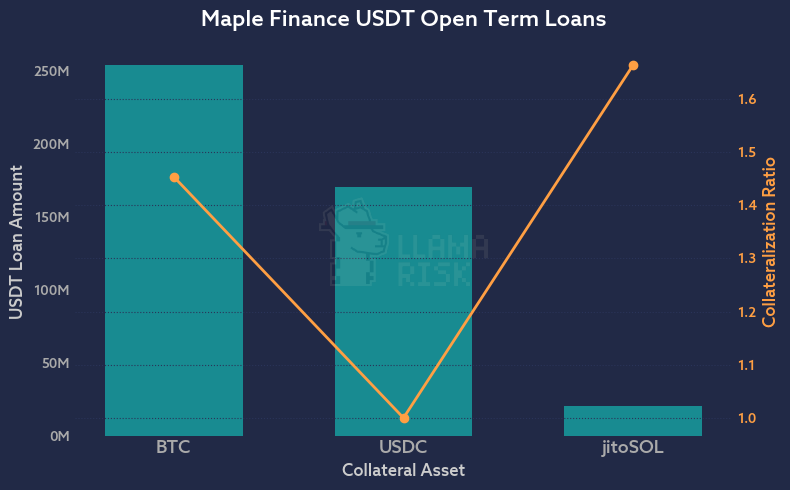
According to the Asset Classification Framework (AAcA), syrupUSDT is classified as a yield-bearing stablecoin backed by overcollateralized institutional loans underwritten and managed by Maple Direct. The syrupUSDT ERC-4626 vault currently manages 566.8M USDT, representing the sum of all USDT deposited into the pool and managed by various syrupUSDT strategies. The open-term loan composition shows that the USDT backing syrupUSDT is primarily lent out to BTC-collateralized borrowers, totaling $253.7M at an average collateralization ratio of 1.45x. Additional exposure includes $170M lent against USDC collateral at a 1.00x ratio (loan1, loan2), and $20M lent against jitoSOL collateral at 1.66x. In total, these loans account for roughly $444M of active lending, at a 1.29x ratio. When combined with the $122.5M supplied to Aave V3 Core as liquidity reserves via AaveStrategy, the aggregate matches syrupUSDT’s ~$567M in total USDT deposits, indicating that nearly all Maple’s USDT liquidity reserves are deployed within Aave, leaving redemptions primarily dependent on the Aave protocol’s available USDT liquidity.


Source: Maple Finance Active USDT Loans, LlamaRisk, October 27, 2025

This concentration creates a reflexive structure: a significant portion of syrupUSDT’s backing, $122.5M worth of aEthUSDT, is held within the same Aave market it seeks to be onboarded to. Since these reserves can be withdrawn by Maple to meet redemption demands, onboarding syrupUSDT introduces a circular dependency where part of its collateral is sourced from and simultaneously influences the Aave Core market’s own liquidity conditions.

During stress scenarios such as the recent HTX-related withdrawals, when USDT liquidity on V3 Core contracted sharply, Maple’s reserves accounted for over 30% of the market’s available USDT at times, as shown in the chart below. Even at lower balances below $200M (less than 5% of the total USDT Core market size), Maple’s aUSDT position has occasionally represented a meaningful share of available liquidity. We therefore recommend that Maple maintain adequate diversification of its liquidity reserves to reduce reliance on Aave as a single source of redemption liquidity, as correlated withdrawals during market stress could exacerbate liquidity strain on V3 Core.


Source: LlamaRisk, October 27, 2025

Introducing a syrupUSDT/USDT E-mode would encourage recursive positions where users borrow USDT to acquire more syrupUSDT, indirectly cycling USDT liquidity toward Maple. This would reduce available USDT liquidity on Aave and, during stress events, may contribute to temporary rate spikes as users unwind these loops or Maple withdraws liquidity to meet redemptions. While current exposure levels seem manageable, any increase in syrupUSDT exposure should be gradual and closely monitored to mitigate potential feedback effects.

Market Risk

Currently, only a single liquidity pool exists on Ethereum, the Uniswap V4 syrupUSDT/USDC pool, with limited liquidity of approximately $310. The Maple team has indicated that a syrupUSDT/USDT pool with projected liquidity of $20M is being set up, which, once live, should materially improve syrupUSDT’s secondary market depth.


Source: syrupUSDT DEX Liquidity, GeckoTerminal, October 27, 2025

To date, a total of 515.6M syrupUSDT has been minted on Ethereum, the majority of which has been bridged to Plasma. The current circulating supply on Ethereum stands at approximately 62M.


Source: Dune, October 27, 2025

Technological & Counterparty Risk

Since our previous assessment on July 3, 2025, the technological and counterparty risk profile of the protocol remains largely unchanged. The protocol underwent two new security audits for the 24-hour Governor Timelock Contract upgrade, with all identified findings either resolved or formally acknowledged by the team:

  • Sherlock (September 10, 2025): 3 low issues
  • 0xMacro (September 18, 2025): 1 low issue

Access Control

Here are the syrupUSDT controlling wallets on Ethereum:

  • GovernorTimelock: 24-hour RBAC timelock controlled by Maple, handles protocol-wide admin functions such as redemptions, role/parameter changes.
  • PoolDelegate: Syrup-controlled MPC, with upgrade functionality over PoolManager, WithdrawalManagerQueue, and LoanManagers.
  • SecurityAdmin: 3/6 Safe multisig, can call emergency pause function (freezes the protocol entirely).
  • OperationalAdmin: 3/5 Safe multisig, can execute a subset of operational functions.

The following contracts power syrupUSDT on Ethereum:

  • syrupUSDT Pool: Immutable ERC4626 standard vault, allows users to exchange USDT for syrupUSDT token.
  • PoolManager: Upgradeable contract managing core accounting of the pool contract, controlled by PoolDelegate.
  • FixedTermLoanManager: Upgradeable contract, manages fixed-term loan types on behalf of PoolManager, handling fund flow.
  • OpenTermLoanManager: Upgradeable contract, manages open-term loan type.
  • WithdrawalManagerQueue: Upgradeable contract, used to process user withdrawal requests.
  • Globals: Upgradeable contract, responsible for storing Maple-wide system parameters. It is controlled by the GovernorTimelock.
  • PoolDelegateCover: Immutable contract facilitating funds transfer and the recipient of liquidation funds.

Note: This assessment follows the LLR-Aave Framework, a comprehensive methodology for asset onboarding and parameterization in Aave V3. This framework is continuously updated and available here.

Aave V3 Specific Parameters

Parameters will be presented jointly with Chaos Labs, including syrupUSDT/USDT E-Mode.

Price Feed Recommendation

We recommend pricing syrupUSDT on Aave using Maple’s syrupUSDT/USDT internal rate combined with Chainlink’s USDT/USD feed and CAPO adapter.

Disclaimer

This review was independently prepared by LlamaRisk, a DeFi risk service provider funded in part by the Aave DAO. LlamaRisk is not directly affiliated with the protocol(s) reviewed in this assessment and did not receive any compensation from the protocol(s) or their affiliated entities for this work.

The information provided should not be construed as legal, financial, tax, or professional advice.

Overview

Chaos Labs supports listing syrupUSDT on Aave V3’s Ethereum Core instance. An in-depth risk review of the asset for previous listing on Plasma is available in the respective post. Additionally, a comprehensive technical overview of the Maple Finance protocol is also available.

Motivation

Since the listing of syrupUSDT on the Aave V3 Plasma instance in late October, the asset has gained substantial traction as one of the leading yield-bearing stablecoins, characterized by rapidly filled supply caps and consistent outstanding demand. At the time of writing, over 300 million tokens are supplied on the instance, the overwhelming majority of which is used to collateralize highly correlated USDT0 debt positions.

Considering the substantial implied yield of the asset, its capacity to create additional stablecoin demand is very high. Users on the Plasma instance are borrowing USDT0 at approximately 4.75%, while syrupUSDT’s underlying yield is over 6%, effectively resulting in a positive spread. The highly capital-efficient E-Mode configuration, namely a liquidation threshold of 92%, enables users to take on substantial leverage in looping positions, enhancing the net earnings from the strategy and driving lending activity. Hence, a portion of demand for stablecoin borrowing can be roughly approximated as a function of the spread between the underlying yield of syrupUSDT and borrow rates of the stablecoins included in the E-Mode.

Events Related to the CORE Dispute

Maple Finance recently disclosed that its BTC Yield program, which operated through a segregated portfolio vehicle dedicated to a pilot strategy involving CORE staking, has been affected by an ongoing legal dispute with the CORE Foundation. Public statements indicate that the BTC Yield program required partial conversion of BTC into CORE tokens to enable staking and that this exposure was hedged via put options supported by collateral provided by CORE. Following CORE’s objection to Maple’s planned syrupBTC product, an injunction was issued restricting Maple’s ability to utilize CORE-related assets, including both the purchased CORE tokens and the associated hedging instruments. Maple states that this injunction, together with CORE’s alleged non-performance under the hedge agreement, has prevented the orderly unwinding of the position and led to an estimated potential shortfall for BTC Yield depositors. Maple has announced that it will return 85 percent of principal to affected lenders while pursuing legal remedies for the remainder.

These events are fully ring-fenced to the BTC Yield program and are isolated from Maple’s other offerings, including syrupUSDT and syrupUSDC. Each Maple product is structured through an independent segregated portfolio with distinct assets, liabilities, and counterparty exposures, and there is no evidence of cross-contamination between programs. The reserves backing syrupUSDT and syrupUSDC remain separate from the BTC Yield vehicle, and no impairment or operational disruption has been observed in either product. Given the structural separation, the absence of shared collateral, and the continued normal functioning of Maple’s stablecoin products, we do not assess the CORE dispute as posing material risk to syrupUSDT or syrupUSDC. Within the constraints of publicly disclosed information, both assets continue to demonstrate sound operational performance and remain suitable for listing under the proposed parameters.

Reflexivity Risk

syrupUSDT introduces an element of recursive dependency for Aave, as a portion of the asset’s backing is represented by aethUSDT deposits on Ethereum Core and Plasma instances. This structural reliance means that the dominant portion of syrupUSDT’s liquid reserves is deposited within the same market, which will facilitate borrowing against syrupUSDT. Consequently, the asset both contributes to and depends on Aave’s USDT market liquidity.

Under normal market conditions, the relationship is highly beneficial for both parties: the spread between the underlying yield of syrupUSDT and USDT borrow rates allows for the growth of syrupUSDT’s total supply, which in turn contributes to USDT liquidity, lowers utilization, and further incentivizes borrow activity. However, in a high-stress scenario, the dynamic can reverse. Large-scale syrupUSDT redemptions would require Maple to withdraw the aethUSDT deposits from Aave in order to meet the redemption requests in a timely manner. The decrease in USDT supply will increase market utilization, pushing interest rates higher and causing additional unwinding of syrupUSDT / USDT looping positions, thereby amplifying Maple’s redemption queue pressure and shrinking the USDT supply on the market.

The Slope2 Risk Oracle dynamically mitigates this risk by adjusting Aave’s variable-rate curve in real time. When utilization deviates from the optimal, the oracle gradually steepens the Slope 2 segment of the rate function, increasing borrowing costs as liquidity tightens. This mechanism prevents sudden rate spikes during large withdrawals and encourages organic deleveraging, thereby dampening short-term volatility in the USDT market.

Additionally, Maple’s reserve composition has gradually shifted towards diversification into different lending markets such as Fluid. While this presents additional risk considerations, such as exposure to Fluid’s collateral risk parameters, it minimizes the reflexivity risk posed by its Aave allocation. Chaos Labs is in contact with the Maple team and is working closely with them to ensure the liquidity composition of the asset remains safe and that backing changes are properly reviewed. We will continuously monitor syrupUSDT’s reserve composition and lending flows, managing recursive liquidity exposure through ongoing parameter oversight and cap management to ensure sustainable market growth.

Market and Liquidity

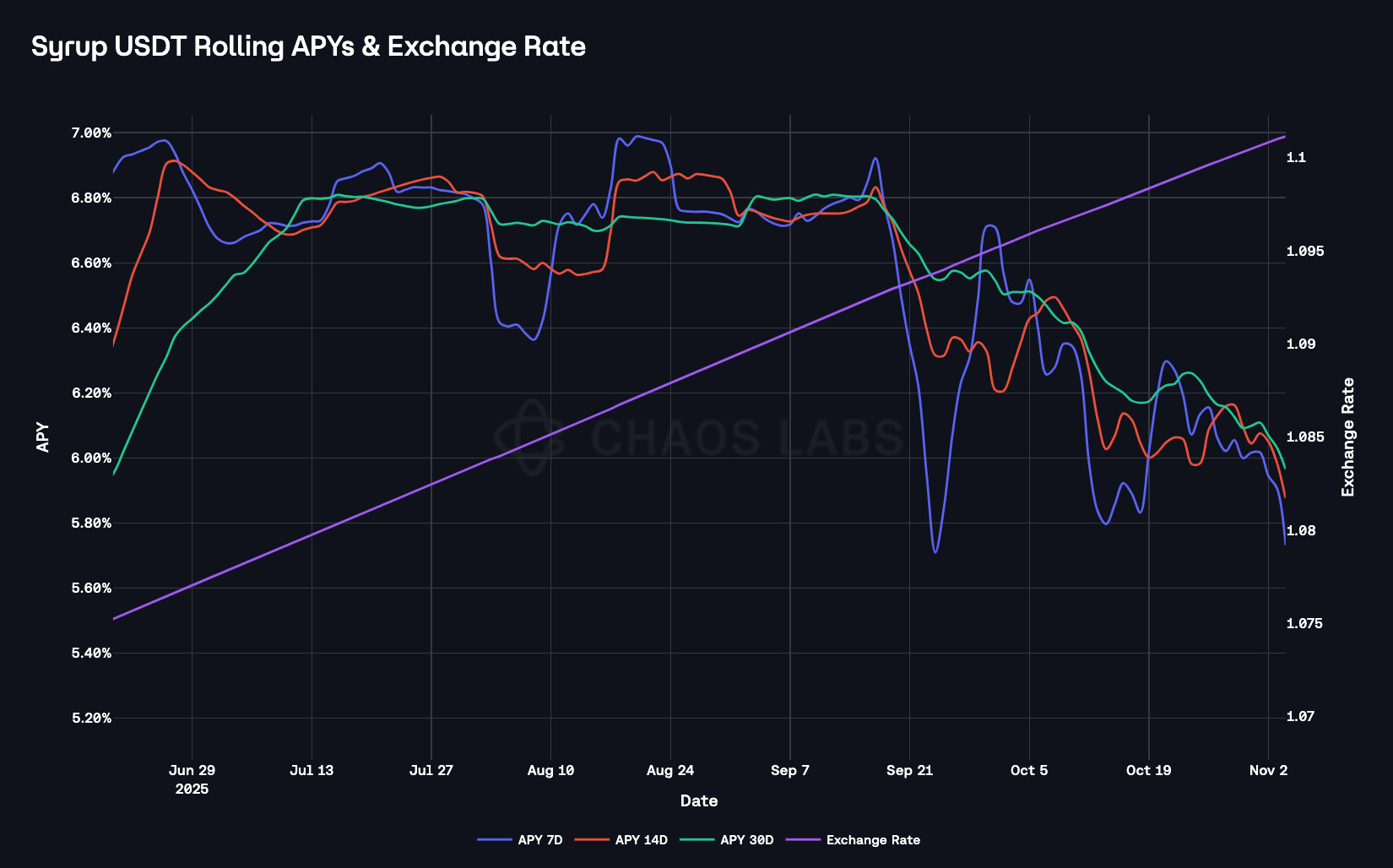
As syrupUSDT has scaled in both adoption and market cap, the underlying yield has exhibited a moderate decline, specifically since July, it has fallen by over 12%, stabilizing at 6% annualized APY.

The primary liquidity venues for syrupUSDT on Ethereum are currently the Fluid DEX and Uniswap V4, with respective reserves of 4.6 and 3.8 million tokens. At the time of writing, a sell order of 10 million syrupUSDT would incur approximately 3.5% slippage, providing substantial liquidity in case of liquidations.

Redemptions

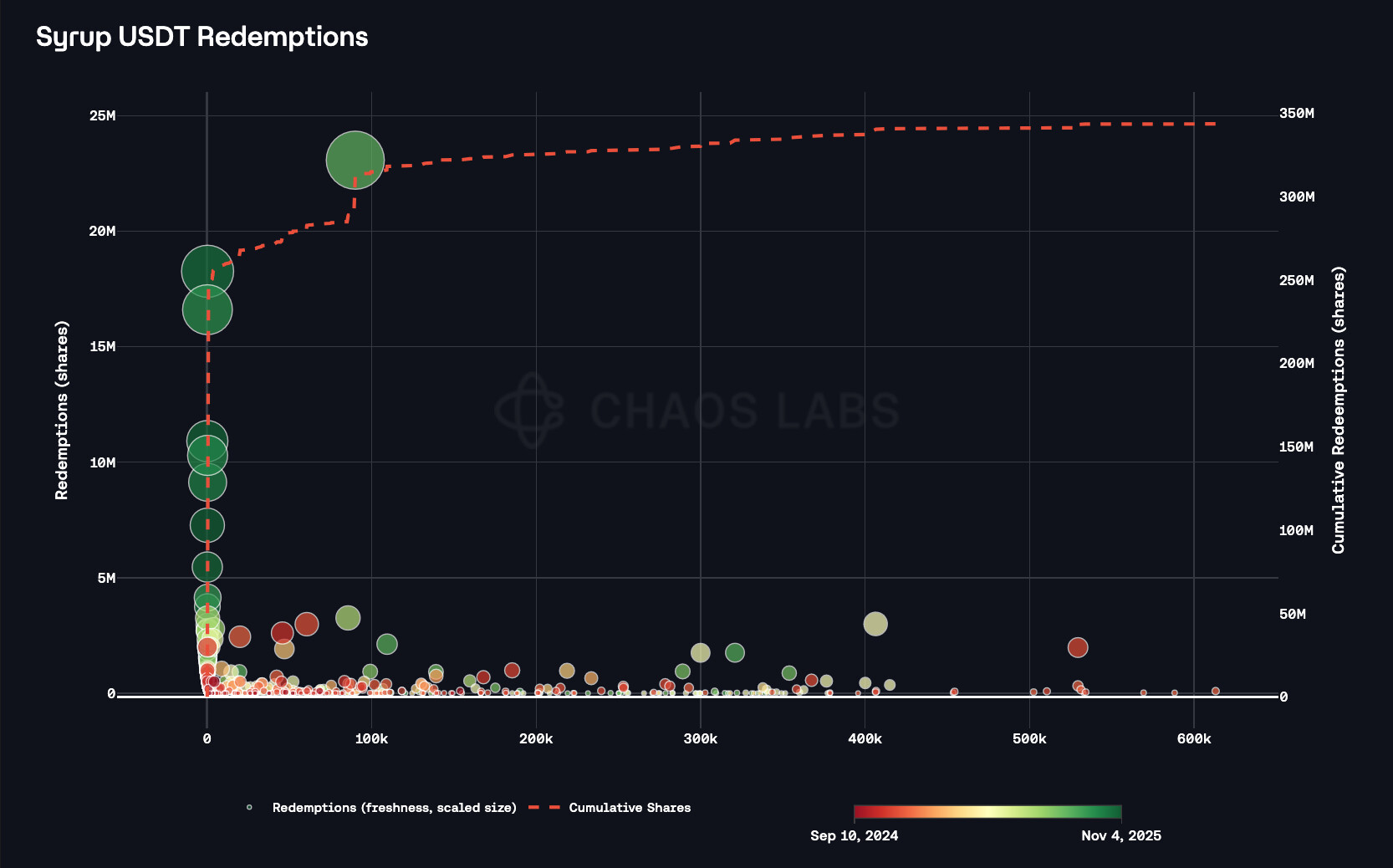
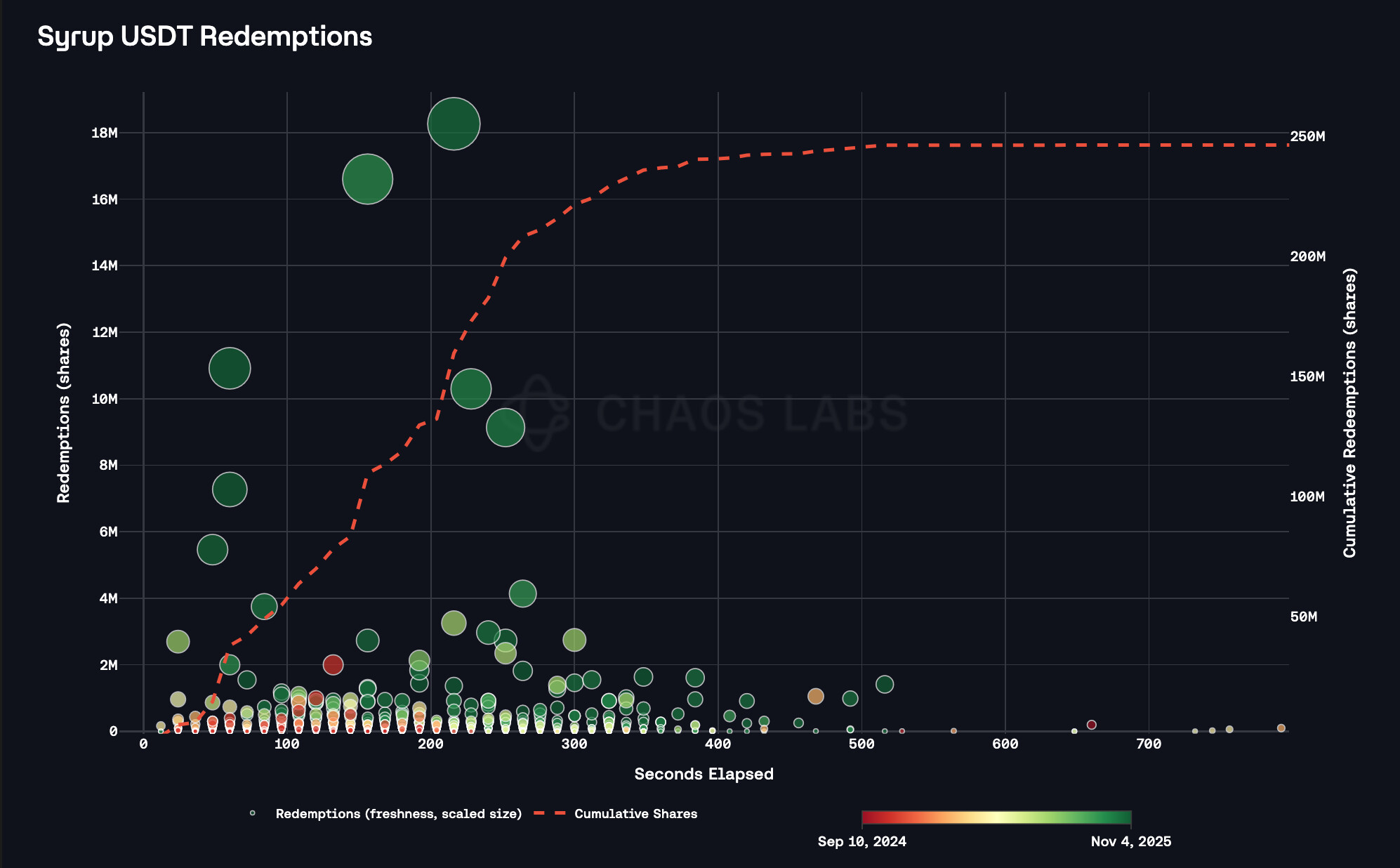
syrupUSDT redemptions have remained fast and orderly, supported and facilitated by the reserves deposited on Aave. This setup allows the repayment funds to be sourced directly from the protocol, instead of prompting a return of funds from other counterparties, decreasing the settlement times considerably. The argument is further supported by the plot below, as we observe that redemption times have decreased substantially over time.

Moreover, we observed that redemption speed exhibits minimal correlation with redemption size, highlighting efficient liquidity management across scales. Overall, the redemption process demonstrates strong operational resilience, in part due to the reliance on Aave-allocated reserves, with responsiveness improving substantially recently.

Pricing and CAPO

Consistent with the implementation used for syrupUSDT on Plasma, Chaos Labs recommends utilizing a USDT / USD price feed augmented with a convertToExitAssets() value from the syrupUSDT contract. Such a structure ensures that any potential shortfall from the Maple protocol borrowers is accurately reflected within the reported price. Additionally, the setup will be safeguarded by CAPO, which maintains price integrity through bounded updates.

Recommendation

Chaos Labs recommends onboarding syrupUSDT to the Ethereum Core instance of Aave V3 under the parameters outlined below. The asset has already demonstrated strong traction on the Plasma instance. The main risks associated with the asset are constrained by the orderly redemptions and substantial on-chain liquidity. Given its recursive exposure through aethUSDT reserves, we recommend limiting its collateral capacity to the E-Mode and maintaining a conservative initial supply cap. Future cap adjustments will be evaluated with the level of recursive exposure in mind, and Chaos Labs will closely monitor reserve composition and market behavior to ensure systemic stability as the asset scales.

Specification

Parameter Value
Isolation Mode No
Borrowable No
Collateral Enabled Yes
Supply Cap 50,000,000
Borrow Cap -
Debt Ceiling -
LTV 0.05%
LT 0.10%
Liquidation Bonus 6%
Liquidation Protocol Fee 10%

E-Mode

Parameter Value Value
Asset syrupUSDT USDT GHO
Collateral Yes No No
Borrowable No Yes Yes
Max LTV 90.00% - -
Liquidation Threshold 92.00% - -
Liquidation Bonus 4.00% - -

CAPO

maxYearlyRatioGrowthPercent ratioReferenceTime MINIMUM_SNAPSHOT_DELAY
8.45% monthly 7

Disclosure

Chaos Labs has not been compensated by any third party for publishing this recommendation.

Copyright

Copyright and related rights waived via CC0.
2 Likes