[Direct to AIP] Onboard USDe & sUSDe May expiry PT tokens on Aave V3 Core Instance

[Direct to AIP] Onboard USDe & sUSDe May expiry PT tokens on Aave V3 Core Instance

Author: ACI

Date: 2026-01-13

Proposal updated on 2026-01-29 to update Risk Params provided by Risk Service Providers

Summary

This ARFC proposes to onboard USDe and sUSDe May expiry PT tokens on Aave V3 Core Instance.

This proposal will be a Direct to AIP.

Motivation

The previous USDe and sUSDe PT tokens that were onboarded have brought significant inflows to Aave, in preparation for the expiry and rollover we propose to onboard the next expiry of this PT token. We expect at a minimum that deposits will match those in the current expiry PT token, with potentially some sidelined demand.

Specification

PT-sUSDE-7MAY2026: Address: 0x3de0ff76...1cef80f49 | Etherscan

PT-USDe-7MAY2026: Address: 0xaebf0bb9...657d96ce0 | Etherscan

Risk Parameters

Specification

Parameter Value Value
Asset PT-USDe-7MAY2026 PT-sUSDe-7MAY2026
Isolation Mode No No
Borrowable No No
Collateral Enabled No No
Supply Cap 45,000,000 100,000,000
Borrow Cap - -
Debt Ceiling - -
LTV - -
LT - -
Liquidation Bonus - -
Liquidation Protocol Fee 10.00% 10.00%
E-Mode Category PT-USDe Stablecoins, PT-USDe USDe PT-sUSDe Stablecoins, PT-sUSDe USDe

PT-USDe-7MAY2026

Initial E-Mode Risk Oracle

Parameter Value Value
E-Mode Stablecoins USDe
LTV 87.2% 88.1%
LT 89.2% 90.1%
LB 4.4% 3.4%

Linear Discount Rate Oracle

Parameter Value
initialDiscountRatePerYear 4.95%
maxDiscountRatePerYear 25.69%

PT-USDe Stablecoins E-Mode

Asset PT-USDe-7MAY2026 PT-USDe-5FEB2026 USDe USDC USDT USDtb
Collateral Yes Yes Yes No No No
Borrowable No No Yes Yes Yes Yes
LTV Subject to Risk Oracle Subject to Risk Oracle Subject to Risk Oracle - - -
LT Subject to Risk Oracle Subject to Risk Oracle Subject to Risk Oracle - - -
Liquidation Bonus Subject to Risk Oracle Subject to Risk Oracle Subject to Risk Oracle - - -

PT-USDe USDe E-Mode

Asset PT-USDe-7MAY2026 PT-USDe-5FEB2026 USDe
Collateral Yes Yes Yes
Borrowable No No Yes
LTV Subject to Risk Oracle Subject to Risk Oracle Subject to Risk Oracle
LT Subject to Risk Oracle Subject to Risk Oracle Subject to Risk Oracle
Liquidation Bonus Subject to Risk Oracle Subject to Risk Oracle Subject to Risk Oracle

PT-sUSDe-7MAY2026

Initial E-Mode Risk Oracle

Parameter Value Value
E-Mode Stablecoins USDe
LTV 86.4% 87.2%
LT 88.4% 89.2%
LB 5.5% 4.5%

Linear Discount Rate Oracle

Parameter Value
initialDiscountRatePerYear 5.02%
maxDiscountRatePerYear 25.67%

PT-sUSDe Stablecoins E-Mode

Asset PT-sUSDe-7MAY2026 PT-sUSDe-5FEB2026 sUSDe USDC USDT USDe USDtb
Collateral Yes Yes Yes No No No No
Borrowable No No No Yes Yes Yes Yes
LTV Subject to Risk Oracle Subject to Risk Oracle Subject to Risk Oracle - - - -
LT Subject to Risk Oracle Subject to Risk Oracle Subject to Risk Oracle - - - -
Liquidation Bonus Subject to Risk Oracle Subject to Risk Oracle Subject to Risk Oracle - - - -

PT-sUSDe USDe E-Mode

Asset PT-sUSDe-7MAY2026 PT-sUSDe-5FEB2026 sUSDe USDe
Collateral Yes Yes Yes No
Borrowable No No No Yes
LTV Subject to Risk Oracle Subject to Risk Oracle Subject to Risk Oracle -
LT Subject to Risk Oracle Subject to Risk Oracle Subject to Risk Oracle -
Liquidation Bonus Subject to Risk Oracle Subject to Risk Oracle Subject to Risk Oracle -

Useful Links

https://docs.pendle.finance/ProtocolMechanics/YieldTokenization/PT

Disclaimer

ACI is not directly affiliated with Pendle and did not receive compensation for the creation of this proposal. Some ACI employees may hold Pendle tokens.

Next Steps

  1. Publish proposal to gather community and Service Providers feedback.
  2. Publish an AIP vote for final confirmation and enforcement of the proposal.

Copyright

Copyright and related rights waived under CC0

Summary

LlamaRisk supports the listing of PT-USDe-07MAY2026 and PT-sUSDe-07MAY2026 on the Aave V3 Core instance. At the time of this analysis, both assets have approximately 111 days remaining until maturity.

Although the TVL in these specific May maturity pools is significantly lower than in prior maturities ($0.54M for USDe and $1.48M for sUSDe), the Ethena ecosystem remains a dominant force in the market. Onboarding these assets enables users to lock in fixed rates while providing a natural rollover destination for liquidity exiting maturing pools. Given the early stage of these pools (deployed on January 8, 2026), we recommend setting conservative initial supply caps and expect gradual collateral demand growth as the maturity rollover nears.

Assessment of PT base asset: Link

Assessment of Pendle PTs: Link

Considered PT asset maturities: PT-USDe-07MAY2026, PT-sUSDe-07MAY2026

Asset State

Ethena’s USDe supply has recently entered a consolidation phase, with little change in TVL over the past month. The total USDe supply now stands at 6.42B. A substantial portion is staked into sUSDe, with the yield-bearing token’s supply exceeding 3.77B, resulting in a staking ratio of 58.73%.


Source: LlamaRisk Ethena Risk Portal, January 15, 2026

Underlying Stability

The market price of USDe remains firmly pegged at $1.00, with no material deviations observed since the 10/10 market crash. The secondary market discount for sUSDe/USDe has been fluctuating, stabilizing within a 10 bps range in early January. From a protocol health standpoint, Ethena maintains a solvency ratio of 101.05% and is supported by a Reserve Fund capitalized at over $62.06M.


Source: LlamaRisk, January 15, 2026

Underlying Yield Source

The primary incentives for holding USDe and sUSDe are the Ethena “sats” program and the native yield from sUSDe. The sats system provides users with multipliers for different activities.

  • USDe deposited on Pendle generates a sats multiplier.
  • sUSDe deposited on Pendle generates a sats multiplier on top of its underlying yield.

Total Supply

Both the PT-sUSDe-07MAY2026 and PT-USDe-07MAY2026 maturity pools have demonstrated linear growth since their inception. Analysis of the pools’ liquidity reveals a slow bootstrapping process, with total liquidity significantly lower than that of established pools, as users are just beginning to rotate into this maturity. This is in line with the current yield conditions and the short time since the pools’ deployment.

PT-USDe-07MAY2026 Liquidity Growth


Source: LlamaRisk, January 15, 2026

The pool composition is as follows:

  • Total Liquidity: $536,206
  • SY USDe: $485,129 (90.47%)
  • PT USDe: $51,076 (9.53%)

PT-sUSDe-07MAY2026 Liquidity Growth


Source: LlamaRisk, January 15, 2026

The pool composition is as follows:

  • Total Liquidity: $1.48M
  • SY sUSDe: $1.28M (86.43%)
  • PT sUSDe: $201,505 (13.57%)

Market State

Price and Yield

The implied yields for PT-USDe and PT-sUSDe reflect the market’s discount rate on the underlying assets.

PT-USDe Yield

The implied yield for the USDe PT is currently sitting at 3.32%, with the Max LP yield being 18.7%.


Source: LlamaRisk, January 15, 2026

PT-sUSDe Yield

The implied yield has remained relatively flat, hovering around 4.8%, while the Max LP yield is peaking currently at 18.8%.


Source: LlamaRisk, January 15, 2026

As of this review (111 days to maturity), the implied yields are:

  • PT-USDe: ~3.32% Fixed APY
  • PT-sUSDe: ~4.78% Fixed APY

Current yield levels imply an unfavorable setup for looping, with PT-USDe showing a negative spread versus the stablecoin borrow rate and PT-sUSDe offering only a very tight spread. This dynamic is likely to limit demand for PTs as collateral. Nonetheless, we expect that the conditions improve gradually as the rollover date nears.

Pool Parameters

The pools have the following parameters on Pendle:

PT-USDe

  • Maturity: 07 May 2026
  • Liquidity Yield Range: 3.5% - 23.5%
  • Input Tokens: USDe
  • Maker Fee: 0%
  • Taker Fee: 0.04% (via AMM) / 0.06% (via Orderbook)

PT-sUSDe

  • Maturity: 07 May 2026
  • Liquidity Yield Range: 3.5% - 23.5%
  • Input Tokens: sUSDe
  • Maker Fee: 0%
  • Taker Fee: 0.07% (via AMM) / 0.09% (via Orderbook)

Maturities

The availability of the February maturity allows for the continued rollover of exposure for Aave users as the earlier PT pools reach maturity. The existence of overlapping maturities (February and May) ensures users have constant access to fixed-rate offerings.


Source: Pendle, January 15, 2026

Integrated Venues

PT-USDe-07MAY2026 and PT-sUSDe-07MAY2026 are not yet integrated into other lending venues due to the recency of the pools. This represents a first-mover advantage for Aave to capture the primary lending demand for these assets.

Recommendations

Market Parameters Recommendation

The risk parameter recommendations for the PT-USDe-07MAY2026 and PT-sUSDe-07MAY2026 listings are to be aligned and presented jointly with @ChaosLabs.

Price Feed Recommendation

For pricing both PT tokens on Aave, a specific dynamic linear discount rate oracle has been developed by BGD Labs. It is recommended that both PT-USDe-07MAY2026 and PT-sUSDe-07MAY2026 tokens be priced using it.

Disclaimer

This review was independently prepared by LlamaRisk, a DeFi risk service provider funded in part by the Aave DAO. LlamaRisk serves as a member of Ethena’s Risk Committee and an independent attester of Ethena’s PoR solution. LlamaRisk did not receive compensation from the protocol(s) or their affiliated entities for this work. The information should not be construed as legal, financial, tax, or professional advice.

Overview

In line with the Principal Token Risk Oracle framework outlined here, we present risk parameter recommendations for listing PT-USDe-7MAY2026 and PT-sUSDe-7MAY2026, including initialDiscountRatePerYear and maxDiscountRatePerYear derived from the dynamic linear discount rate oracle methodology described here. Our research paper, “Stress Testing Ethena: A Quantitative Look at Protocol Stability,” examines how rapid growth in USDe, sUSDe, and Pendle PT deposits impacts Aave’s collateral mix and funding dynamics. Using scenario analysis and Monte Carlo simulations, it evaluates liquidity, leverage, and backing-side tail risks, while showing that Aave’s existing risk-oracle , E-Mode configurations, and liquidation controls absorb most shocks. The upcoming native mechanism to offload Ethena-collateralized debt, enabled by Aave’s whitelisted redeemer status, further strengthens stress resilience for duration-sensitive assets such as PTs, as detailed here. Finally, “Aave’s Growing Exposure to Ethena: Risk Implications Throughout the Growth and Contraction Cycles of USDe” shows that falling sUSDe yields drive leverage unwinds, releasing stablecoin liquidity into Aave. At the same time, PT/USDe borrowers shift debt into other stablecoins, supporting USDe pricing during redemption pressure. Repayments from unwinders generally exceed PT debt migration, creating a natural liquidity buffer that stabilizes Aave markets.

Risk Oracle Parameter Evolution

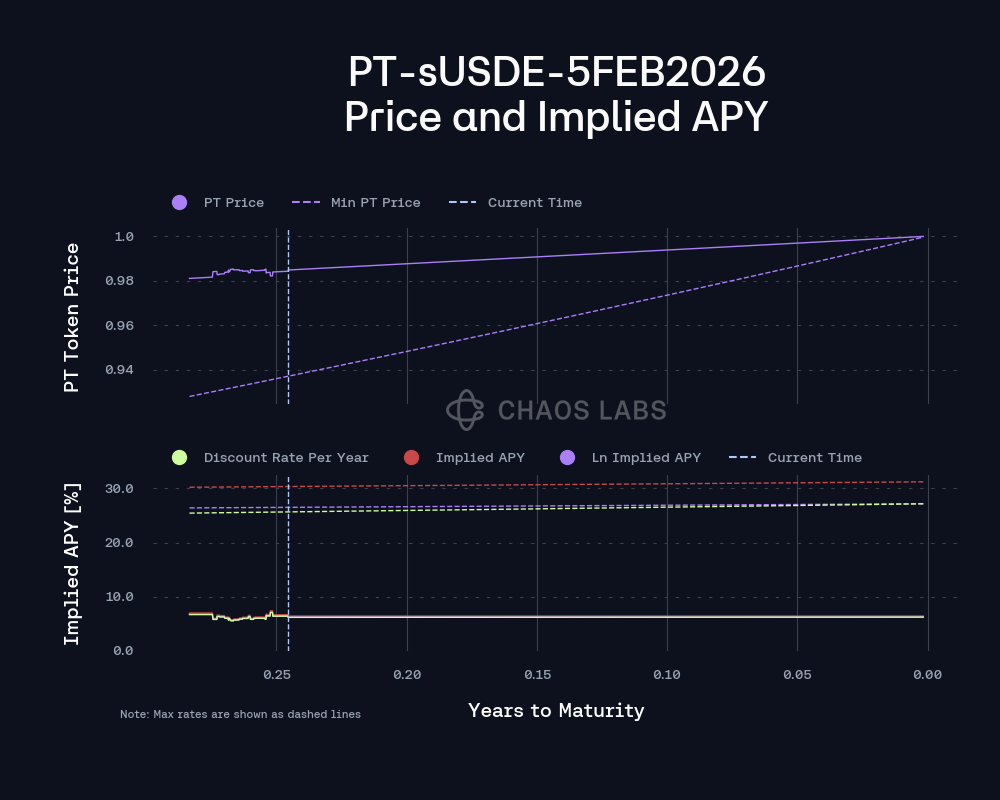
Through our rigorous quantification of the algorithm, we find that the integration risk decays as the PT approaches maturity. This justifies the utilization of progressively less conservative risk parameters over time. Taking into account the underlying configuration of USDe E-Mode within Aave, we outline the projected evolution of the LT, LTV, and LB, with the initial parameterization of the Stablecoin and USDe specific E-Modes for USDe and sUSDe May-expiry principal tokens approximately as follows:

Stablecoin E-Mode

PT-USDe-7MAY2026 — LTV: 87.2%, LT: 89.2%, LB: 4.4%

PT-sUSDe-7MAY2026 — LTV: 86.4%, LT: 88.4%, LB: 5.5%

USDe E-Mode

To improve capital efficiency, we propose a dedicated USDe E-Mode for PT-USDe-7MAY2026 and PT-sUSDe-7MAY2026. As both the PT underlying and debt asset are anchored to USDe, risk parameters should primarily reflect Pendle AMM liquidity and PT pricing dynamics rather than traditional underlying asset risk. Initial LT, LTV, and LB parameters are outlined below.

PT-USDe-7MAY2026 — LTV: 88.1%, LT: 90.1%, LB: 3.4%

PT-sUSDe-7MAY2026 — LTV: 87.2%, LT: 89.2%, LB: 4.5%

Discount Rates

Based on historical observed data and the pricing configuration of the market, our initial recommendations for the discount rate parameters are as follows:

PT-USDe-7MAY2026

initialDiscountRatePerYear: 4.95%, maxDiscountRatePerYear: 25.69%

PT-sUSDe-7MAY2026

initialDiscountRatePerYear: 5.02%, maxDiscountRatePerYear: 25.67%

Supply Caps

Liquidity for PT-sUSDe-7MAY2026 and PT-USDe-7MAY2026 is driven by both underlying USDe market depth and Pendle’s PT/SY AMM, with current liquidity at moderate levels. As shown in the plots, slippage declines materially as maturity approaches, reflecting reduced convexity in PT pricing. Under current AMM conditions, swaps of up to $5.5M (PT-sUSDe) and $2.1M (PT-USDe) can be executed within 3% slippage. Assets with lower scalarRoot values exhibit greater slippage sensitivity earlier in the lifecycle, but this effect compresses significantly closer to expiry.


The SY Liquidity in PT-sUSDe-7MAY2026 and PT-USDe-7MAY2026’s AMM has reached $6M and $2.5M. While the liquidity expansion is extremely recent, we expect the depth to persist over time. Additionally, the expected evolution of AMM depth, typical of such markets, further decreases the risk of failed liquidations.


Migration of Existing PTs

To support a seamless migration from other PT-USDe and sUSDe assets maturing in February to PT-sUSDe-7MAY2026 and PT-USDe-7MAY2026, we recommend including PT-USDe-5FEB2026 and PT-sUSDe-5FEB2026 in the newly created E-Modes.

Underlying Oracle

As the underlying PT-USDe is anchored to USDe, we recommend leveraging the Capped USDT/USD feed as the underlying ASSET_TO_USD_AGGREGATOR within the PT-USDe PendlePriceCapAdapter.

Specification

Parameter Value Value
Asset PT-USDe-7MAY2026 PT-sUSDe-7MAY2026
Isolation Mode No No
Borrowable No No
Collateral Enabled No No
Supply Cap 30,000,000 70,000,000
Borrow Cap - -
Debt Ceiling - -
LTV - -
LT - -
Liquidation Bonus - -
Liquidation Protocol Fee 10.00% 10.00%
E-Mode Category PT-USDe Stablecoins, PT-USDe USDe PT-sUSDe Stablecoins, PT-sUSDe USDe

PT-USDe-7MAY2026

Initial E-Mode Risk Oracle

Parameter Value Value
E-Mode Stablecoins USDe
LTV 87.2% 88.1%
LT 89.2% 90.1%
LB 4.4% 3.4%

Linear Discount Rate Oracle

Parameter Value
initialDiscountRatePerYear 4.95%
maxDiscountRatePerYear 25.69%

PT-USDe Stablecoins E-Mode

Asset PT-USDe-7MAY2026 PT-USDe-5FEB2026 USDe USDC USDT USDtb
Collateral Yes Yes Yes No No No
Borrowable No No Yes Yes Yes Yes
LTV Subject to Risk Oracle Subject to Risk Oracle Subject to Risk Oracle - - -
LT Subject to Risk Oracle Subject to Risk Oracle Subject to Risk Oracle - - -
Liquidation Bonus Subject to Risk Oracle Subject to Risk Oracle Subject to Risk Oracle - - -

PT-USDe USDe E-Mode

Asset PT-USDe-7MAY2026 PT-USDe-5FEB2026 USDe
Collateral Yes Yes Yes
Borrowable No No Yes
LTV Subject to Risk Oracle Subject to Risk Oracle Subject to Risk Oracle
LT Subject to Risk Oracle Subject to Risk Oracle Subject to Risk Oracle
Liquidation Bonus Subject to Risk Oracle Subject to Risk Oracle Subject to Risk Oracle

PT-sUSDe-7MAY2026

Initial E-Mode Risk Oracle

Parameter Value Value
E-Mode Stablecoins USDe
LTV 86.4% 87.2%
LT 88.4% 89.2%
LB 5.5% 4.5%

Linear Discount Rate Oracle

Parameter Value
initialDiscountRatePerYear 5.02%
maxDiscountRatePerYear 25.67%

PT-sUSDe Stablecoins E-Mode

Asset PT-sUSDe-7MAY2026 PT-sUSDe-5FEB2026 sUSDe USDC USDT USDe USDtb
Collateral Yes Yes Yes No No No No
Borrowable No No No Yes Yes Yes Yes
LTV Subject to Risk Oracle Subject to Risk Oracle Subject to Risk Oracle - - - -
LT Subject to Risk Oracle Subject to Risk Oracle Subject to Risk Oracle - - - -
Liquidation Bonus Subject to Risk Oracle Subject to Risk Oracle Subject to Risk Oracle - - - -

PT-sUSDe USDe E-Mode

Asset PT-sUSDe-7MAY2026 PT-sUSDe-5FEB2026 sUSDe USDe
Collateral Yes Yes Yes No
Borrowable No No No Yes
LTV Subject to Risk Oracle Subject to Risk Oracle Subject to Risk Oracle -
LT Subject to Risk Oracle Subject to Risk Oracle Subject to Risk Oracle -
Liquidation Bonus Subject to Risk Oracle Subject to Risk Oracle Subject to Risk Oracle -

Disclaimer

Chaos Labs has not been compensated by any third party for publishing this recommendation.

Copyright

Copyright and related rights waived via CC0

2 Likes

From our end, we think this is a sensible continuation of Aave’s successful PT token strategy, and we appreciate how the conservative risk parameters appropriately mitigate the inherent complexity of these instruments.
The supply caps for PT-sUSDe and PT-USDe, respectively, seem reasonable given the demonstrated demand from the current expiry tokens.

With the quality of service providers working on this, we also trust that there are adequate liquidity-monitoring mechanisms in place as we approach the May 2026 maturity, given the potential for concentrated redemption activity. Overall, supportive of how this is moving forward.

We received the capo adapter today.
The current caps are materially too low to support an increase in our PT Ethena lending exposure and are insufficient even to maintain existing liquidity. The primary risk is TVL leakage to competitors and user friction that discourages migration.

  • PT USDe: the current 30m supply cap would require three successive cap increases to accommodate the existing 231m rollover into the new maturity.
  • PT sUSDe: the current 70m supply cap would similarly require three cap increases to support the existing 412m rollover.

Our objective should be to grow TVL, not merely preserve it. So we need to be sure we permit preservation and allow us to have small gap for growth

Given that the listing vote will take 5 days, caps should be set at a minimum of ~35% of current outstanding supply. This would allow, subject to risk steward approval and KPI validation:

  • ~70% migration on listing day
  • up to 140% migration after 3 days, once the steward timelock expires

To enable a smooth transition and avoid artificial bottlenecks, I recommend setting the initial caps as follows:

  • PT USDe: 81m
  • PT sUSDe: 145m

These levels are the minimum required to support the upcoming maturity transition while keeping risks relatively low.

1 Like

We agree that minimizing rollover friction is important; however, sizing the initial May-2026 PT caps based on the outstanding February-2026 PT supply is not feasible to maintain a consistent risk profile. The two instruments do not share the same risk profile, and as such, should not be considered equivalent when determining initial caps. The near-expiry PTs have reached the low-duration regime where convergence to par is mechanically tighter, the remaining downside to boundary conditions is smaller, and liquidation feasibility improves as maturity approaches. A longer-dated PT sits in the higher-convexity part of its lifecycle: implied-yield repricing can generate meaningfully larger mark-to-market moves over a longer window, and the system must remain robust to larger tail moves before the PT Linear Risk Oracle naturally becomes more deterministic closer to expiry. This is why we quantify risk as a function of time-to-maturity and implied-rate volatility, and why the initial configuration must be anchored to the higher-risk regime rather than assuming “rollover size” is a proxy for “safe exposure”.

The liquidity picture of these assets reinforces this constraint. The outgoing sUSDe Feb-2026 market has materially deeper liquidity (roughly $37.6M) than the new sUSDe May-2026 market (roughly $7.5M). When the new expiry has significantly less executable depth, raising caps increases the probability that Aave accumulates an exposure that cannot be unwound efficiently under stress, precisely when duration risk is higher, and the market is more sensitive to repricing. For that reason, we set initial caps and parameters to reflect the new PTs’ longer-dated risk and current liquidation capacity, then scale caps as the PT risk profile decays over time and the liquidity is migrated from the prior expiries.

Finally, the migration constraint does not imply that users are forced to exit, idle capital, or stop earning while caps are full. Because USDe and sUSDe are part of the PT E-Mode collateral set, users who cannot immediately migrate to the new PT maturity redeem the expiring PT into their underlying and maintain an open, yield-bearing position within the same correlated collateral environment, as observed in the plots below. This provides continuity of exposure and reduces the practical risk of TVL leakage during the transition window, while allowing caps for the new maturity to be increased in a manner consistent with the quantified risk decay over time and demonstrated depth in the relevant Pendle markets.

However, given that the AIP has not yet been launched over the last week, the May-2026 PT has mechanically moved further down its lifecycle and the associated duration risk has materially decayed. On our time-to-maturity framework, this translates into an approximately ~10% reduction in duration-driven mark-to-market sensitivity versus the point at which the initial parameters were set. This incremental decay supports cap increases of $30M and $15M for PT-sUSDe-7MAY2026 and PT-USDe-7MAY2026, respectively, relative to the previously parameterized value, while remaining consistent with the principle that caps should scale with quantified risk decay (and not simply mirror rollover sizing).

Specification

Asset Previous Recommended Supply Cap Current Recommended Supply Cap
PT-USDe-7MAY2026 30,000,000 45,000,000
PT-sUSDe-7MAY2026 70,000,000 100,000,000

Disclaimer

Chaos Labs has not been compensated by any third party for publishing this recommendation.

Copyright

Copyright and related rights waived via CC0

2 Likes